The 2026 Feature Paradox: More is Less
We are officially in the era of the "Frankenstein App."
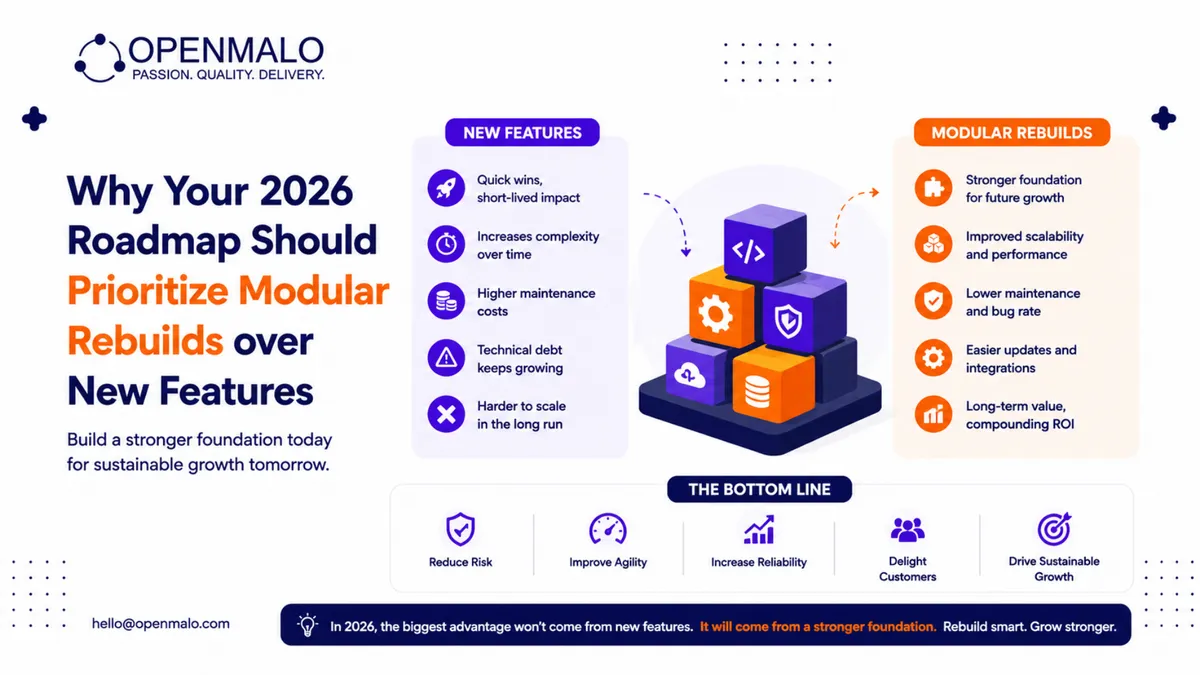
For the last three years, the rush to integrate AI has left most software ecosystems looking like a digital junkyard. We've bolted on LLM wrappers, real-time analytics, and "smart" notifications onto 10-year-old monolithic skeletons. The result? Developer velocity has plummeted. In 2026, adding a simple "Save" button to a legacy enterprise app now takes three weeks because the code is so tightly coupled that touching one thread pulls the whole sweater apart.
The hard truth: You cannot innovate on top of a swamp. If your 2026 roadmap is just a list of "New Features," you aren't building a product; you're building a liability. The winners this year are the ones brave enough to say: "Stop. We are rebuilding the core."
Modular Rebuilds Defined: It's Not Just "Cleaning Code"
When I talk about a Modular Rebuild, I'm not talking about a weekend of refactoring. I'm talking about Composable Architecture.
It is the process of breaking your "One Big App" into independent, interchangeable parts.
- Old Way: If your payment gateway breaks, your entire login system goes down because they share the same database and logic.
- Modular Way (2026 Standard): Your "Payments" module is a black box. If it fails, the rest of the app doesn't even notice. You can swap Stripe for a local Indian provider like Razorpay in an afternoon without touching the core codebase.
The Global Shift: India and US Perspectives
The 2026 market has split into two distinct needs:
1. The US Market: The Efficiency Mandate
In the US, the era of "cheap money" is long gone. Enterprise buyers are no longer impressed by 100 features they don't use. They want Reliability and Security. A modular system allows for "Zero-Trust" security at the module level—something a monolith can never achieve.
2. The Indian Market: Scaling for the Next Billion
In India, the scale is the challenge. As the next 300 million users come online, apps built on "quick-fix" code are crashing under the load. Modular rebuilds allow Indian startups to scale horizontally, handling massive traffic spikes (like during the Cricket World Cup or festive sales) by only scaling the specific modules that are under stress.
The Brutal ROI of Refactoring (Real Numbers)
Business owners hate the word "Refactor" because it sounds like "paying for work we already did." Let's change the language to ROI.
Recent 2026 industry data shows that companies prioritizing modularity achieve:
- 40% Increase in Feature Velocity: Once the foundation is modular, new features are built as "plugins," cutting development time by nearly half.
- 60% Reduction in Technical Debt Interest: You spend less time fixing bugs caused by other bugs.
- Infrastructure Savings: You can run specific modules on cheaper server instances, reducing AWS/Azure bills by 20-30%.
The "Do Nothing" Cost: If you keep adding features to a monolith in 2026, your "Maintenance-to-Innovation" ratio will flip. You'll eventually spend 80% of your budget just keeping the lights on.
Sector-Specific Use Cases
For Founders
Your goal is an exit or a massive Series C. Investors in 2026 are performing Deep Technical Due Diligence. A monolithic "mess" is a red flag that lowers your valuation. A modular, API-first architecture is a scalable asset that proves your business can handle 10x growth without collapsing.
For HR Professionals
Modular rebuilds solve your "Talent Problem." It is nearly impossible to find a developer who wants to work on a 500,000-line spaghetti codebase. However, developers love owning a single, clean "Module." Modularity improves retention and makes onboarding new hires 3x faster.
For Developers
Stop being a "Firefighter" and start being an "Architect." Modular rebuilds allow you to use the best tool for each job. Want to write the high-performance "Search" module in Rust while keeping the rest in Node.js? In a modular world, you can.
For Enterprise Buyers
A modular product means you aren't locked into a single vendor forever. You are buying "Legos," not a "Statue." This flexibility is the #1 requirement for CTOs in 2026.
For Students
If you are learning to code, don't just learn "how to build a feature." Learn System Design. The highest-paid roles in 2026 aren't for "Full Stack" devs; they are for "Modular Architects" who understand how systems talk to each other.
Technology Breakdown: Composable Architecture Simplified
Think of your software like a Kitchen.
- The Monolith: One giant machine that is a fridge, oven, and toaster combined. If the toaster breaks, you have to throw out the whole fridge.
- Modular Rebuild: You have a separate Fridge, a separate Oven, and a separate Toaster. They all plug into the same wall (the API). You can upgrade your Oven to a "Smart Oven" without affecting how your Fridge stays cold.
Key Technologies for 2026:
- Micro-frontends: Breaking the UI into independent pieces.
- Serverless Functions: Running code only when needed.
- Event-Driven Architecture: Modules communicating via "signals" rather than being hard-wired together.
Risk Factors: When Rebuilds Go Wrong
I promised no sugarcoating. Modular rebuilds are hard.
- The "Infinite Rebuild" Trap: Some teams start a rebuild and never finish because they try to make it "perfect." Use the Strangler Pattern: Replace one module at a time while the old system keeps running.
- Complexity Overhead: Managing 50 small modules is harder than managing one big app. You need strong DevOps and Observability tools (like OpenTelemetry) to see what's happening.
- Skill Gap: Your team might know how to build features, but do they know how to design distributed systems? If not, you're just building a "Distributed Monolith," which is the worst of both worlds.
Conclusion: The Roadmap for 2027
The decisions you make in your 2026 roadmap will determine if you are a market leader or a "Legacy Burden" by 2027.
By prioritizing modular rebuilds now, you are building an Agile Engine. When the next big tech shift happens (be it Quantum Computing or widespread Spatial Reality), your modular system will be ready to adapt in weeks. Your competitors will still be trying to untangle their 2024 code.
Here's How We Help Businesses Move From Idea to Scalable Product
Most agencies want to sell you "The Next Big Feature." We want to sell you The Next Ten Years of Growth.
At Openmalo Technologies, we specialize in the "Deep Work" of engineering. We don't just build apps; we architect ecosystems that are ready for the 2026 global economy. Whether you're a startup in Bengaluru or an enterprise in New York, we provide the strategic technical leadership required to turn legacy debt into a competitive advantage.
Contact Openmalo Technologies today for:
- Modern Web & Mobile App Development
- Strategic Cloud & SaaS Re-architecting
- High-Fidelity UI/UX Design
- Custom CRM & AI Solutions
- GPT & Agentic Workflow Integration