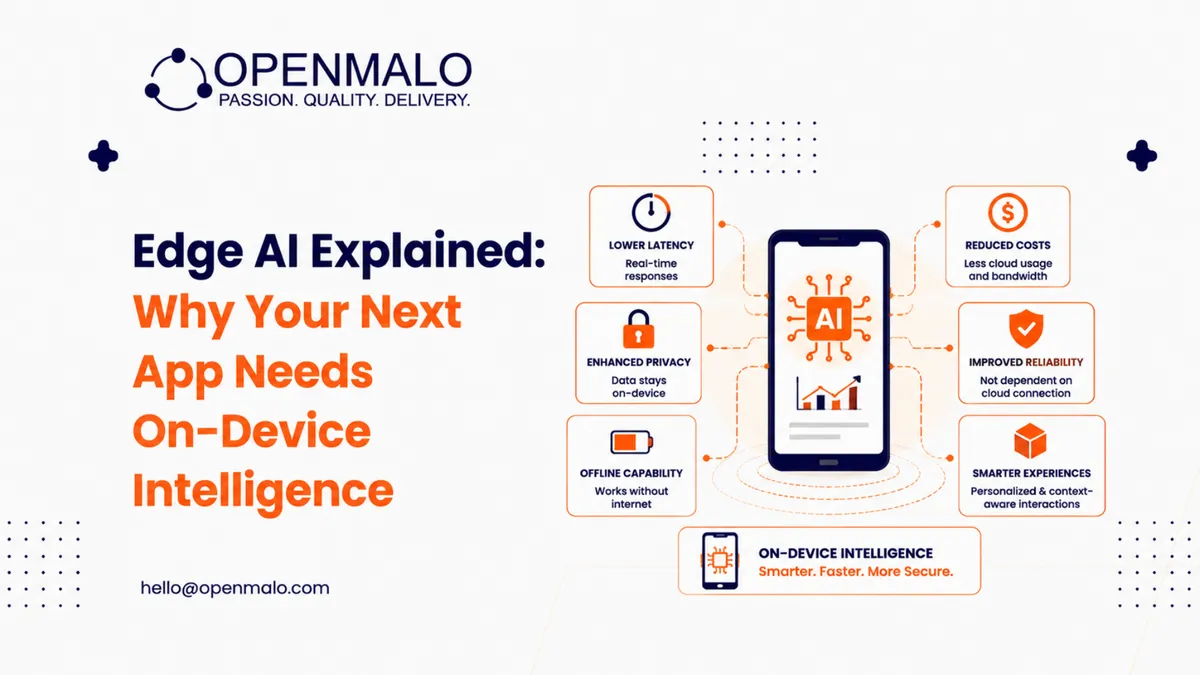
Every AI feature you have built so far probably follows the same pattern: user input goes to the cloud, the cloud does the thinking, the answer comes back. It works. But it has a ceiling - and that ceiling is latency, privacy, and connectivity dependency.
In 2026, 79% of enterprise decision-makers have already moved or are moving AI workloads from public cloud to on-prem or edge. The reasons are not theoretical. They are cost, speed, and data sovereignty. Edge AI is how you break through the cloud ceiling.
What Edge AI Is - and Is Not
Edge AI means running AI model inference on the device itself - smartphone, laptop, IoT sensor, manufacturing machine - rather than sending data to a cloud server. The device processes the data and generates the output locally.
It is not a replacement for cloud AI. It is a complement. The right architecture for most applications in 2026 is hybrid: some inference at the edge, some in the cloud, routed intelligently based on the task.
The Three Core Advantages
Speed: Sub-10ms Latency
Cloud AI round-trips add 100ms-500ms+ to every interaction. For most web apps, acceptable. For real-time applications - voice interfaces, AR/VR, autonomous vehicles, real-time video analysis - prohibitive. Edge AI eliminates the network round-trip entirely. This enables applications that are simply impossible with cloud-only architecture.
Privacy: Data Never Leaves the Device
When AI runs on the device, user data never leaves it. No transmission to third-party servers. No cloud storage of sensitive inputs. This is a structural privacy advantage - not just a policy one.
This is decisive for healthcare (patient data), financial services (transaction data), and any consumer app where users are increasingly sceptical of how their data is used. 90% of enterprise decision-makers prefer on-prem or private cloud for AI use cases involving sensitive data.
Reliability: Works Offline
Cloud AI requires a network connection. Edge AI does not. In manufacturing, logistics, agricultural tech, and any mobile application used in low-connectivity environments - this is not a nice-to-have. It is a product requirement. In regulated or mission-critical environments, connectivity cannot be assumed.
Where Edge AI Is Winning Right Now
Healthcare
Patient monitoring apps on wearables analyse vital signs locally - no data leaving the device. Imaging apps run preliminary analysis before sending flagged cases to the cloud for specialist review. Speed and privacy requirements make cloud-only architectures a non-starter.
Manufacturing and Industrial IoT
Predictive maintenance systems that monitor equipment sensors in real time, detect anomaly patterns, and trigger alerts - all at the edge. Response time in milliseconds prevents failures that would take hours to diagnose via cloud round-trip.
Mobile Commerce and Retail
Product recognition, AR try-on, and personalised recommendation features that work without connectivity. Particularly valuable for retail environments and field sales apps where network quality is unpredictable.
Security and Access Control
Facial recognition and biometric authentication that processes data locally - never transmitting biometric data to external servers. This directly addresses the most common privacy objection to AI-based security systems.
Is Edge AI Right for Your App?
Answer these four questions:
- Does your app require real-time responses where 200ms+ latency noticeably degrades the experience? Edge AI candidate.
- Does your app handle data sensitive enough that users would prefer it never leave their device? Edge AI candidate.
- Will your app be used in environments with unreliable connectivity? Edge AI required.
- Is your AI feature simple and high-frequency - classification, keyword detection, object recognition? Edge AI is likely more efficient than cloud.