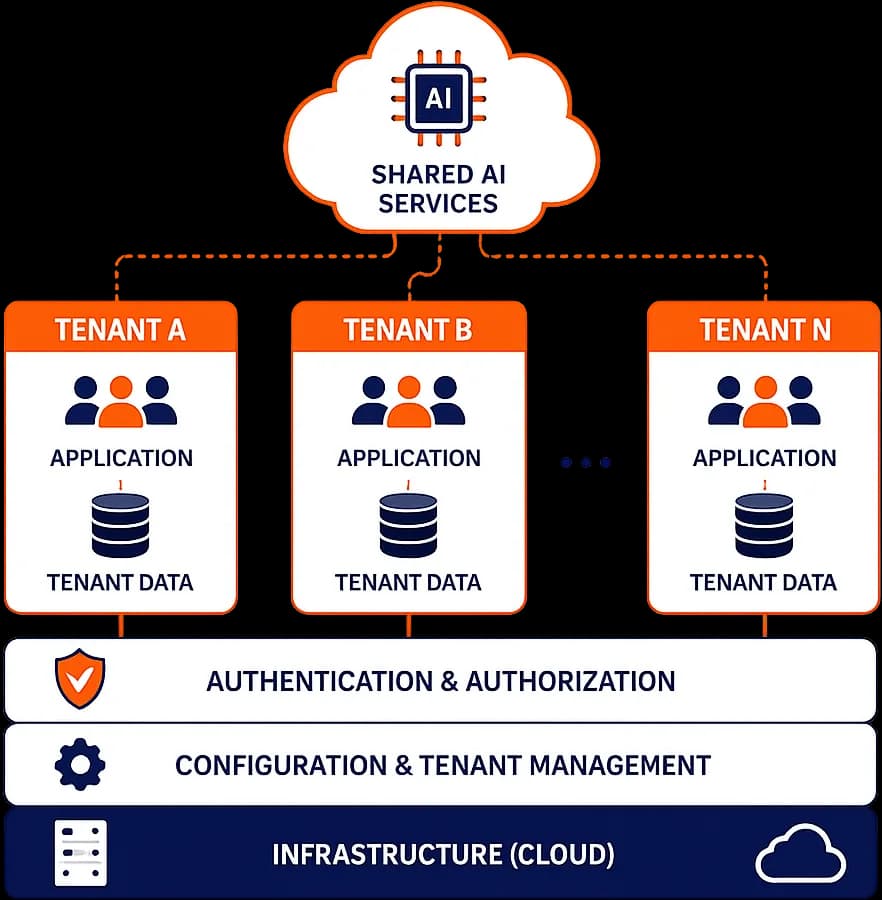
Building a SaaS was once primarily about isolating rows in a SQL database. In 2026, the challenge has evolved into a multi-dimensional engineering feat. When building an AI-native SaaS, multi-tenancy involves isolating high-dimensional vector embeddings, managing shared GPU compute cycles, and ensuring that Tenant A's "private context" never leaks into Tenant B's "hallucination."
At OpenMalo Technologies, we have spent over 12 years architecting high-performance digital products for the US, UAE, and Indian markets. We've seen that for AI SaaS, a "one-size-fits-all" approach to multi-tenancy is a recipe for security breaches or spiraling infrastructure costs. To hit enterprise-grade production, you need an architecture that balances the aggressive cost of GPUs with the absolute necessity of data sovereignty.
1. The New Multi-Tenancy Challenge: Data vs. Compute
In 2026, AI multi-tenancy is split into two distinct operational layers that must be managed simultaneously. It is no longer enough to just protect the database; you must protect the inference pipeline itself.
- The Data Layer: This involves the isolation of Retrieval-Augmented Generation (RAG) pipelines. You must ensure that the vector search engine only retrieves Tenant A's specific PDFs, emails, and private documents. If a vector from Tenant B is accidentally pulled into the context window of Tenant A's session, it's not just a bug—it's a catastrophic data leak.
- The Compute Layer: This is the "Noisy Neighbor" problem on steroids. GPUs are the most expensive part of your 2026 stack. If you have 50 tenants sharing a single H100 cluster, one tenant running a massive fine-tuning job or a recursive autonomous agent can "starve" the others of compute power, leading to timeouts and degraded user experiences across your entire platform.
2. Pattern 1: The "Shared Everything" (Logical Isolation)
This is the most common starting point for early-stage AI startups. In this model, all tenants share the same database and a single massive vector index. Isolation is handled entirely at the Application Query Level.
How it Works:
Every row in your traditional database and every vector embedding in your store (e.g., Pinecone or Supabase pgvector) is tagged with a tenant_id metadata column. When the AI agent performs a search, the query is hard-coded with a strict filter: WHERE tenant_id = 'XYZ'.
The OpenMalo Verdict:
- Pros: It is exceptionally easy to maintain and the most cost-effective approach. You only pay for one database instance and one set of GPU clusters.
- Cons: This pattern carries the highest risk of "Data Leakage." A single developer error—forgetting the
tenant_idfilter in a new feature—can expose one client's data to another. Furthermore, as your largest tenants grow, their massive data volume can slow down the indexing speed for your smaller customers.
3. Pattern 2: The "Namespace/Silo" (Metadata Isolation)
This is the "Goldilocks" zone for mid-market AI SaaS in 2026. You continue to use a shared database cluster but utilize native engine-level isolation features to create virtual "silos."
How it Works:
Instead of just a column filter, you use Namespaces in your vector database or Row-Level Security (RLS) in PostgreSQL. RLS acts as a "firewall" at the database engine level. When a user connects, the database session is restricted to that user's tenant_id. Even if a developer writes a "bad" query that tries to select all data, the database itself will refuse to return rows belonging to other tenants.
The OpenMalo Verdict:
- Pros: This provides high security with moderate operational overhead. It is the best pattern for scaling from 100 to 1,000+ enterprise tenants without multiplying your cloud bill.
- Cons: Some vector databases have practical limits on the number of namespaces they can efficiently index, which can occasionally lead to "hot spots" in your cluster.
4. Pattern 3: The "Hardened Cell" (Physical Isolation)
Reserved for Tier-1 FinTech, Healthcare, or Government clients who demand total data sovereignty. In this model, Tenant A and Tenant B never even touch the same physical hardware.
How it Works:
Every tenant gets their own dedicated physical (or virtual) database, vector index, and even dedicated GPU inference nodes. This is often implemented as a "Single-Tenant, Multi-Instance" architecture.
The OpenMalo Verdict:
- Pros: This offers the maximum possible security. It completely eliminates the "Noisy Neighbor" effect and allows for tenant-specific fine-tuning or custom encryption keys (BYOK - Bring Your Own Key).
- Cons: It is extremely expensive to run and a significant challenge to manage. You need sophisticated Infrastructure-as-Code (IaC) and automated DevOps pipelines to keep all these separate cells updated simultaneously.
5. GPU Multi-Tenancy: Managing the "Fairness" Problem
Managing high-cost GPU resources is the biggest hurdle for AI SaaS providers in 2026. If a "Free Tier" user runs a loop that consumes 100% of your GPU capacity, your "Enterprise" users will suffer.
The OpenMalo Strategy for GPU Fairness:
- Token-Based Rate Limiting: Implement a "Token Bucket" algorithm that tracks and limits token consumption per tenant in real-time.
- Priority Queuing: Use a message broker (like RabbitMQ or Kafka) to route "Premium Tier" requests to a dedicated cluster of high-performance B200 nodes, while "Standard" users share a larger, slightly slower pool of H100s.
- Serverless Inference: Utilize modern providers that allow you to spin up "Cold" inference instances for specific large-scale tasks. This ensures you only pay for the exact milliseconds of compute used, rather than keeping expensive GPUs idling.
Key Takeaways
- RLS is Your Security Foundation: For the majority of B2B AI startups, Row-Level Security on a hybrid database is the most resilient and "hardened" starting point.
- Don't Over-Engineer Day 1: Unless your business model is strictly enterprise-only, Pattern 2 (Namespaces) usually offers the best balance of speed and security.
- Implement "Red Team" Tests: Regularly run automated tests that try to query data without an authenticated session to ensure your logical "walls" are holding up.
- Tag Everything: Metadata is the key to AI management. Ensure every embedding is tagged with strict metadata to allow for instant filtering, updates, and "Right to be Forgotten" deletions.
Conclusion
Multi-tenancy in the age of AI is no longer a "set and forget" database configuration. It is a continuous balance of safety, performance, and economy. As AI agents become more autonomous and process deeper layers of sensitive data, the "walls" between your tenants must become more intelligent. At OpenMalo Technologies, we specialize in "Hardening" these architectures—ensuring that your AI SaaS can scale to thousands of global users without ever compromising the privacy or performance of a single one.
Building a complex, multi-tenant AI product for a global market? OpenMalo Technologies provides the deep architectural expertise needed to design a secure, cost-effective, and scalable foundation for your SaaS. Consult with our SaaS Architects at OpenMalo