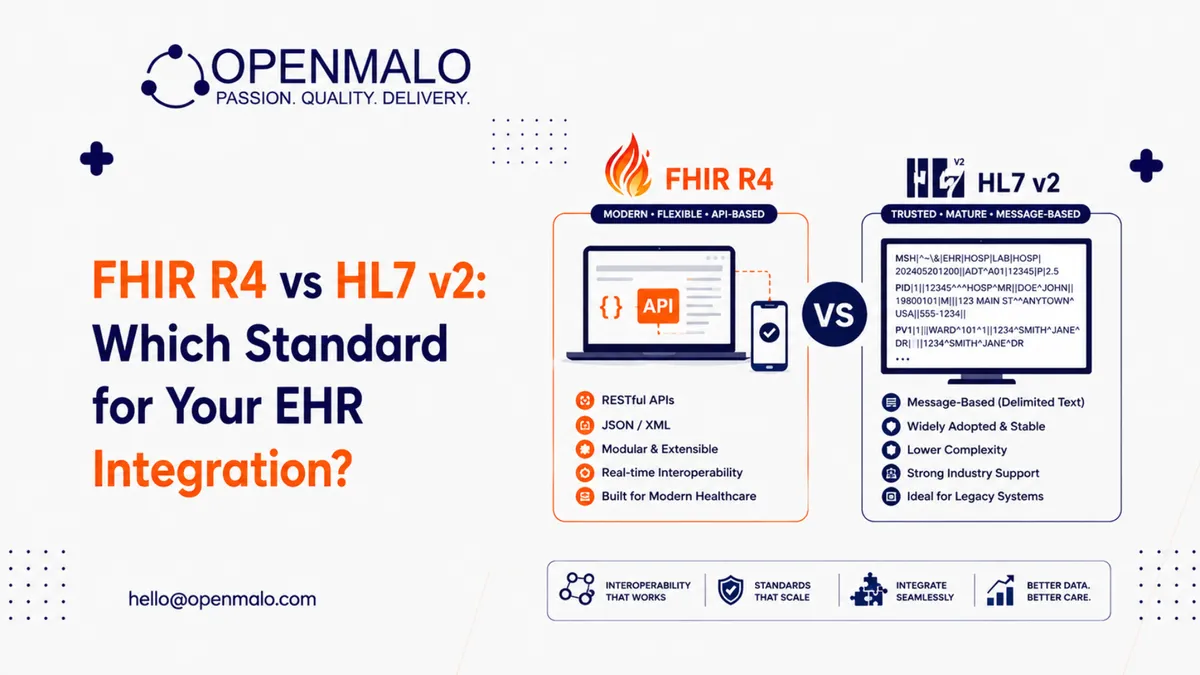
Quick answer: HL7 v2 is the pipe-delimited messaging standard that has powered hospital interface engines since the 1990s — unavoidable in legacy EHR estates. FHIR R4 is the modern web-native standard from HL7 International, normative since 2019; it uses RESTful APIs and JSON/XML payloads, and is the foundation of regulatory mandates worldwide including India’s ABDM. The right answer is rarely either/or — most production environments run both. The winning pattern is a dual-protocol gateway: FHIR R4 on the outside, HL7 v2 translation where legacy demands it.
If you are choosing between FHIR R4 and HL7 v2 for an EHR integration, the choice is rarely either/or in practice. Most production healthcare environments run both — HL7 v2 for legacy interfaces still embedded in core hospital systems, FHIR R4 for new integrations, APIs, and anything that touches a modern mobile or web application. The right answer depends on what you’re integrating with and how long it has to live.
The comparison that matters
| Dimension | HL7 v2 | FHIR R4 |
|---|---|---|
| Transport | TCP / MLLP, file drops, message queues | HTTPS REST APIs |
| Payload format | Pipe-delimited (|) segments |
JSON or XML |
| Developer experience | Steep learning curve, specialised tooling | Familiar to any REST API developer |
| Adoption | Universal in hospital interface engines | Growing fast; mandated for new integrations in many regions |
| Versioning | Many minor versions still in production | R4 is the dominant normative version; R5 evolving |
| Use case fit | Internal hospital messaging, ADT feeds, lab results | Mobile apps, web apps, patient-facing portals, cross-organisation exchange |
| India context | Still common in legacy hospital systems | Foundation of ABDM standards |
| Tooling | Mirth Connect, Iguana, NextGen Connect | Standard REST tooling; HAPI FHIR, Aidbox |
When HL7 v2 wins (or you have no choice)
You will pick HL7 v2 when:
- The target EHR exposes only an HL7 v2 interface (most legacy installations)
- Your integration is an ADT (admit/discharge/transfer) feed, an ORM (order message), an ORU (results message), or another classical hospital interface
- You’re working through an interface engine like Mirth that already speaks HL7 v2 natively
- You’re maintaining an existing v2 integration and rebuilding it in FHIR isn’t worth the lift
The advantage of v2: deeply documented patterns, vast deployed base, every interface engineer has worked with it. The disadvantage: pipe-delimited messages, custom segments, and 30 years of “minor variations” across vendors.
When FHIR R4 wins
You will pick FHIR R4 when:
- The integration is between a modern app and an EHR that exposes FHIR (Epic, Cerner, Athenahealth, many newer Indian systems)
- You’re building patient-facing functionality (patient portal, mobile app, wearables sync)
- You need cross-organisation exchange (TEFCA in the US, ABDM in India, similar elsewhere)
- Your developers are not specialised HL7 v2 engineers
- You want resource-level operations (GET, POST, PUT on
Patient,Observation,Condition, etc.) rather than message-level processing
The advantage of FHIR R4: it works like the rest of the modern web — REST + JSON + OAuth. The disadvantage: in legacy environments you may still need an HL7 v2 ↔ FHIR translation layer to talk to older systems.
The architecture pattern that wins production
What we deliver at OpenMalo for most healthcare clients is a dual-protocol gateway:
- External interface = FHIR R4 — every modern app, mobile, patient portal, and ABDM-facing flow speaks FHIR over HTTPS
- Internal translation layer — converts FHIR resources to/from HL7 v2 messages as needed for legacy hospital systems
- Interface engine in the middle — handles message orchestration, retry, transformation, audit
This pattern lets new development happen in FHIR (faster, better-tooled, more recruitable engineers) while preserving connectivity to the install base.
India-specific FHIR notes
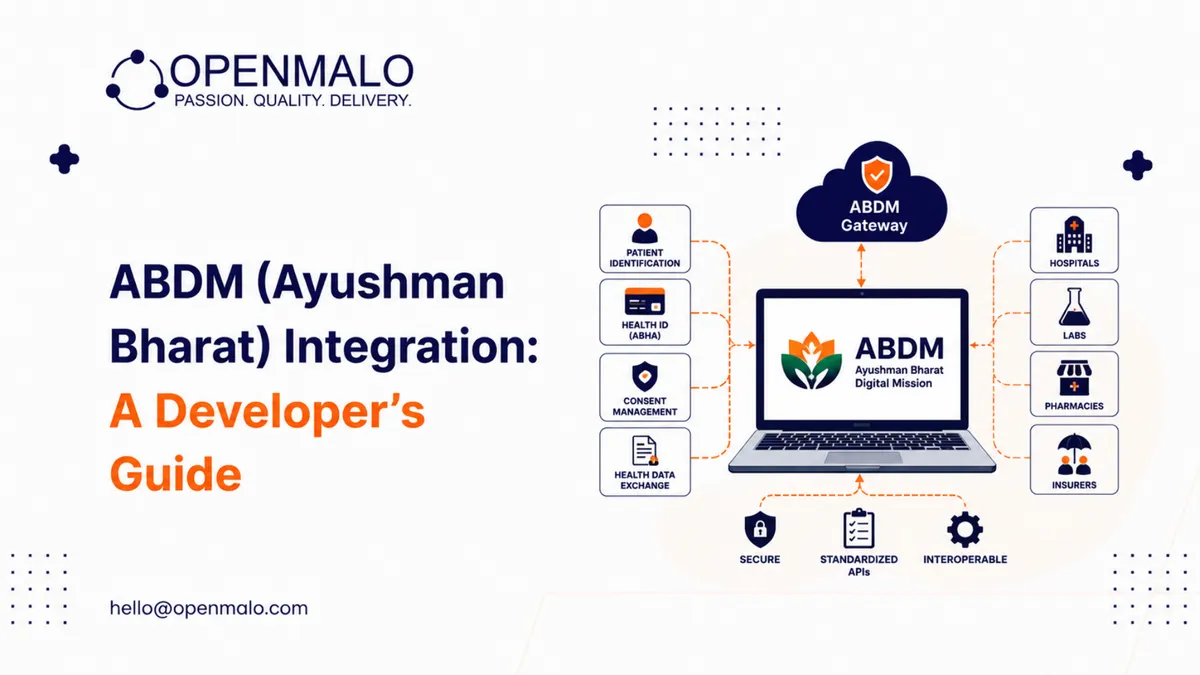
ABDM uses FHIR as the foundation for record exchange. The NDHM Sandbox and the gateway specs publish FHIR resource profiles for India-specific use cases. If you’re building anything that touches ABDM — telemedicine, lab integration, patient PHR — you are working in FHIR R4 with India-specific profiles.
What this means for your team
Hiring: FHIR R4 developers are easier to find than HL7 v2 specialists, because FHIR’s REST/JSON model is familiar to any backend engineer. HL7 v2 expertise is increasingly concentrated in specialised consultancies — including OpenMalo for our healthcare clients.
Tech debt: a pure HL7 v2 estate today is technical debt against the FHIR future. New integrations should be FHIR; legacy should have a migration path.
CTA: OpenMalo’s EHR integration module gives you the dual-protocol gateway — FHIR on the outside, HL7 v2 translation where you need it. See the module →
Closing
The answer to FHIR vs HL7 v2 is “yes” — both, with FHIR on the front and HL7 v2 surviving in the legacy back. Build the gateway architecture that lets you put new features on FHIR while preserving every existing integration. That’s the path that doesn’t paint you into a corner.