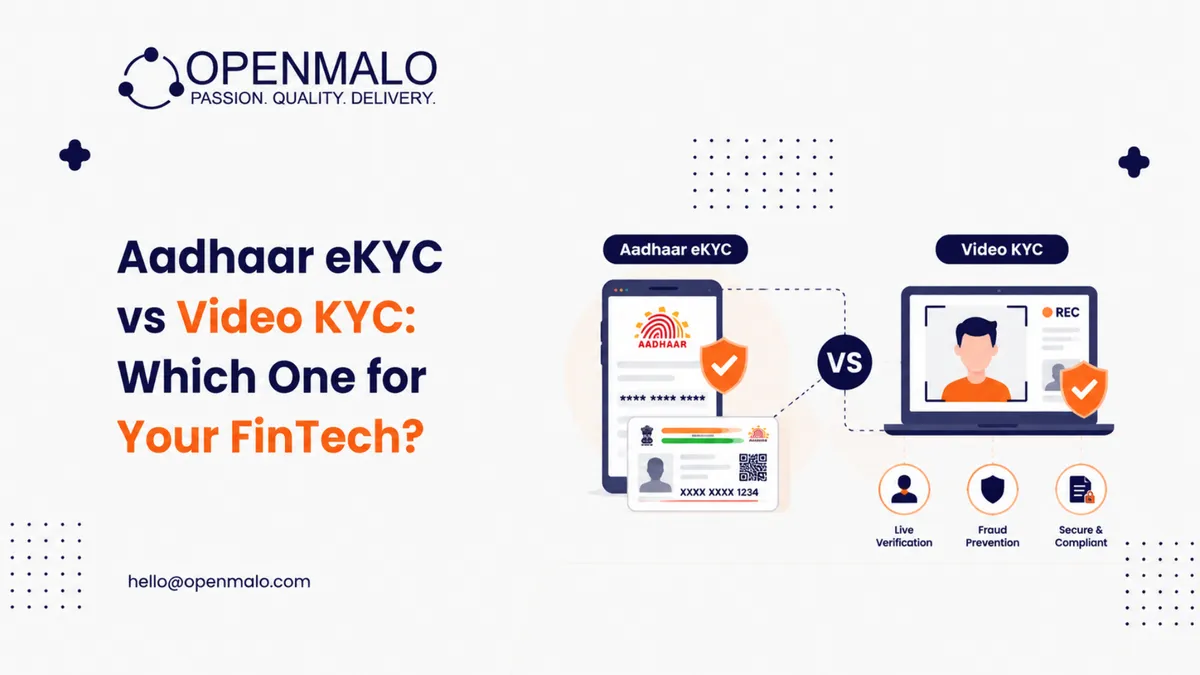
Quick answer: The right choice between Aadhaar eKYC and Video KYC is almost never “pick one and use it for everyone.” Aadhaar OTP eKYC takes about a minute, costs a few rupees, and works for low-risk products within the RBI’s prescribed ticket-size limits. V-CIP has a live agent video-call the user, takes three to six minutes, costs an order of magnitude more, and is required for higher-risk or higher-ticket products. The pattern that wins is a routing layer that sends each user to the cheapest mode they qualify for, with V-CIP as the fallback.
If you are choosing between Aadhaar eKYC and Video KYC (V-CIP) for your fintech onboarding flow, the right answer is almost never “pick one and use it for everyone.” The right answer is a routing layer that sends each user to the cheapest verification mode they qualify for, with V-CIP as the fallback for everyone who fails the cheaper path.
In plain language: Aadhaar eKYC verifies a user by sending an OTP to the Aadhaar-linked mobile number and pulling demographic data from UIDAI. It takes about a minute, costs a few rupees per verification, and works for low-risk products inside the RBI’s prescribed limits. Video KYC (V-CIP) has a live trained agent video-call the user, capture documents, take a geotagged selfie, and complete the verification in real time. It takes three to six minutes, costs roughly an order of magnitude more, and is mandatory for higher-risk and higher-ticket products.
The decision matrix
| Dimension | Aadhaar eKYC (OTP) | Video KYC (V-CIP) |
|---|---|---|
| Time to complete | ~1 minute | 3–6 minutes |
| Drop-off rate | Low (typically <15%) | Higher (typically 25–45%) |
| Cost per success | Very low | Roughly 10–20× higher |
| Risk bands supported | Low risk, limited ticket | All risk bands |
| Failure modes | Aadhaar not linked to mobile, OTP delay | Agent queue time, network drops, document quality |
| Compliance acceptance | Permitted up to RBI limits | Universal acceptance |
| Customer perception | Frictionless | “Why does someone have to call me?” |
When eKYC wins
Pick Aadhaar eKYC when all of the following are true:
- Your product fits inside the RBI’s eKYC ticket-size and account-type limits
- The user has Aadhaar with an active linked mobile number
- You’re comfortable with the limited demographic dataset (no income, no employment)
- You can route the failures to V-CIP automatically
Typical winners: prepaid wallets, small-ticket BNPL, consumer instalment loans below threshold, savings account opening for limited-purpose accounts.
When V-CIP wins
Pick V-CIP when any of the following apply:
- Ticket size or risk band exceeds the eKYC limits
- You need to verify physical documents that aren’t in UIDAI’s possession (PAN with photo match, etc.)
- You operate a non-Aadhaar product (e.g., NRI accounts where Aadhaar isn’t applicable)
- Your audit posture demands the higher-confidence verification
Typical winners: full-KYC bank accounts, larger personal loans, demat openings, insurance with health declarations.
The hybrid pattern that beats both
What we actually build at OpenMalo for most fintechs is a waterfall:
- Attempt CKYCR pull — free if the user has an existing CKYC record
- If not found, attempt Aadhaar OTP eKYC — cheapest fresh verification
- If OTP fails (no mobile link, repeated wrong OTP), fall back to offline Aadhaar XML or DigiLocker
- If the product/risk band needs more, escalate to V-CIP
- Inline PAN verification at every step
A waterfall like this typically reduces blended cost per successful KYC by a meaningful margin compared to a V-CIP-by-default flow, while preserving conversion.
Operational realities most teams underestimate
- V-CIP agent staffing. You need trained agents on shift during your peak hours, not a 9-to-5 BPO. If your user base spikes between 8 and 11pm, that’s when you need staff.
- Recording retention. V-CIP recordings must be retained for the prescribed period after account closure, in tamper-evident storage. Cloud storage cost is non-trivial at scale.
- Failure routing. Every verification can fail for a dozen reasons. Build an explicit retry/fallback ladder rather than dumping failed users to “please try again later.”
CTA: OpenMalo’s KYC module ships with the eKYC → DigiLocker → V-CIP waterfall pre-built, with operator dashboards and agent tooling. See the module →
Closing
eKYC vs V-CIP isn’t an either/or. It’s a routing decision your product makes for every single user, every single attempt. Build the routing layer well and your blended cost lands at the low end of the industry range; build it badly and you pay V-CIP prices for users who would have completed an eKYC in 45 seconds.