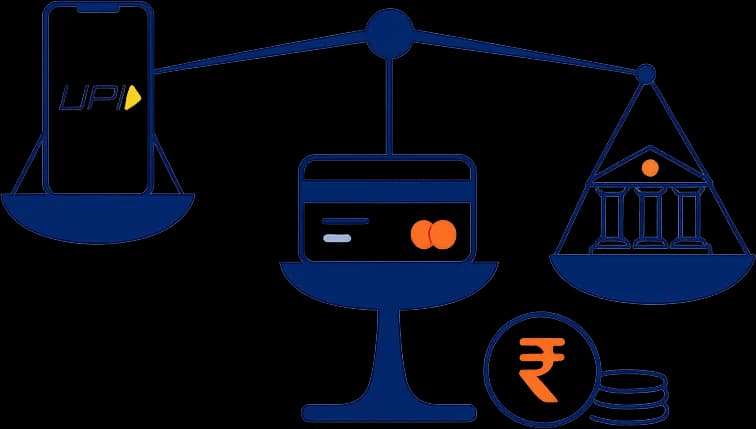
Quick answer: UPI Person-to-Merchant transactions are zero-MDR by regulation for the merchant category most retailers fall into, debit cards have capped MDR depending on issuer and amount, credit cards are negotiable and typically range materially higher than debit, and net banking carries a flat fee per transaction that makes it economical only for higher-ticket payments. RuPay and BHIM-on-UPI have specific government-supported pricing. The number that actually decides your unit economics is effective cost per successful transaction net of failures, refunds, and chargebacks — not the headline MDR.
When you read your payment gateway statement, the headline MDR is rarely the actual cost. There are interchange fees, scheme fees, acquirer markups, GST, and method-specific surcharges that compound on top of the quoted rate. If you’re a merchant comparing payment methods on a real cost basis, here is the breakdown that matters.
In plain language: UPI Person-to-Merchant transactions are zero-MDR by regulation for the merchant category most retailers fall into, debit cards have capped MDR depending on issuer and amount, credit cards are negotiable and typically range materially higher than debit, and net banking carries a flat fee per transaction that makes it economical only for higher-ticket payments. RuPay and BHIM-on-UPI have specific government-supported pricing.
The merchant cost ladder, plain version
| Method | Typical effective merchant cost | Notes |
|---|---|---|
| UPI (P2M, eligible MCC) | 0% | Zero-MDR mandated; government compensates banks separately |
| RuPay debit (small-ticket) | 0% | Zero-MDR mandate |
| Visa / Mastercard debit | Capped low | RBI cap; varies by ticket size and merchant category |
| Net banking | Flat fee per txn | Economical above a certain ticket size |
| Visa / Mastercard credit | Higher single-digit % | Interchange + scheme + acquirer; reward cards cost more |
| International cards | Highest single-digit % | Cross-border interchange + currency conversion |
| Wallets (closed/semi-closed) | Negotiated | Often comparable to UPI for partner wallets |
Why “zero MDR on UPI” is not zero cost for you
The MDR is zero, but you still pay for:
- The payment gateway’s per-transaction technology fee (small but real)
- Settlement bank charges if any
- Failed-transaction retry and customer support cost
- Chargeback-adjacent operations (UPI has very limited recourse, which is its own cost)
For most merchants UPI remains the cheapest method by a wide margin. But “free” is a marketing word, not an accounting one.
Why credit cards aren’t always the enemy
Credit cards cost more per transaction, but they:
- Convert better on higher-ticket purchases (EMI propensity)
- Are the only feasible method for international customers in many categories
- Capture a higher average order value (AOV)
- Don’t have UPI’s failure rate for large transactions
A 1.8% MDR on a ₹5,000 AOV credit transaction can be more profitable than zero-MDR UPI if the credit card conversion adds 25% AOV uplift. Run the math on your own funnel; don’t assume cheaper = better.
The hidden costs that don’t appear on the headline rate
- Failure rate — UPI has a non-trivial failure rate on certain bank rails; each failure is a lost conversion and a customer-support ticket.
- Chargebacks — Credit cards carry chargeback exposure; budget 0.1–0.5% of card volume as a chargeback risk, depending on category.
- Reversal & refund speed — Refunds on UPI can return in seconds; refunds on cards take days. The slower refund increases your customer support load.
- Reconciliation — Multi-method merchants spend non-trivial finance time reconciling settlements across rails. Pick a gateway that consolidates.
What this means for your payment method mix
For most Indian merchants the dominant-method UPI mix wins on cost, but you should:
- Offer cards anyway for the AOV uplift on the segment that prefers them
- Offer net banking for high-ticket B2B transactions
- Negotiate your card MDR explicitly — the rack rates are not the real rates
- Monitor failure rate by method monthly; switch acquirers if a method underperforms
CTA: OpenMalo’s payments gateway integration gives you UPI, cards, net banking, and wallets through one API with consolidated reconciliation. See the module →
Closing
MDR is the most-quoted, least-useful payments metric. The number that decides your unit economics is effective cost per successful transaction net of failures, refunds, and chargebacks, computed monthly per method. Build the dashboard, look at it every month, and renegotiate when the curves shift.