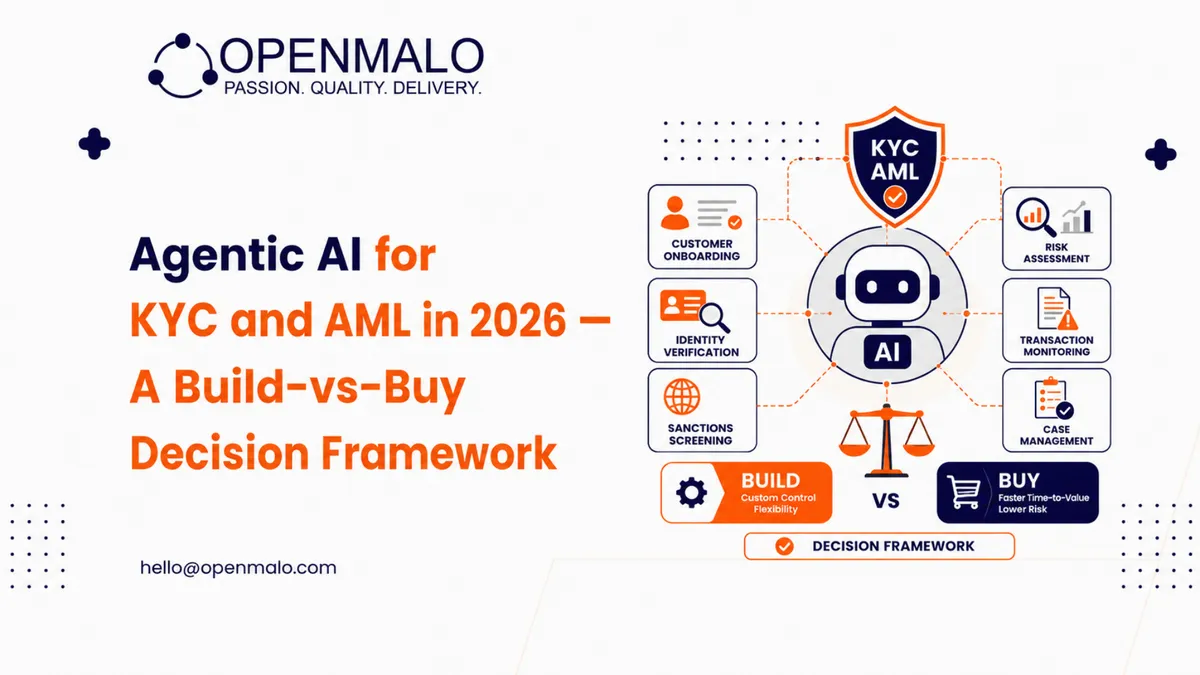
Quick answer: Agentic AI in compliance is no longer optional — adoption among finance teams jumped from under 7% in early 2025 to roughly 44% by Q1 2026. The right question is not whether to deploy it, but how: buy a packaged agent (FIS, ComplyAdvantage, Hawk, Quantexa), embed agents into a KYC/AML platform via API, or build proprietary agents on Bedrock/Vertex/Azure. This framework helps you decide based on volume, risk appetite, regulator footprint, and engineering depth.
Two years ago, "AI in compliance" mostly meant a transaction-monitoring engine with a slightly better false-positive rate. Today it means autonomous agents that complete end-to-end workflows: a KYC agent that pulls documents, runs OCR, cross-references sanctions lists, scores risk, drafts an Enhanced Due Diligence memo, and routes to a human reviewer — without a single ticket in between.
McKinsey's early-2026 work on banking productivity puts the gain from agentic compliance at 200% to 2,000%, depending on the workflow and starting baseline. FIS publicly announced in May 2026 that it is partnering with Anthropic to ship an AML agent for BMO and Amalgamated Bank. Inside that productivity number is a real signal: the work is being redefined, not just sped up.
For compliance leaders and fintech CTOs, that means three pressures arrive simultaneously: your regulators expect you to be using AI responsibly, your competitors are quoting 24-hour onboarding instead of 5 days, and your existing case management vendor is suddenly pitching an "agent" that may or may not be one.
The three deployment patterns we see in 2026
There is no fourth path. Every agentic AI deployment in financial crime compliance falls into one of these three:
Pattern A — Buy a packaged agentic platform. Vendors like ComplyAdvantage, Hawk, Quantexa and FIS (post-Anthropic deal) ship agents pre-trained on KYC/AML workflows with their own case management UI. You are buying a system, not a model.
Pattern B — Embed agents into your existing case manager. You keep your incumbent platform (Actimize, SAS, Verafin), and bolt agentic capability through their published agent APIs or via a third-party orchestrator like Sardine or Unit21.
Pattern C — Build proprietary agents on cloud foundations. AWS Bedrock Agents, Vertex AI Agent Builder, or Azure AI Foundry. You own the orchestration, prompts, tool calls, and audit trail. You also own every regulatory question.
The build-vs-buy decision framework
Score your situation across these six axes. Each scores 1–5. Total score guides the recommendation:
- Annual onboarding volume: Score 1 if under 50,000 customers/yr (lean buy). Score 5 if over 2M customers/yr (lean build).
- Regulatory footprint: Score 1 for single jurisdiction. Score 5 for 5+ jurisdictions, varied regimes.
- Existing engineering bench: Score 1 if under 5 ML/AI engineers. Score 5 if over 25 ML/AI engineers + applied research.
- Differentiation thesis: Score 1 if compliance is a cost center. Score 5 if compliance speed is a product moat.
- Vendor lock-in tolerance: Score 1 if high (moves are rare). Score 5 if low (strategic flexibility required).
- Time to value: Score 1 if you need it in under 90 days. Score 5 if you can absorb 12+ months.
Score 6–14: Buy a packaged platform. Your incremental ROI from building is negative.
Score 15–22: Embed agents into your existing case manager. You get speed and customization without owning the model layer.
Score 23–30: Build. The math, the moat, and the team support it.
Most fintechs and mid-size banks land in the embed zone. Tier-1 banks and high-volume neobanks (Revolut, Chime-scale) land in build. Early-stage fintechs almost always belong in buy.
What "agentic" actually buys you in KYC and AML
The hype is real but uneven. Here is where agentic AI is genuinely changing economics in 2026, and where it is not.
Genuinely transformed workflows:
- Document collection and verification. Agents pull, OCR, validate, and score identity documents in seconds. Manual queues that ran 4–48 hours now resolve in under 2 minutes for clean cases.
- Sanctions and PEP screening. Continuous re-screening replaces batch jobs. Agents resolve name-collision false positives by reasoning over context (DOB, geography, occupation) rather than fuzzy-matching scores.
- Enhanced Due Diligence memos. Agents draft EDD narratives by pulling adverse media, corporate registries, and beneficial ownership data, citing each source. Human reviewers go from authoring to editing.
- Regulatory change monitoring. Agents scan FATF, FinCEN, FCA, MAS, and EU regulator publications, identify changes affecting your institution, and produce an impact assessment. This was a quarterly project; it is now a daily output.
Hyped but still maturing:
- Transaction monitoring rule generation. Promising; not yet ready to replace your model risk management process.
- Fully autonomous case decisioning. Regulators are not comfortable. Keep a human on file closures involving SAR/STR.
- Cross-institution intelligence. Privacy law (GDPR, CCPA, sectoral) makes federated learning across banks slow.
Three regulatory traps to avoid
- Model risk management ambiguity. SR 11-7 and equivalent frameworks were written for traditional models. Agentic systems with tool use and chain-of-thought are not cleanly covered. Document your governance posture now — before your first exam.
- Explainability theater. "Here is the chain-of-thought" is not regulator-grade explainability. You need decision logs that map every action an agent took to a policy and a trigger.
- Vendor SOC 2 ≠ regulatory comfort. Your regulator does not care that your agent vendor has SOC 2 Type II. They care that you can demonstrate control over decisions made on your behalf.
How OpenMalo helps
OpenMalo has been shipping payments, KYC, and fraud-prevention systems since 2013, with 280+ production deployments across the fintech, banking, and payments stack. Our compliance engagements range from agent integration sprints (8 weeks) to full proprietary builds on Bedrock/Vertex (6–9 months). If you are scoring 15+ on the framework above and need help mapping your build, book a 30-minute architecture review.