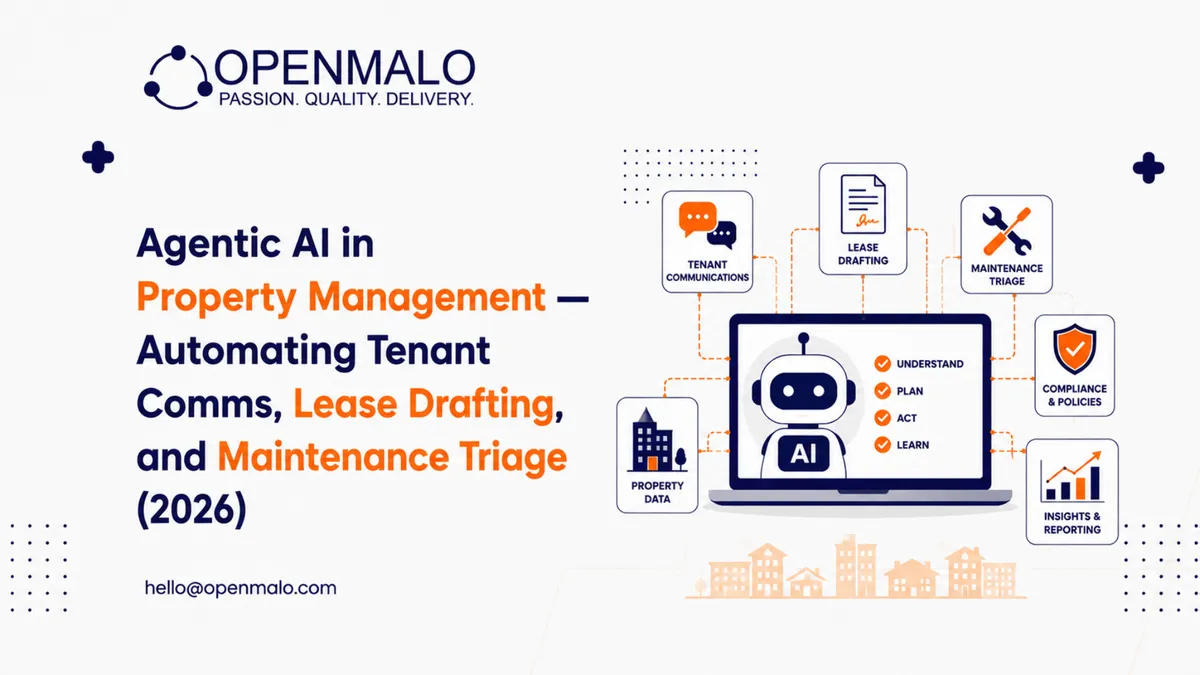
Quick answer: Three property management workflows are now reliably handled by agentic AI in 2026: tenant communication (24/7 multilingual response with escalation rules), lease drafting (clause selection, jurisdiction tailoring, redlining), and maintenance triage (work-order classification, vendor dispatch, follow-up). Combined, these typically cut a property manager's per-unit operational hours by 25–40% while raising tenant satisfaction. The deployment pattern below works for portfolios from 200 to 20,000 units.
PropTech has been "AI-curious" for five years. In 2026, two things changed.
First, agentic AI moved from content generation to autonomous decision-making and execution. ICSC's 2026 PropTech report calls this "the next phase of proptech" — agents now triage maintenance, route to vendors, and follow up without a human in the loop on routine cases.
Second, the macroeconomics finally lined up. Operating margins on multi-family and commercial portfolios compressed in 2024–2025. AI moved from "interesting experiment" to "the only way to keep margin."
92% of CRE companies are now running live AI pilots or implementations, per industry surveys, and over 72% of portfolios use smart-building tech for energy management, tenant experience, and predictive maintenance. The PropTech market sits at $40–55B in 2026, growing 13–17% annually.
For property managers and proptech founders, the question is no longer whether to deploy agentic AI — it is which workflows to start with, what to build versus buy, and how to roll it out without breaking a three-decade-old vendor stack.
The three workflows worth automating first
Not every property management workflow is ready for agents. These three are.
Workflow 1 — Tenant communication (highest immediate ROI)
The pain is concrete: 35–55% of a leasing or property manager's day is reactive tenant communication. Most of it repeats. "When is my rent due?" "Is there parking on Saturday?" "How do I reset my access fob?"
A well-designed agentic tenant comms system handles 60–80% of these without a human, in any language the tenant types in, 24/7. The technical pattern in 2026:
- Channels: SMS, email, WhatsApp, web portal, voice (Twilio + a real-time speech model).
- Knowledge base: building-specific FAQs, lease terms, vendor contact info, all retrievable by the agent.
- Escalation rules: explicit thresholds for human handoff (any complaint about safety, harassment, urgent maintenance, eviction-related questions).
- Integration: ties into AppFolio, Yardi, Buildium, or RealPage so the agent can read tenant state.
The biggest mistake teams make is over-scoping the agent. Start with FAQs and rent inquiries; add complexity later.
Workflow 2 — Lease drafting and redlining
A standard residential lease has 60–120 clauses; a commercial lease 200–500. Most landlords reuse a template and adjust 5–15 clauses per deal. This is exactly the work agentic AI does well in 2026.
A lease-drafting agent in 2026 can:
- Select the right base template by jurisdiction and property type.
- Insert tenant- and unit-specific terms (rent, term, deposit, parking, pets, utilities).
- Apply jurisdiction-specific clauses (rent control, eviction, security deposit caps).
- Redline a counterparty's proposed lease, flagging deviations from your standard with risk commentary.
- Generate a signature-ready PDF and route through DocuSign or Dropbox Sign.
What it should not do without human review: any non-standard clause, any waiver, any jurisdiction the agent has not been trained on. Treat the agent as a senior paralegal — fast, accurate, and supervised.
Workflow 3 — Maintenance triage and dispatch
Maintenance is where agentic AI moves from "save time" to "save real money." A modern triage agent handles:
- Intake: tenant submits a request via SMS, app, or call. Agent extracts urgency, category (plumbing, HVAC, electrical, appliance, structural), and unit.
- Classification: agent assigns priority based on building rules and lease terms (a leak above unit 4B is P0; a slow-draining sink in vacant unit 2A is P3).
- Vendor selection: agent picks the right vendor from your approved list based on category, availability, and historical quality scores.
- Scheduling: agent coordinates entry with the tenant, including showing-up windows and access codes.
- Follow-up: agent confirms completion, requests tenant feedback, updates the work order in your PMS.
Maintenance triage agents have produced 25–40% reductions in per-ticket cost and 30%+ improvements in resolution time across pilots in 2026.
Build vs. buy in 2026: where the line falls for property managers
- Buy (AppFolio AI, Yardi Aspire, EliseAI, Travtus): under 2,000 units, standard residential portfolio, in-house engineering team under 3, need it live in under 90 days.
- Build (custom on Bedrock/Vertex): over 5,000 units, mixed-use / commercial / specialty, in-house team with PropTech experience, 9–18 month build acceptable.
Most property managers below 5,000 units should buy. Above 5,000 units, or with non-standard property types (student housing, senior living, mixed-use, commercial), the build economics start to work — especially if proprietary AI is part of your differentiation thesis.
A 90-day rollout plan that actually works
Days 1–14 — Discovery. Pick one property type (start with a mid-size multi-family asset, 100–300 units), one workflow (we recommend tenant comms), audit your existing PMS integrations, and pick a champion property manager.
Days 15–45 — Pilot. Launch the agent on the chosen asset. Train it on building-specific FAQs. Set a hard escalation rule: any unresolved tenant message after 4 hours goes to a human. Measure deflection rate, tenant CSAT, and escalation-after-resolution rate.
Days 46–75 — Expand workflow. Add maintenance triage on the same asset. Wire to your top three vendors. Track per-ticket cost and resolution time vs. baseline.
Days 76–90 — Decision gate. If deflection rate above 55%, CSAT held or improved, and per-ticket cost dropped over 20% — expand to next 5–10 assets. If not, diagnose: usually it is knowledge-base completeness, not model quality.
How OpenMalo helps
OpenMalo has been building software for the real estate and PropTech sector since 2013, with 280+ shipped projects across portfolio management, tenant platforms, and maintenance automation. Our 90-day Agentic Property Management Sprint covers tenant comms, maintenance triage, and PMS integration with AppFolio, Yardi, Buildium, or your custom stack. Book a 30-minute call.