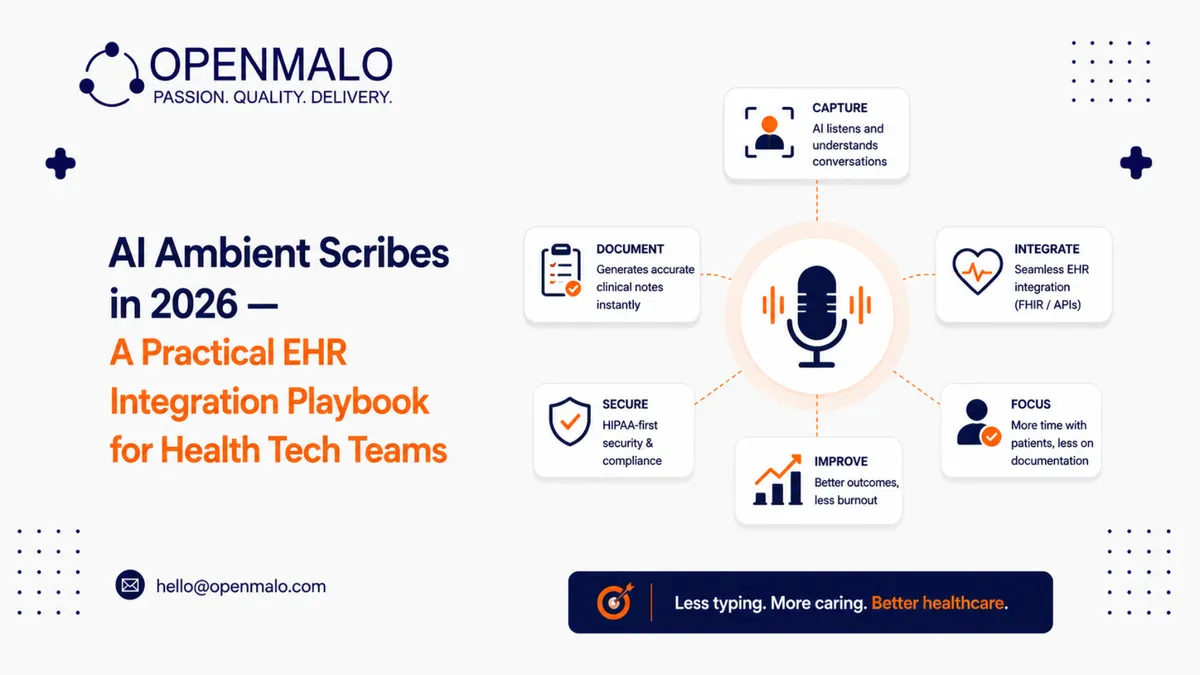
Quick answer: Integrating an AI ambient scribe into a clinical workflow takes roughly 8–14 weeks and breaks into four layers: secure audio capture, HIPAA-compliant transcription, EHR-aware summarization (Epic/Cerner/Athena), and clinician-in-the-loop review. The hardest part is rarely the model — it is the EHR write-back, the shadow IT problem, and the billing-code mapping. This playbook walks through all three.
In the last 18 months, ambient AI scribing went from "interesting demo" to the most-implemented clinical AI use case at U.S. health systems. Mayo Clinic, Mount Sinai, Atrium Health and Permanente Medical Group are all running ambient scribes at scale, and Wolters Kluwer's 2026 trends report calls it the year ambient documentation moves from ambulatory pilots to inpatient production.
The reason is simple: physicians spend roughly two hours on documentation for every one hour of patient care. Ambient AI flips that ratio. It listens to the visit, structures the note, drafts the assessment-and-plan, suggests ICD-10 codes, and lets the clinician sign with one click.
If you are a CTO at a health-tech startup, a clinical informatics lead at a hospital, or a product owner at a payer-provider, the question in 2026 is not whether to deploy an ambient scribe — it is how to integrate one without violating HIPAA, breaking your EHR's clinical decision support, or creating a shadow IT problem.
The four-layer architecture every ambient scribe needs
Whether you build, buy, or assemble, every production ambient scribe has the same four layers:
Layer 1 — Secure audio capture. This is where most teams underestimate the work. Capture has to be opt-in per visit, encrypted at rest and in transit, retained only as long as required, and recoverable for audit. iOS background audio rules, Android battery-optimization quirks, and ambient noise in exam rooms (vitals carts, baby monitors, hallway traffic) all degrade transcription quality if you do not handle them at the device layer.
Layer 2 — HIPAA-compliant transcription. You cannot pipe PHI to a general consumer LLM. You need either (a) a BAA-covered cloud transcription service (AWS HealthScribe, Azure Health Bot, Google Cloud Healthcare API), (b) a HIPAA-eligible LLM provider with PHI-redaction (Anthropic, OpenAI Enterprise, AWS Bedrock with VPC endpoints), or (c) on-premise/private-cloud Whisper variants tuned for medical vocabulary. Most production deployments in 2026 use a hybrid: transcription in a covered cloud, summarization in a domain-tuned LLM.
Layer 3 — EHR-aware summarization. This is where the real value lives. A generic transcript summary is useless. A useful summary maps the conversation to the EHR's note template (SOAP, H&P, discharge), reuses the patient's prior history, and surfaces care-gap reminders without inventing facts. This requires retrieval over the patient chart — what most teams now build as a small RAG layer between the LLM and the EHR FHIR API.
Layer 4 — Clinician-in-the-loop review and write-back. Auto-signing notes is a regulatory non-starter in most jurisdictions. Your scribe must surface a draft, let the clinician edit, and write back to the EHR through a sanctioned interface — typically Epic Haiku/Limerick, Cerner CareAware, or a SMART on FHIR app. Inline diff UI matters more than model accuracy here; clinicians need to see what changed and why.
Build vs. buy in 2026: the honest decision framework
Here is the trade-off matrix we walk our health-tech clients through at OpenMalo before they commit a dollar of engineering budget:
- Time to first clinician: Buy (Abridge, Nuance DAX, Suki, Augmedix) — 4–8 weeks. Build (custom on Bedrock/Vertex/Azure) — 14–24 weeks.
- Per-clinician cost: Buy — $200–$600/mo SaaS. Build — $40–$120/mo at scale (year 2+).
- EHR integration depth: Buy — pre-built for Epic/Cerner. Build — custom, but you control roadmap.
- Specialty coverage: Buy — strong in primary care, weaker in surgery, psych, peds. Build — you build for your clinicians.
- Data ownership: Buy — vendor retains aggregate signal. Build — you own everything.
- Best fit: Buy — fewer than 50 clinicians, generalist mix. Build — 200+ clinicians, specialty depth, or you sell scribing as a feature.
The pivot point is roughly 150 active clinicians. Below that, vendor SaaS wins on TCO and speed. Above that, the per-seat math, the specialty-tuning needs, and the data-ownership argument flip the equation.
Seven pitfalls we have watched health-tech teams hit (and how to avoid them)
- Underestimating EHR write-back complexity. Epic certifies fewer than 1,000 third-party apps for write-back. Plan 6–10 weeks of certification, not the 2 your vendor pitch promised.
- Skipping the shadow-IT review. If your clinicians are already using ChatGPT to summarize visits (and they are), formalize a sanctioned tool before IT cracks down. Surveys in early 2026 show 38% of clinicians have used a non-sanctioned LLM for documentation.
- Trusting model accuracy benchmarks. Vendor accuracy claims are measured on clean studio audio. Real exam-room WER is 2–4× higher. Pilot in actual rooms.
- Ignoring billing-code mapping. A scribe that drafts notes but does not suggest ICD-10/CPT codes is leaving 15–25% of revenue cycle value on the table.
- Auto-signing. Do not. Most U.S. states have not caught up to autonomous clinical AI; auto-signing creates malpractice exposure your insurer has not priced.
- Forgetting non-English visits. If your panel is more than 10% Spanish-speaking, monolingual scribes will create a tier of patients with worse documentation. This is a quality and equity problem.
- No clinician champion. Adoption tracks 1:1 with whether a respected clinician on staff publicly uses and praises the tool. No champion, no rollout.
A 90-day implementation roadmap
Days 1–14 — Discovery. Specialty mix audit, EHR integration inventory, BAA inventory, security review, clinician champion recruitment.
Days 15–45 — Pilot build. Select vendor or stand up the four-layer stack, integrate with a single specialty (start with primary care), enroll 8–12 clinicians.
Days 46–75 — Pilot run. Real visits, weekly clinician feedback, WER measurement against ground truth, billing-code accuracy spot-checks, after-hours documentation time tracking.
Days 76–90 — Decision gate. Three metrics decide go/no-go: clinician documentation time reduced by 40%+, opt-in rate above 70%, zero PHI incidents. Hit all three and you expand to the next specialty.
How OpenMalo helps
OpenMalo has shipped 280+ production AI systems across regulated industries since 2013. Our clinical AI engagements typically run 12–16 weeks: discovery, secure architecture, EHR integration (Epic, Cerner, Athena), and clinician-in-the-loop UX. If you are evaluating build vs. buy, we run a free 30-minute architecture review.