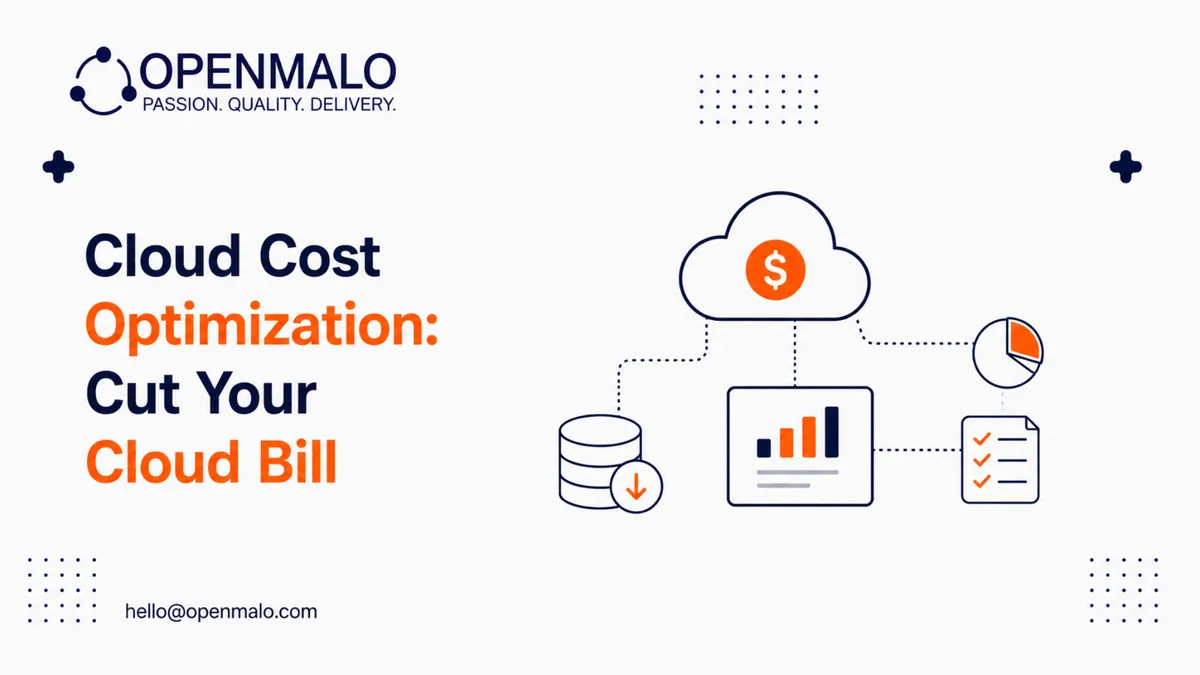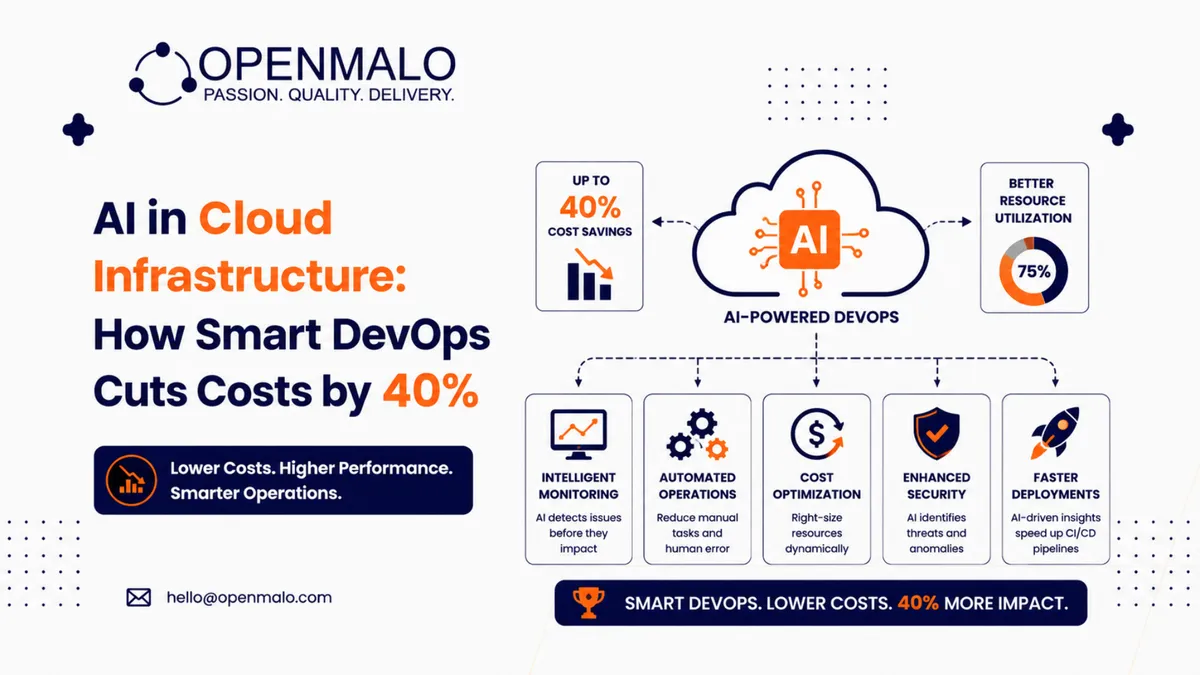
Cloud bills have a predictable life cycle. Month 1: exciting and manageable. Month 6: growing but justifiable. Month 18: someone in finance wants an explanation for why you are spending 3x the original estimate.
The dirty secret: most organisations are over-provisioned, under-monitored, and paying for resources that sit idle 40-60% of the time. AI-powered infrastructure management changes this equation. But only when it is implemented with intention, not as a checkbox.
The Cloud Cost Problem Nobody Solves Until It Hurts
According to IDC, the top driver for cloud migration is operational efficiency - 46% of organisations cite it as the primary reason for moving to the cloud. But cloud migration alone does not deliver efficiency. Intelligence layered on top of cloud infrastructure does.
The 5 AI Applications Delivering Real Savings
1. Intelligent Auto-Scaling
Traditional auto-scaling reacts to current load. AI-powered auto-scaling predicts load patterns based on historical data, time of day, and scheduled events - scaling ahead of demand. Result: 20-35% reduction in compute spend for applications with predictable traffic patterns.
2. Automated Right-Sizing
Most production environments have instances sized for workloads that changed 12 months ago. AI-powered right-sizing continuously analyses actual CPU, memory, and I/O utilisation and recommends - or automatically applies - size adjustments. AWS Compute Optimizer, Google Cloud Recommender, and Azure Advisor offer this natively. The teams getting the most value have automated the implementation of low-risk recommendations, not just the identification.
3. Self-Healing Infrastructure
AI agents monitor health, detect anomalies, and execute remediation without human involvement for known failure patterns. Disk full: agent cleans logs and archives old data. Service unresponsive: agent restarts with health checks. Database connection pool exhausted: agent scales the pool parameters. Result: mean time to resolution reduced 30-50% for Tier-1 incidents.
4. Anomaly Detection and Cost Attribution
Cloud cost anomalies - a service consuming 10x its normal resources - often go undetected for days in large environments. AI-powered monitoring detects these within hours and attributes them to specific services, teams, or code changes. This makes cost accountability politically tractable: when AI tells you exactly which deployment caused a $12,000 spike last Tuesday, the budget conversation becomes much cleaner.
5. Workload Scheduling Optimisation
Not all workloads need to run during peak hours. AI schedulers move batch jobs, training runs, and non-time-sensitive workloads to off-peak windows with lower spot pricing. Result: 15-40% cost reduction on batch and training workloads.
The Hybrid Cloud Shift: What AI Has to Do With It
79% of enterprise decision-makers have moved or are moving AI workloads from public cloud to on-prem or private infrastructure. The top reasons: data sovereignty, higher-than-expected cloud costs, and latency requirements.
AI plays a dual role: it is both the cause of increased cloud costs (AI workloads are compute-intensive) and the solution to managing those costs (intelligent orchestration and right-sizing). The organisations handling this well build hybrid architectures - sensitive and latency-critical inference on-prem, cloud for burst capacity and training, AI-powered orchestration optimising the balance automatically.