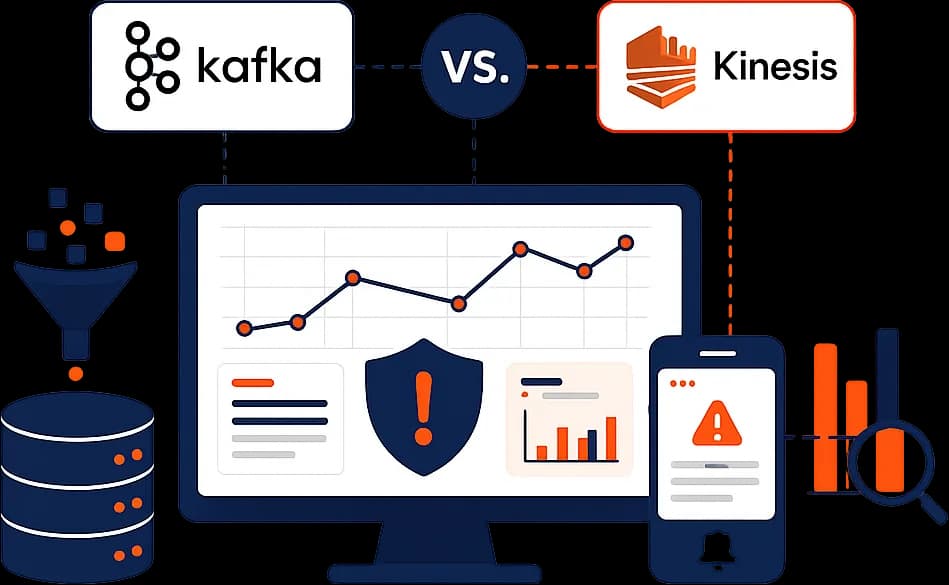
In high-frequency digital finance, the difference between a blocked fraudulent transaction and a total loss is measured in milliseconds. By the time a traditional batch process identifies an anomaly, the capital has often been moved across three different jurisdictions.
To build a robust fraud detection system in 2026, you need a streaming backbone that can ingest millions of events per second with sub-millisecond latency. The two primary contenders for this role are Apache Kafka and AWS Kinesis.
While both serve as the "central nervous system" for your data, they offer vastly different trade-offs in operational overhead, throughput limits, and ecosystem flexibility. At OpenMalo Technologies, we've helped enterprises across the US, India, and Dubai navigate these choices to build hardened, production-ready AI agents. This guide breaks down which platform wins the fraud detection race for your specific architecture.
1. The Architecture of a Fraud Detection Pipeline
Before choosing a tool, we must understand the job. A 2026-standard fraud detection system typically follows this flow:
- Ingestion: Capturing credit card swipes, login attempts, or API calls.
- Stream Processing: Comparing the current event against historical patterns (e.g., "Has this user ever logged in from this device?").
- Inference: Routing the event through an AI model (like a Random Forest or Neural Network) to generate a "Fraud Score."
- Action: Blocking the transaction or triggering an immediate MFA request.
For this to work, your message broker (Kafka or Kinesis) must be durable enough to never lose a transaction and fast enough to keep the user from waiting at the checkout counter.
2. Apache Kafka: The High-Performance Thoroughbred
Apache Kafka is the industry standard for low-latency, high-throughput messaging. It is an open-source distributed event store that excels at handling massive volumes of data with extreme efficiency.
Why Use Kafka for Fraud Detection?
- Unmatched Latency: A well-tuned Kafka cluster can achieve sub-10ms end-to-end latency. In fraud detection, every millisecond saved in the broker is another millisecond available for your AI model to perform deeper analysis.
- Complex Ecosystem: With Kafka Streams and ksqlDB, you can perform stateful processing (like calculating rolling averages of spending) directly on the stream.
- No Vendor Lock-in: Kafka runs on-premise, in any cloud, or via managed providers like Confluent or Amazon MSK. This portability is vital for enterprises with multi-cloud strategies.
The Downside: Kafka is notoriously complex. Unless you use a managed service, you need a dedicated engineering team to handle partition rebalancing, broker tuning, and cluster upgrades.
3. AWS Kinesis: The Managed Workhorse
AWS Kinesis Data Streams is Amazon's fully managed alternative. It is built for teams that want to focus on business logic rather than infrastructure management.
Why Use Kinesis for Fraud Detection?
- Zero Infrastructure Management: There are no servers to provision. You define your capacity in "shards," and AWS handles the underlying scaling.
- Seamless AWS Integration: Kinesis connects natively with AWS Lambda (perfect for serverless fraud scoring) and Amazon SageMaker for real-time AI inference.
- Security by Default: It inherits AWS-grade security, including IAM roles, KMS encryption, and VPC endpoints, making compliance audits significantly easier.
The Downside: Kinesis typically has higher propagation delay than Kafka. While "Enhanced Fan-out" can reduce this, the base polling mechanism can introduce latencies of 200ms or more—a lifetime in high-stakes finance.
4. The Latency War: When Milliseconds Matter
In fraud detection, we focus on the "Critical Path." This is the window between the user clicking "Pay" and the merchant receiving approval.
- Kafka wins on raw speed. Its "zero-copy" architecture allows it to move data directly from the disk buffer to the network socket, making it the preferred choice for high-frequency banking and stock exchanges.
- Kinesis is "fast enough" for 90% of retail use cases, but for high-stakes fraud prevention, the overhead of the AWS API can introduce delays that result in a degraded user experience or missed detection windows.
5. Scaling Under Pressure: Handling Black Friday Spikes
Fraud patterns change during high-traffic events like Black Friday. Your infrastructure must scale instantly to handle 10x the normal load without dropping a single event.
Scaling Kafka: Requires adding new brokers and rebalancing partitions. While the new KRaft mode (replacing ZooKeeper in 2026) has made this faster, it still requires deliberate engineering effort.
Scaling Kinesis: Scaling is a simple slider in the AWS Console. However, Kinesis has strict hard limits per shard (1MB/sec write). If your data spikes unexpectedly, you may face "ProvisionedThroughputExceeded" errors unless you use "On-Demand" mode, which can be expensive.
6. Cost Comparison: Total Cost of Ownership (TCO)
The "sticker price" of Kinesis is often lower, but the Total Cost of Ownership tells a different story.
- Small to Mid-Scale: Kinesis is often cheaper because you don't need to hire a specialized Kafka administrator.
- Enterprise Scale: Once you cross a certain throughput threshold (e.g., 500+ MB/sec), Kinesis's per-shard and per-payload pricing becomes exorbitant. At this scale, a self-managed Kafka cluster or Amazon MSK often results in 40–60% savings.
Key Takeaways
- Choose Kafka if: You need the absolute lowest latency, require multi-cloud portability, or are dealing with extreme data volumes.
- Choose Kinesis if: You are already an AWS-native shop, have a moderate throughput, and want to minimize operational overhead.
- Hybrid is an Option: Many OpenMalo clients use Amazon MSK to get Kafka's performance with Kinesis-like management.
- Data Retention: Kafka allows for practically unlimited retention (via tiered storage), which is vital for re-training your fraud models on historical data.
Conclusion
The choice between Kafka and Kinesis isn't about which tool is "better," but which one fits your Operational Maturity. For a startup in Dubai or India looking to launch a secure digital wallet quickly, Kinesis provides the fastest path to market. However, for established financial institutions hardening their infrastructure for global scale, the control and performance of Kafka are indispensable.
At OpenMalo Technologies, we don't just build pipelines; we build resilient digital foundations. Whether you need to migrate from Kinesis to Kafka or optimize your existing streaming architecture, our team ensures your fraud detection is both lightning-fast and bulletproof.
Building a real-time AI agent for financial security? At OpenMalo Technologies, we specialize in architecting high-performance streaming pipelines that scale with your ambitions. Schedule a Strategy Session with our Data Engineers.