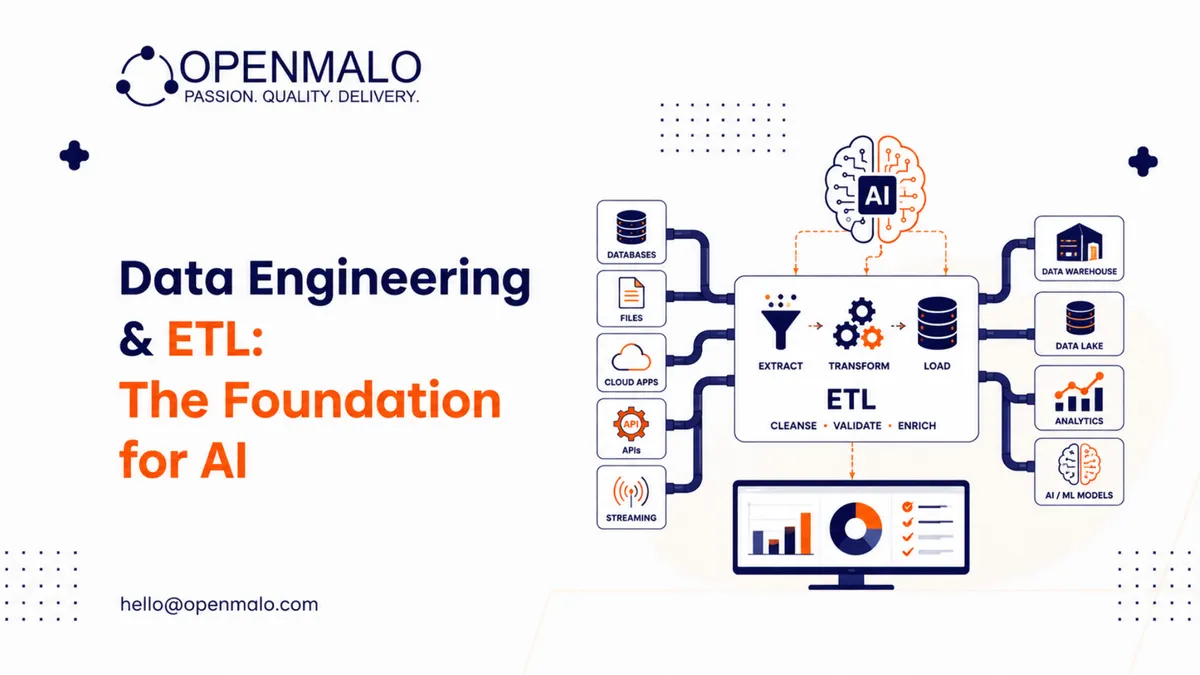
TL;DR: Data engineering creates the infrastructure that moves, cleans and organizes your data so it's usable by analytics and AI. ETL (extract, transform, load) and data integration unify data from your CRMs, ERPs, databases and SaaS tools into a query-ready form. Without this foundation, even the best AI model produces poor results.
Data engineering builds the pipelines, warehouses and lakehouses that feed analytics and AI. Reliable AI depends on clean, well-modeled, accessible data — so for most AI projects, data engineering is a prerequisite, not an afterthought. ETL and data integration are the backbone that makes it all work.
This is the pillar for our cloud and operations posts: DevOps, cloud migration, cloud cost optimization, MLOps and cloud maintenance.
What is data engineering and do you need it for AI?
Data engineering builds the pipelines, warehouses and lakehouses that feed analytics and AI. The honest truth: most stalled AI projects fail on data, not models. If your data is scattered, dirty or inaccessible, even a great model produces poor results — so for the majority of AI projects, data engineering is a prerequisite, not an afterthought. This is exactly what an AI readiness assessment checks first.
What is data integration / ETL?
Data integration and ETL move and transform data between systems — CRMs, ERPs, databases, SaaS tools — into a unified, query-ready form. ETL stands for extract (pull data from sources), transform (clean and reshape it), and load (store it where it can be used). It's the backbone of analytics, reporting and AI features, because it turns scattered, inconsistent data into something a model or dashboard can actually rely on.
Why "garbage in, garbage out" rules AI
An AI model is only as good as the data it sees. Inconsistent formats, duplicates, missing fields and stale records all degrade output — and the model can't tell you the data was bad, it just answers worse. Investing in clean, well-modeled data is usually the highest-leverage thing you can do for AI quality.
What does a data foundation for AI include?
- Pipelines — reliable, automated movement of data from source to destination.
- Warehouse / lakehouse — a central, query-ready store for analytics and AI.
- ETL / ELT — extracting, cleaning and reshaping data.
- Data quality — validation, deduplication and monitoring.
- Governance — access, classification and retention. See data governance.
How does the data foundation connect to RAG and AI features?
RAG and other AI features sit on top of this foundation. RAG retrieves from your data, so retrieval quality depends on how well that data is organized, cleaned and kept current. Building AI features without a sound data foundation is like building on sand — it may demo well but won't hold up in production.