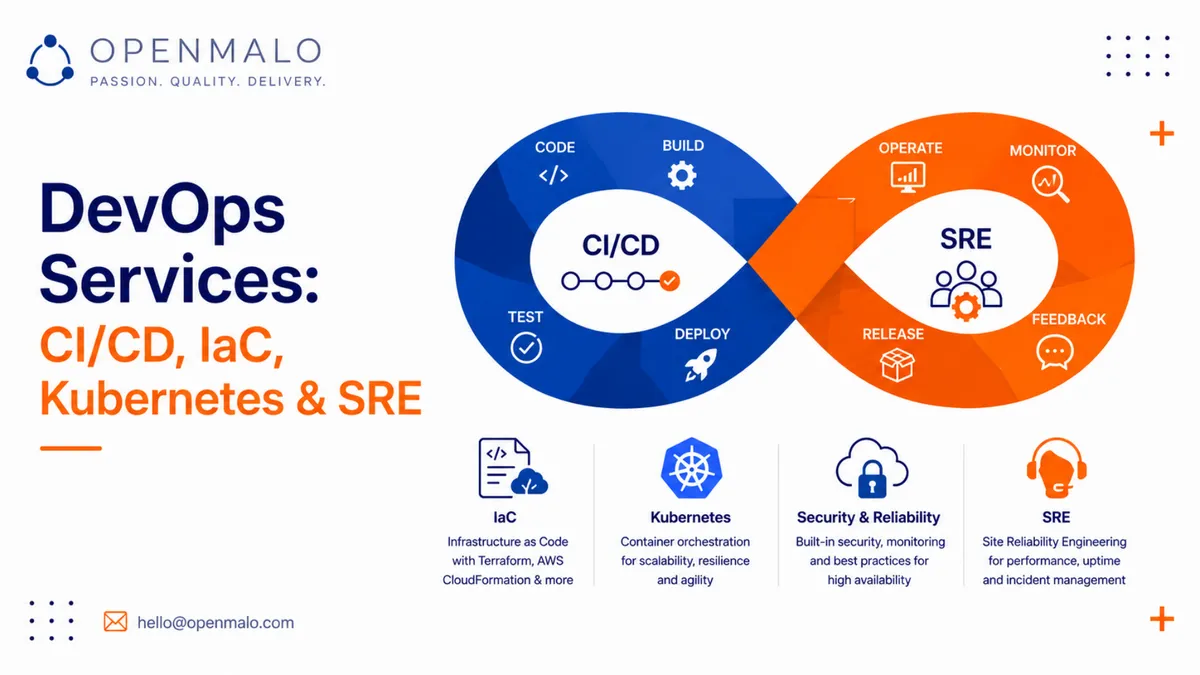
TL;DR: DevOps is the practice and tooling that lets teams release software quickly, safely and repeatably. It automates building, testing and deploying (CI/CD), manages infrastructure as code, runs workloads reliably (Kubernetes, SRE), and monitors everything (observability). The result is more frequent releases with fewer outages.
DevOps services cover CI/CD pipeline engineering, Infrastructure-as-Code (Terraform), Kubernetes, observability and SRE. Together they help teams ship faster without breaking production, using stacks like GitHub Actions, ArgoCD, Datadog and Prometheus.
This post sits under our pillar on data foundations for AI.
What do DevOps services include?
- CI/CD pipeline engineering — automated build, test and deploy on every change.
- Infrastructure-as-Code (IaC) — infrastructure defined in code (Terraform), so it's repeatable and reviewable.
- Kubernetes — running and scaling containerized workloads reliably.
- Observability — metrics, logs and traces so you can see what's happening.
- SRE — site reliability engineering practices for uptime and incident response.
Common tools include GitHub Actions, ArgoCD, Datadog and Prometheus.
How does DevOps help you ship faster without breaking things?
By automating the risky, manual steps. CI/CD runs your tests and quality gates on every change and deploys consistently, so releases are routine rather than scary events. IaC makes environments reproducible, and observability means problems are spotted and fixed fast. The combined effect: teams release often and keep production stable — the two stop being a trade-off.
Why Infrastructure-as-Code matters
When infrastructure is clicked together by hand, it's inconsistent, undocumented and hard to recover. Defining it as code makes it version-controlled, reviewable and reproducible — you can rebuild an environment reliably and see exactly what changed. It's the foundation of dependable deployments.
Who needs DevOps services?
- Teams deploying manually or fearing releases.
- Products that need to scale reliably.
- Organizations adopting Kubernetes or cloud-native architecture.
- AI teams that also need MLOps for model deployment.