TL;DR: CloudNativePG helps keep PostgreSQL highly available. If the main database server fails, CloudNativePG automatically promotes a healthy replica, keeps the application running, and rebuilds the failed node — without anyone needing to manually intervene, and without customers noticing anything went wrong.
Introduction
Most teams don't lose customers because PostgreSQL crashed. They lose them because recovery takes too long.
Every minute of database downtime can mean failed payments, interrupted customer experiences, missed orders, and engineers scrambling to fix production at 3 AM. High availability isn't just an infrastructure concern — it's a business requirement.
This is where CloudNativePG comes in. CloudNativePG is a Kubernetes operator — a tool that manages PostgreSQL deployments natively on Kubernetes. Instead of manually setting up replication, monitoring health, and handling failures yourself, CloudNativePG automates the entire lifecycle of your PostgreSQL cluster: provisioning, replication, failover, backups, and recovery.
In this post, we'll walk through how CloudNativePG handles failover — what happens when the main database server fails, how a replica takes over, and what that actually means for the business — using a simple demo setup.
At OpenMalo Technologies, we work with teams running production PostgreSQL workloads on Kubernetes, helping them move beyond "it works on my cluster" toward infrastructure that holds up under real-world failure conditions. The walkthrough below reflects how we approach failover in production, not just in theory.
What This Demo Shows
For this walkthrough, we set up a small cluster to demonstrate failover in action:
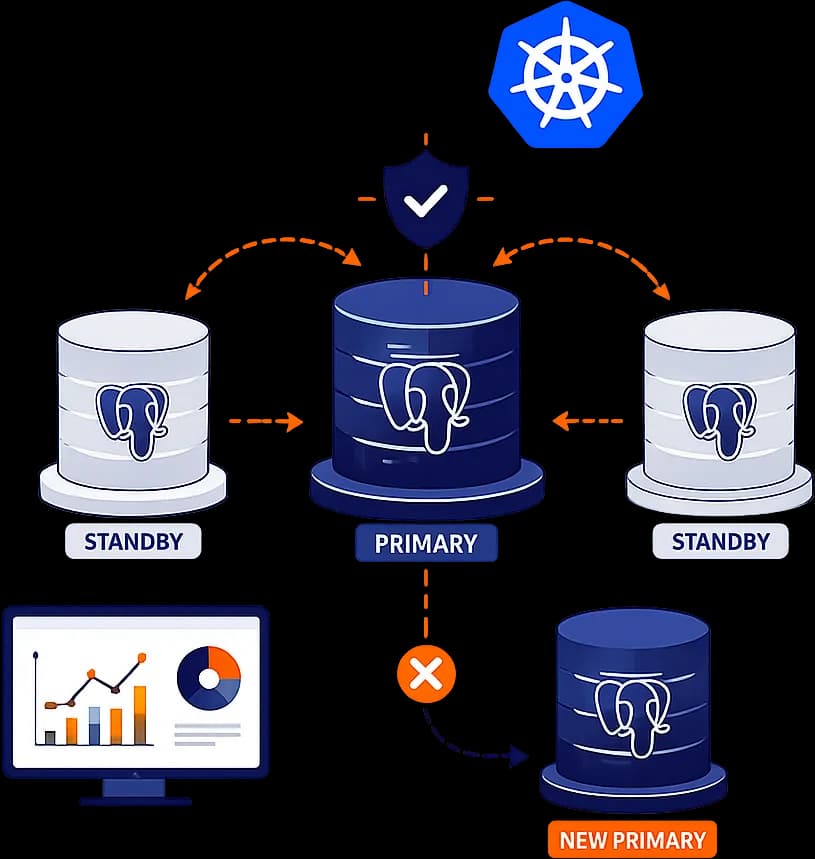
- 1 Primary PostgreSQL node
- 2 Replica nodes
- Automatic failover
- Self-healing recovery
- Minimal downtime
Demo Flow
Here's what happens, step by step, when a primary node fails:
- The primary database is running normally, handling all read and write traffic.
- The primary node is intentionally stopped (simulating a crash or node failure).
- CloudNativePG's monitoring detects the failure within seconds — no engineer needs to be watching a dashboard at 3 AM for this to work.
- A healthy replica is automatically promoted to primary.
- Applications continue using the same endpoint, so users keep placing orders, making payments, and accessing the product without ever knowing a failover happened.
- The failed node is rebuilt in the background and rejoins the cluster as a replica, ready for the next failure.
The result: the business keeps running while the infrastructure heals itself.
Why It Matters
Every minute your primary database is unavailable can impact revenue, customer trust, and team productivity.
Without automated failover, a database outage means someone has to manually step in — get paged, diagnose the problem, promote a replica by hand, and reconfigure connections. Depending on how quickly your team responds, that downtime can stretch from minutes to hours. And it almost always happens at the worst possible time.
With CloudNativePG, recovery happens automatically:
| Technical capability | Business outcome |
|---|---|
| Automatic failover | Less downtime means less revenue loss |
| Replica promotion | Customers don't notice an outage |
| Self-healing recovery | Engineers spend less time firefighting |
| Kubernetes-native automation | Lower operational overhead and easier scaling |
| High availability | Better SLAs and stronger customer trust |
Automation removes the delays of manual recovery, helping businesses meet uptime commitments while reducing operational costs.
Important Note: Failover Is Not Backup
This is one of the most common misunderstandings we see teams run into — failover and backup solve different problems.
Failover protects against:
- Database crashes
- Pod failures
- Node failures
Failover does not protect against:
- Accidental deletes
- Data corruption
- Ransomware
- Region-wide disasters
If someone runs a bad DELETE query, failover won't save you — the replica will faithfully copy that mistake too. For complete protection, backups and Point-in-Time Recovery (PITR) need to be part of the strategy too — otherwise high availability gives a false sense of security.
Production Best Practices
Running this kind of setup reliably in production takes more than just enabling failover. Some practices we recommend:
- Run at least 3 database instances (a 2-node setup can't safely determine which node is "correct" during a split)
- Enable automated backups
- Monitor replication lag closely
- Use connection pooling
- Test failover regularly — don't assume it works just because it's configured
- Deploy across multiple nodes or availability zones
Skipping any of these doesn't just create technical risk — it creates business risk that usually surfaces at the worst possible moment.
Beyond High Availability: Why Businesses Invest in It
High availability isn't just about avoiding outages. It's about reducing business risk.
- Protect customer experience during infrastructure failures
- Reduce costly production incidents and late-night firefighting
- Meet uptime commitments and SLA targets
- Free engineering teams to build products instead of managing emergencies
- Scale confidently as traffic and business grow
Key Takeaway
CloudNativePG automatically handles PostgreSQL failover, promotes healthy replicas, rebuilds failed nodes, and helps keep applications online with minimal downtime. But failover alone isn't a complete strategy — pairing it with solid backup practices, monitoring, and multi-zone deployment is what makes a setup truly production-ready, and what actually protects the business when failures happen.
Need Help Setting This Up?
Getting failover working in a demo is one thing. Getting it production-ready is another.
We work with teams that are moving beyond "it works on my cluster" toward production-ready infrastructure. That means designing resilient PostgreSQL deployments, validating failover under real-world conditions, implementing backup and recovery strategies, and building systems that stay available when failures inevitably happen.
If you'd like help building infrastructure that protects your customers, your SLAs, and your team's sleep schedule, OpenMalo Technologies can help. Get in touch to talk about your infrastructure.