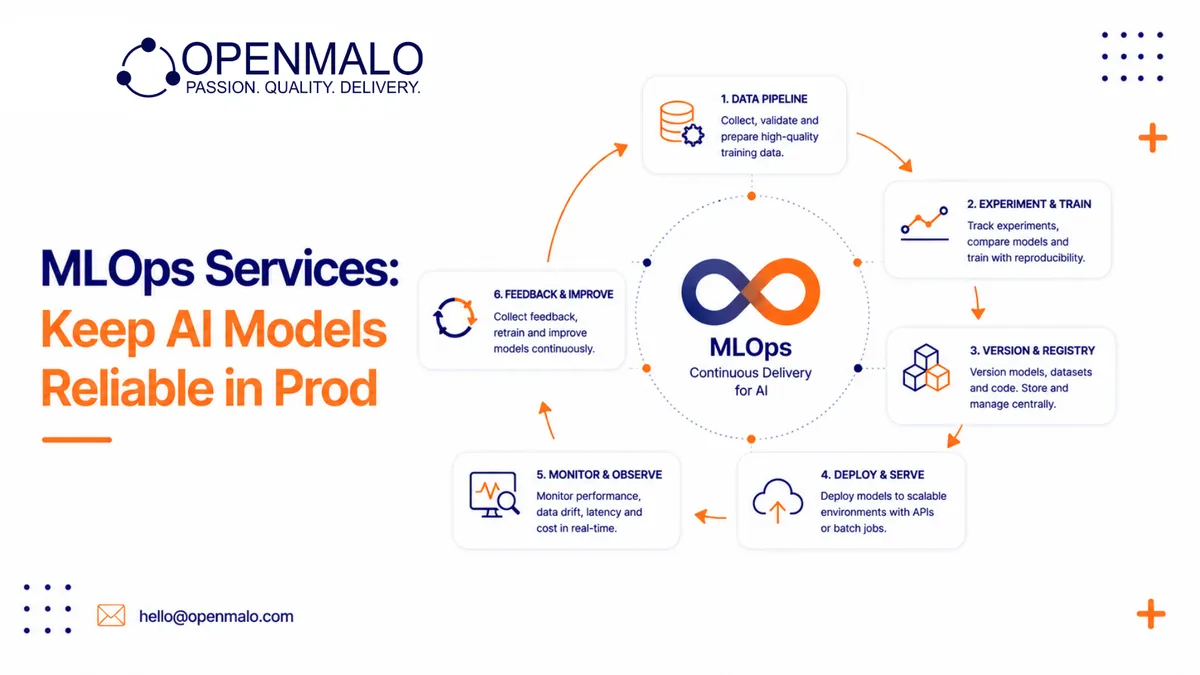
TL;DR: MLOps is DevOps for machine learning. It manages the model lifecycle in production: deploying models reliably, versioning them, retraining as data changes, and monitoring for drift (when a model's accuracy quietly degrades). Without MLOps, models decay silently after launch; with it, they stay accurate and trustworthy.
MLOps services productionize machine-learning models — CI/CD for models, automated retraining, monitoring for drift, versioning and observability — so models stay reliable after launch. Common tools include MLflow, Kubeflow and modern observability stacks.
This post sits under our pillar on data foundations for AI, and complements DevOps services.
What are MLOps services?
MLOps services productionize machine-learning models — CI/CD for models, automated retraining, monitoring for drift, versioning and observability — so models stay reliable after launch. We use tools like MLflow, Kubeflow and modern observability stacks. In short, MLOps is what keeps a model working after the data scientists move on.
What problem does MLOps solve?
Models don't fail loudly — they drift. The world changes, new data looks different from training data, and accuracy degrades quietly while the system keeps returning confident answers. MLOps catches this through drift monitoring and triggers retraining, while versioning lets you roll back a bad model. It turns "deploy and pray" into a managed, observable lifecycle.
What is model drift?
Drift is when a model's accuracy declines over time because the live data diverges from what it was trained on — new customer behavior, new products, seasonal shifts. Because the model still outputs predictions, drift is invisible without monitoring. Detecting and correcting it is a core reason MLOps exists.
When should a company invest in MLOps rather than ad-hoc model deployment?
Invest in MLOps when:
- A model is in production and matters to the business.
- Data changes over time, so accuracy will drift without retraining.
- You deploy more than one or two models, or update them regularly.
- You need auditability — to know which model version produced which result.
Ad-hoc deployment is fine for a one-off experiment; the moment a model is load-bearing, MLOps pays for itself by preventing silent decay.
What do MLOps services include?
- Model CI/CD — automated, repeatable deployment.
- Versioning — track models, data and experiments (e.g. MLflow).
- Automated retraining — refresh models as data evolves.
- Drift & performance monitoring — catch degradation early.
- Observability — visibility into model behavior in production.