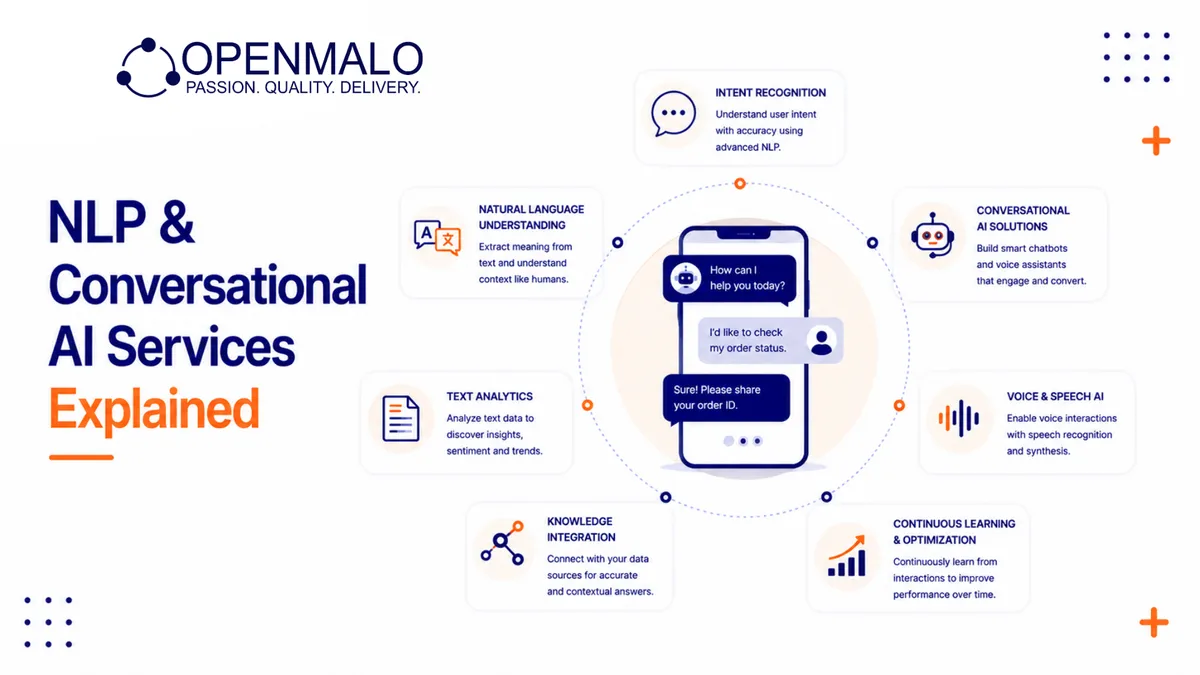
TL;DR: Natural language processing (NLP) is how software understands and generates human language. Conversational AI applies it to dialogue — chatbots and voice agents. Together they enable intent detection, document understanding, search and text analytics, increasingly powered by large language models.
NLP and conversational AI services build systems that understand and generate human language — chat, voice, document understanding and intent detection. They power chatbots, voice agents, search and analytics over unstructured text, turning messy human language into something software can act on.
This post sits under our pillar on adding GPT or Claude to your SaaS.
What are NLP and conversational AI services?
They build systems that work with human language across several capabilities:
- Understanding — intent detection, entity extraction, classification, sentiment.
- Generation — drafting, summarizing and answering.
- Conversation — chat and voice dialogue with memory and context.
- Document understanding — reading and structuring unstructured text. See document intelligence.
Modern NLP is largely LLM-powered, which makes these systems far more capable than the rule-based tools of a few years ago.
Where are NLP and conversational AI used?
- Customer support — chatbots and voice agents that understand and respond.
- Search & knowledge — semantic search and RAG over your content.
- Analytics — sentiment, themes and insights from reviews, tickets and surveys.
- Automation — routing and triage based on understanding text, not keywords.
How is modern NLP different from the old approach?
Older NLP relied on hand-crafted rules and narrow models that broke on anything unexpected. Today's LLM-based NLP generalizes across phrasing, handles nuance and context, and needs far less manual rule-writing — so systems are both more accurate and faster to build. The trade-off is the need for grounding and evaluation to keep them reliable.
How does conversational AI understand intent?
It interprets what a user wants, not just the words they used. An LLM maps varied phrasings ("cancel my plan," "I want out," "how do I stop billing") to the same intent, extracts relevant details (entities), and routes to the right answer or action — far more robustly than keyword matching.