TL;DR: RAG (retrieval-augmented generation) retrieves relevant passages from your data and feeds them to an LLM at answer time, so responses are grounded in your content and can cite sources. It's the most reliable, lowest-risk way to make an LLM useful on private or fast-changing information — usually cheaper and safer than fine-tuning.
RAG development is the practice of connecting a large language model (LLM) to your own data so it answers from your facts instead of its training memory. You need it whenever answers must be accurate, current and citable — support, search, internal knowledge, compliance. Done well, production RAG uses hybrid search, re-ranking, evaluation and citation traceability.
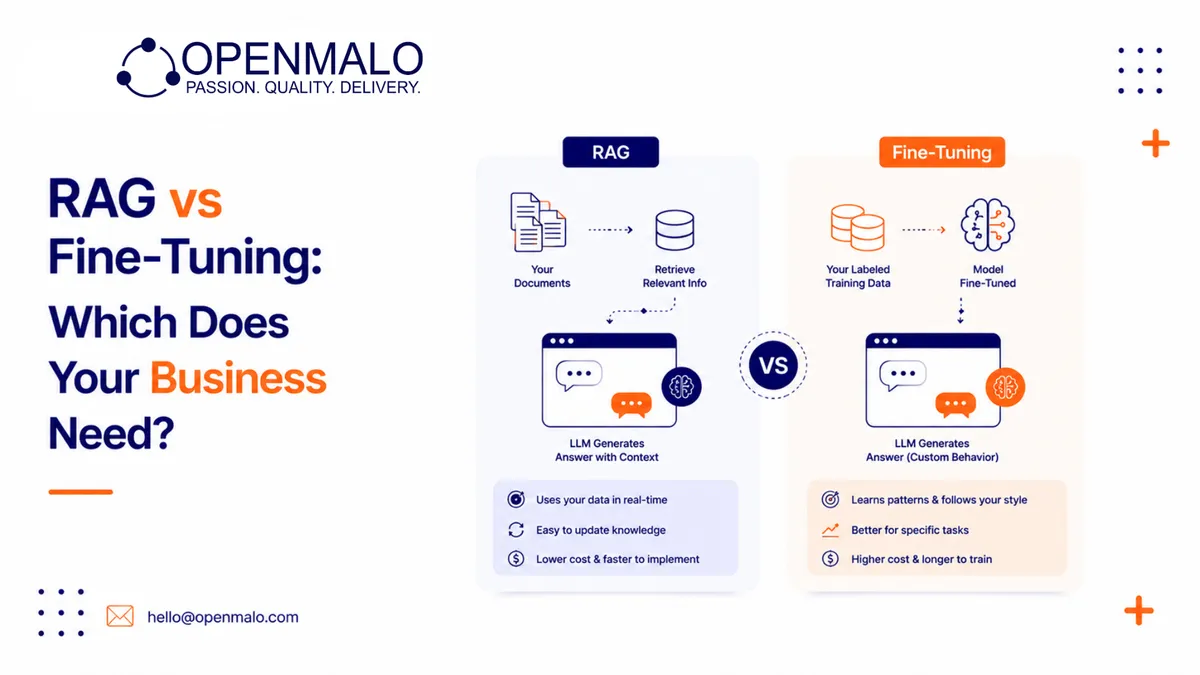
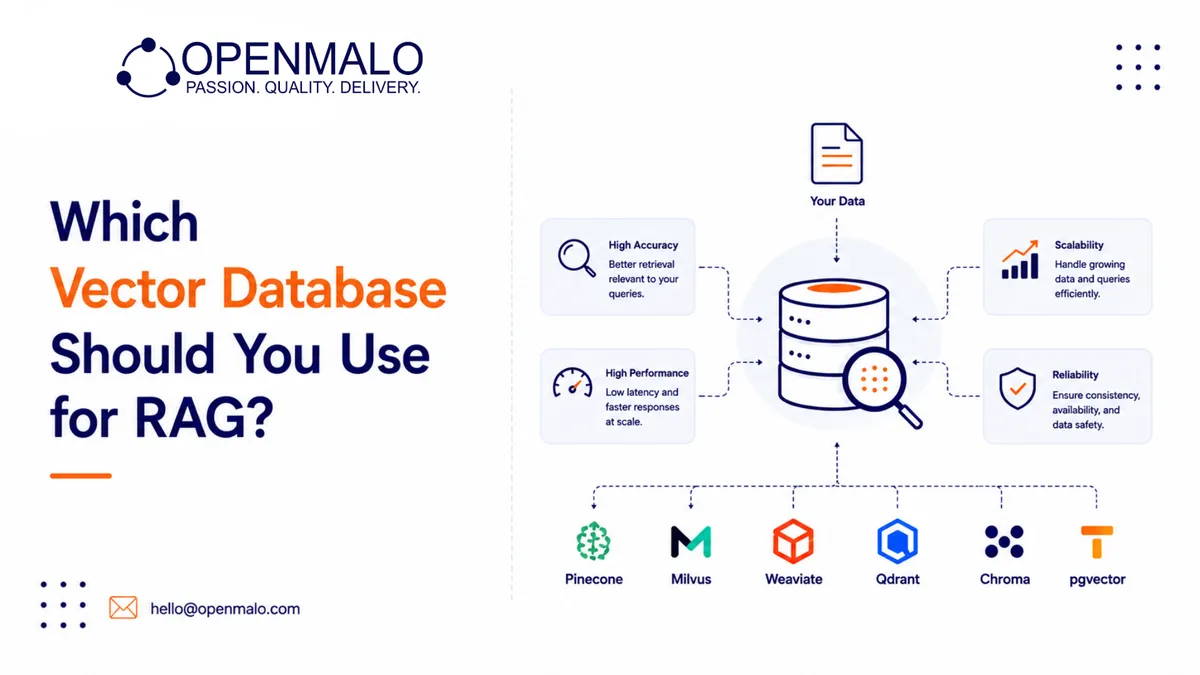
This is the pillar guide for our deeper posts on RAG vs fine-tuning, how much a RAG application costs, and which vector database to use.
What is RAG and why do you need it?
RAG is a technique that retrieves relevant chunks of your data and supplies them to the LLM as context before it answers. The model then generates a response grounded in those passages rather than its general training.
You need RAG when:
- Answers must reflect your documents, products or policies — not the public internet.
- Information changes often (prices, inventory, regulations) and can't wait for retraining.
- You need citations — the ability to show where an answer came from.
- Accuracy and auditability matter, as in financial services, healthcare and legal.
How is RAG different from just using ChatGPT?
A raw LLM answers from what it learned during training, which is frozen and generic. It can't see your internal docs and may "hallucinate" confidently. RAG grounds every answer in retrieved source text, dramatically cutting hallucinations and letting you cite the exact passage used.
How does a production RAG system work?
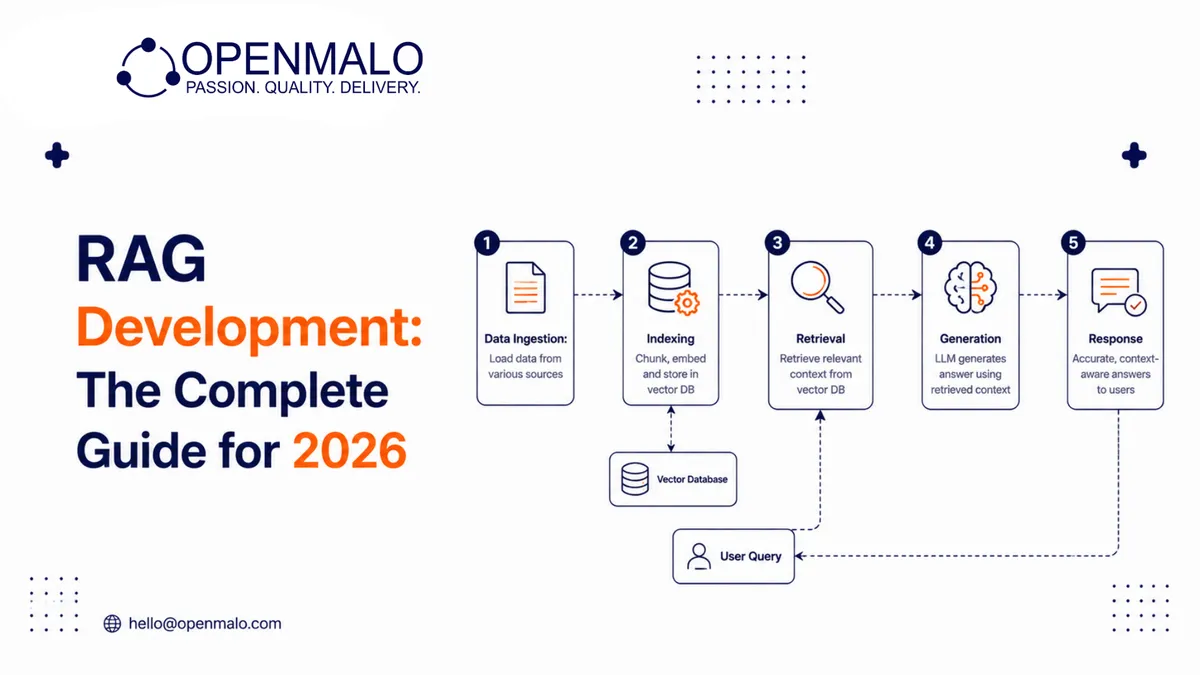
A real RAG pipeline is more than "embed and search." The production-grade flow looks like this:
- Ingestion & chunking — documents are parsed and split into passages sized for retrieval.
- Embedding — each chunk is converted to a vector and stored in a vector database.
- Hybrid search — at query time, combine semantic (vector) search with keyword search for recall.
- Re-ranking — a re-ranker reorders candidates so the most relevant passages reach the model.
- Generation — the LLM answers using the retrieved context, with instructions to cite sources.
- Evaluation & guardrails — automated checks for accuracy, groundedness and safety.
What makes RAG hard in production?
The demo is easy; the last 20% is where projects fail. Common hard parts:
- Retrieval quality — bad chunking or embeddings return irrelevant context, so answers degrade.
- Citation traceability — proving each claim maps to a real source passage.
- Evaluation — measuring groundedness and hallucination rate, not vibes.
- Cost and latency — keeping responses fast and affordable at scale.
What are LLM development services, and how do they relate to RAG?
LLM development services cover building custom large language models, fine-tuning open-source models (Llama, Mistral, Qwen) on your data, evaluating quality, and deploying privately on your cloud. They suit teams needing full data control — financial services, healthcare and government. RAG and fine-tuning are often combined: RAG supplies fresh facts; fine-tuning shapes tone, format and domain behavior. See RAG vs fine-tuning for when to use each.
What is AI model development and training?
AI model development is building and training machine-learning models from your data — from classical ML through deep learning and fine-tuned LLMs — including data prep, training, evaluation and deployment. For most RAG projects you won't train a model from scratch; you'll use a strong foundation model for generation and a smaller embedding model for retrieval, then invest your effort in data quality and evaluation.
How do you deploy RAG securely in a regulated industry?
For regulated data, retrieval and generation can run inside your own perimeter. That means a self-hosted LLM (Llama, Mistral or a fine-tuned variant) plus a private vector store, so no data leaves your environment. Access controls ensure the retriever only surfaces documents a given user is allowed to see — a step naive RAG often skips.