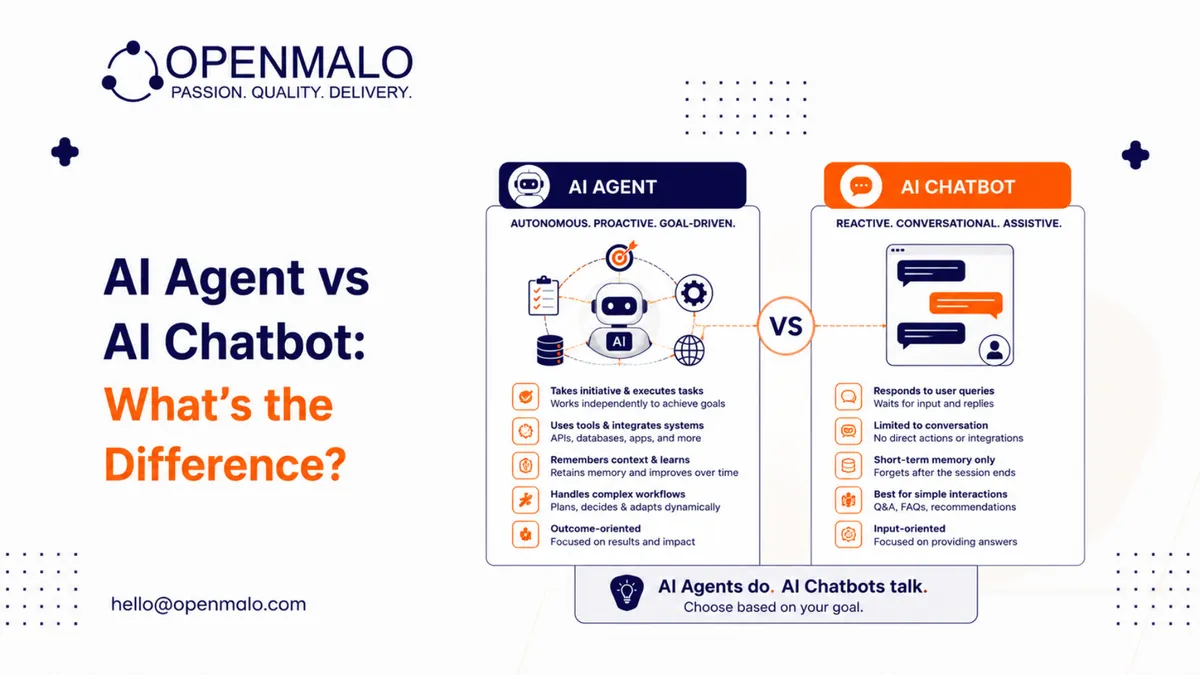
TL;DR: An AI chatbot is a conversational interface that responds with answers. An AI agent is an autonomous system that plans, uses tools, holds memory, and completes multi-step tasks on its own. Many real products combine both — a chat front-end over an agent backend. A voice AI agent is the same idea delivered over a phone call.
A chatbot answers questions in conversation; an AI agent takes action. The chatbot informs — it replies with information. The agent does — it plans multiple steps, calls tools and APIs, and completes a task end to end. The simplest way to remember it: chatbots inform, agents act.
This is the pillar for our deeper posts on AI agent development, AI chatbot development and voice AI development.
How is an AI agent different from a chatbot?
A chatbot maps a question to an answer. An AI agent breaks a goal into steps, decides what to do at each step, calls external tools or APIs to act, and checks its own progress until the task is done.
| AI chatbot | AI agent | |
|---|---|---|
| Job | Answer questions | Complete tasks |
| Behavior | Responds | Plans and acts |
| Tools/APIs | Rarely | Core capability |
| Memory | Often per-session | Across steps and sessions |
| Example | "What's your return policy?" | "Process this return, refund the card, email the customer" |
A concrete example
Ask a chatbot "Can I reschedule my appointment?" and it explains how. Ask an agent the same thing and it checks the calendar, finds an open slot, moves the booking, updates the CRM, and sends a confirmation — without a human in the loop. Same question, very different system.
What is an AI agent, exactly?
An AI agent is an autonomous, LLM-powered system that plans multi-step tasks, calls APIs and tools, holds memory across sessions, and completes workflows end to end. In regulated settings, production agents add audit trails and human-in-the-loop guardrails so they can act safely. We cover how to build them in AI agent development.
What is the difference between an AI agent, a chatbot and a voice AI agent?
All three are conversational AI, but they differ in capability and channel:
- Chatbot — text conversation that answers. Best for support deflection and knowledge.
- AI agent — acts by calling tools and APIs to complete tasks. Best for automation.
- Voice AI agent — an agent (or chatbot) delivered over a phone call using real-time speech. Best for inbound/outbound calls like scheduling and lead qualification. See voice AI development.
The lines blur in practice: a strong product often pairs a chat or voice front-end with an agent backend that can actually get things done.
Which one does your business need?
- Choose a chatbot when the goal is to answer questions accurately — support, FAQs, internal knowledge — grounded with RAG.
- Choose an agent when the goal is to complete work — process orders, reconcile data, run multi-step workflows.
- Choose voice AI when the interaction happens on the phone.
- Choose a combination when users converse naturally but also expect things to actually happen.