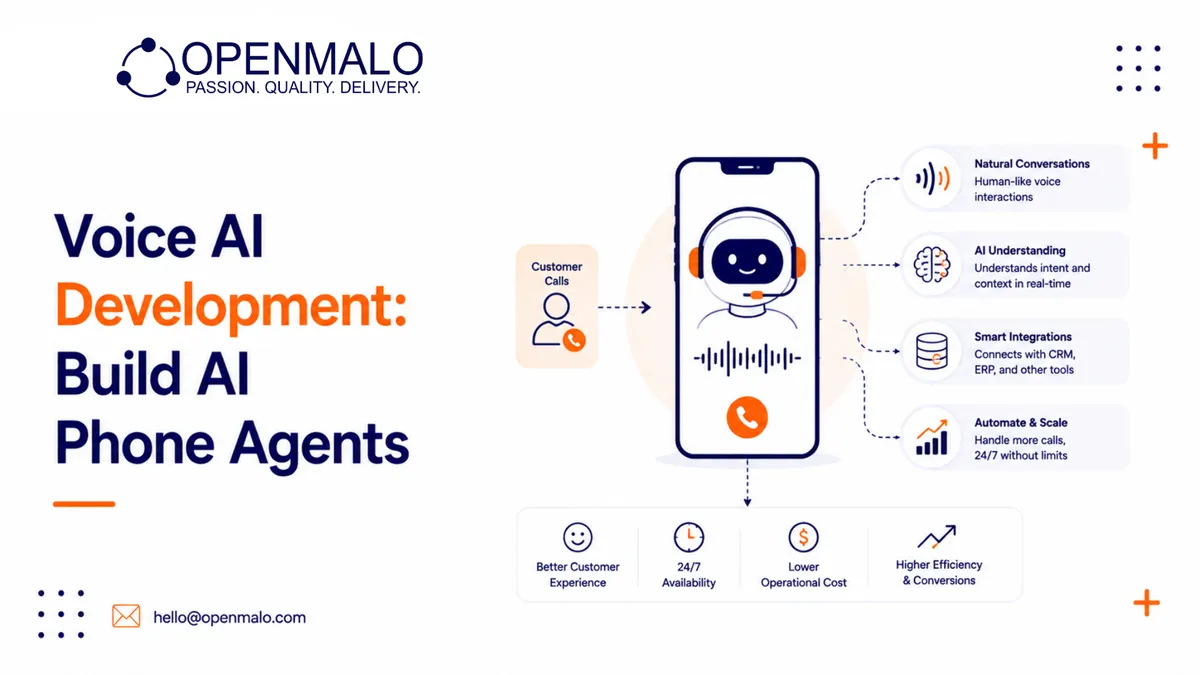
TL;DR: A voice AI agent answers or makes phone calls and holds a natural spoken conversation. It transcribes speech in real time (STT), reasons with an LLM, and replies with lifelike speech (TTS), often calling tools to take action like booking an appointment. It's an AI agent delivered over the phone.
Voice AI development builds conversational voice agents that handle inbound and outbound calls — support, scheduling, lead qualification — using real-time speech-to-text, an LLM "brain," and natural text-to-speech. Modern stacks are built on tools like Vapi, Retell, OpenAI Realtime and Deepgram.
This post sits under our pillar on AI agents vs chatbots.
How does a voice AI agent work?
Three layers run in a tight real-time loop:
- Speech-to-text (STT) — transcribes the caller's words as they speak.
- LLM reasoning — understands intent, decides what to say or do, and can call tools (calendar, CRM).
- Text-to-speech (TTS) — replies in a natural voice with low latency.
The engineering challenge is latency and interruption handling — a voice agent must respond fast and gracefully handle the caller talking over it, or the conversation feels robotic.
What can voice AI agents do?
- Inbound support — answer FAQs, triage, and route or resolve calls 24/7.
- Scheduling — book, reschedule and confirm appointments by voice.
- Lead qualification — call or receive leads, ask qualifying questions, log to CRM.
- Outbound follow-ups — reminders, confirmations and simple surveys.
Because it's an agent under the hood, a voice AI can act — not just talk — by calling the same tools and APIs a text AI agent uses.
What technologies power voice AI?
Production voice agents are commonly built on:
- Vapi / Retell — orchestration platforms for voice agents.
- OpenAI Realtime — low-latency speech-to-speech.
- Deepgram — fast, accurate speech-to-text.
- LLM of choice — for reasoning and tool calls, often grounded with RAG.
The right stack depends on latency targets, languages, call volume and integration needs.
What makes a voice AI agent feel natural?
- Low latency — sub-second responses keep the conversation flowing.
- Barge-in handling — the agent stops talking when the caller interrupts.
- Grounded answers — RAG keeps responses accurate, not invented.
- Graceful escalation — a clean hand-off to a human when needed.