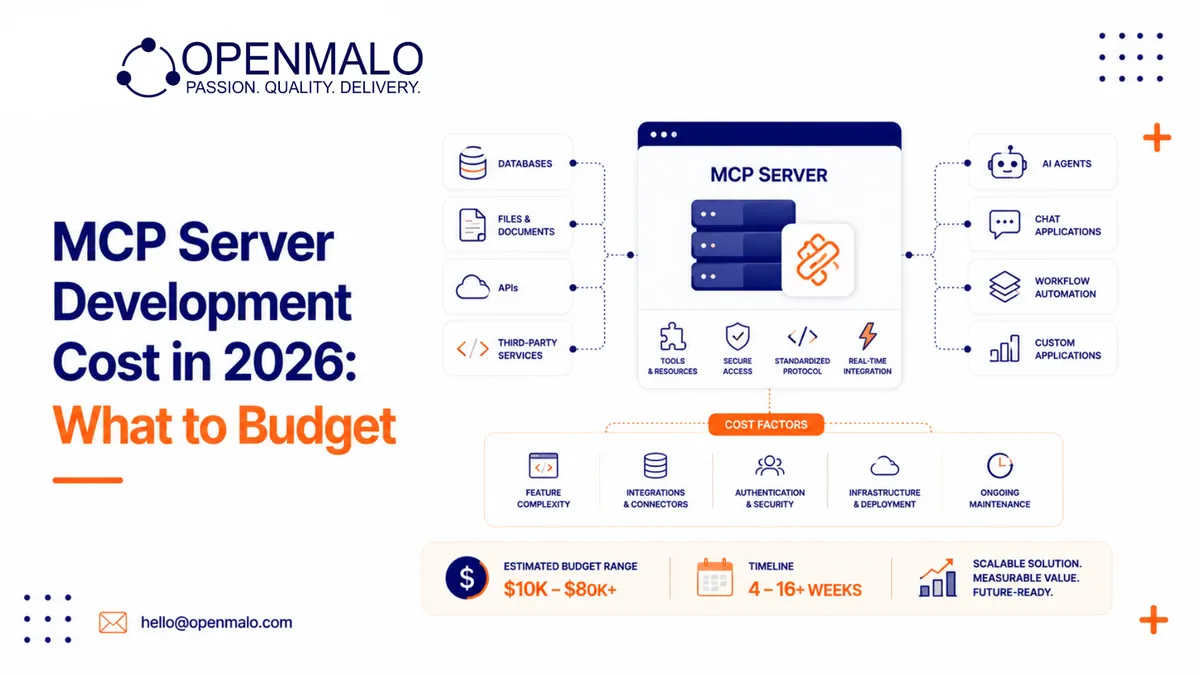
In 2026, AI agent development costs vary widely by scope. A focused single-task agent typically lands in the lower five figures (USD), while a multi-step agent with several tool integrations, memory, and human-in-the-loop controls commonly runs into the higher five or low six figures. The biggest single driver is integration surface — how many systems the agent must read from and act on.
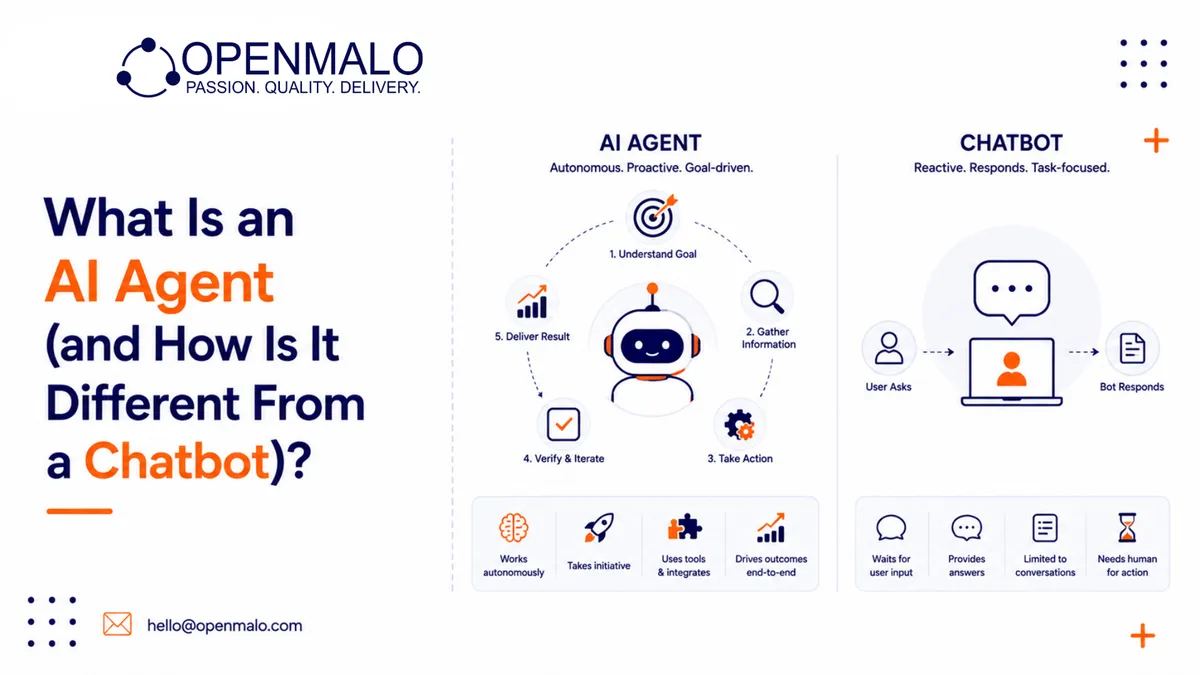
An "AI agent" here means software that uses a language model to plan and take actions — calling tools, querying data, and chaining steps toward a goal — rather than a chatbot that only replies with text. Because agents touch your real systems, the price is driven less by the model and more by everything around it: integrations, data, guardrails, and testing. Every project is scoped individually, so treat the numbers below as market ranges, not quotes.
What drives the cost
Five factors account for most of the variation between a cheap proof-of-concept and a production agent:
- Scope and autonomy. A read-only assistant that answers questions is far cheaper than an agent allowed to take actions (send emails, update records, trigger workflows), which needs approval flows and rollback.
- Integration count. Each external system — CRM, ERP, ticketing, database, third-party API — adds connector work, auth, error handling, and tests. Integrations are usually the largest line item.
- Data and retrieval. If the agent needs your knowledge base, RAG (retrieval-augmented generation) pipelines, embeddings, and data cleanup add cost. Messy or unstructured source data adds more.
- Guardrails and compliance. Industries like finance and healthcare require audit logs, PII handling, and human review steps — real engineering, not a checkbox.
- Model strategy. Using a hosted frontier model is cheaper to build but adds ongoing per-token costs; self-hosting or fine-tuning raises build cost but can lower run cost at scale.
Typical project tiers
Ranges below are general market ranges and vary widely by region, team, and scope:
- Simple — single task, one or two integrations, hosted model, no fine-tuning. Lower five figures (USD).
- Mid — multi-step agent, retrieval over your data, three to five integrations, basic human-in-the-loop. Mid-to-high five figures.
- Complex — multiple agents or a planning layer, many integrations, compliance and audit requirements, evaluation harness, and ongoing tuning. Six figures and up.
Typical phases
Most agent builds follow the same arc, and the cost is spread across it:
- Discovery. Define the task, success metrics, the systems involved, and the failure modes. This is where scope creep is contained.
- Prototype. A thin slice that proves the agent can complete the core task against real (or realistic) data.
- Build. Integrations, retrieval pipelines, guardrails, logging, and the evaluation set that tells you the agent is actually getting better.
- Hardening and launch. Security review, rate limiting, monitoring, and fallback behavior for when the model is wrong.
- Support and tuning. Agents drift as your data and prompts change; budget for ongoing evaluation and adjustment.
Engagement models
How you contract affects the total as much as the scope:
- Fixed scope. Best when the task is well understood. You get a fixed estimate; changes go through change requests.
- Time and materials. Best for exploratory work where the right approach is still being discovered.
- Dedicated team. Best for an ongoing agent program with multiple use cases over time.
What changes the price up or down
Price goes up with: more integrations, real action-taking (not just answers), strict compliance, fine-tuning, low tolerance for errors, and poor-quality source data. Price goes down with: a single clear task, hosted models, clean data, reusing existing connectors, and starting with a narrow prototype before committing to the full build. The cheapest path to a good number is a tight discovery phase.
Ongoing run cost is separate from build cost. Hosted model usage, vector database hosting, and monitoring are recurring; plan for them in your operating budget, not the build.
For a scoped, fixed estimate, see AI Agent Development Services or book a discovery call.