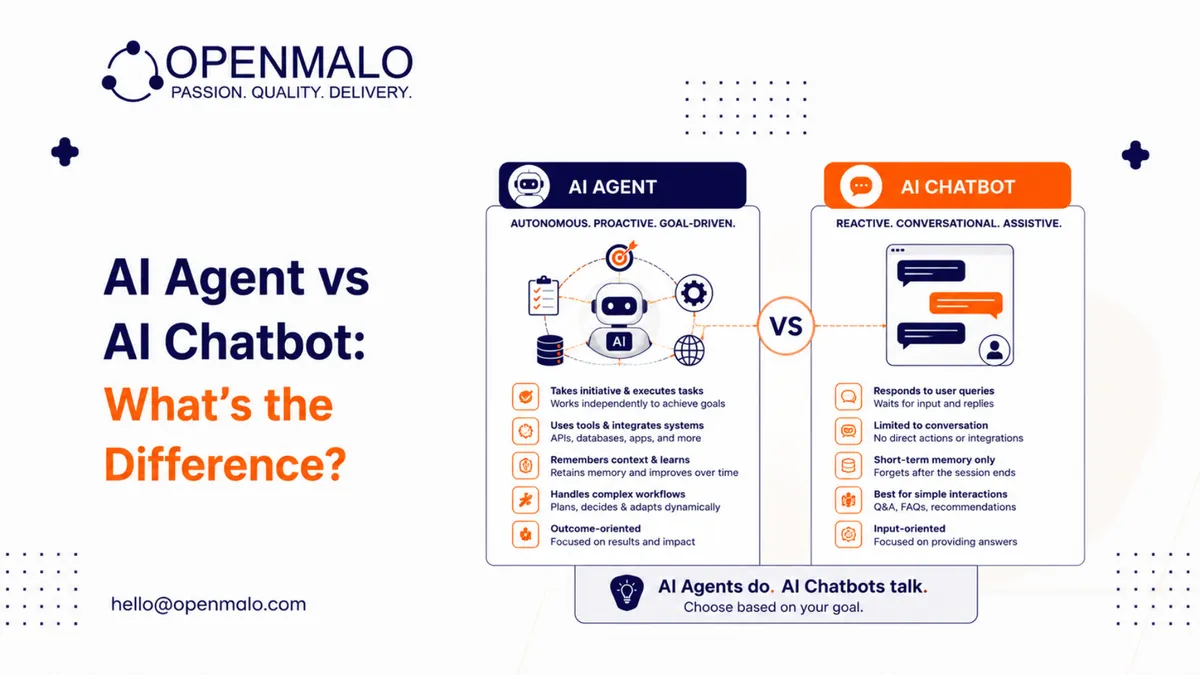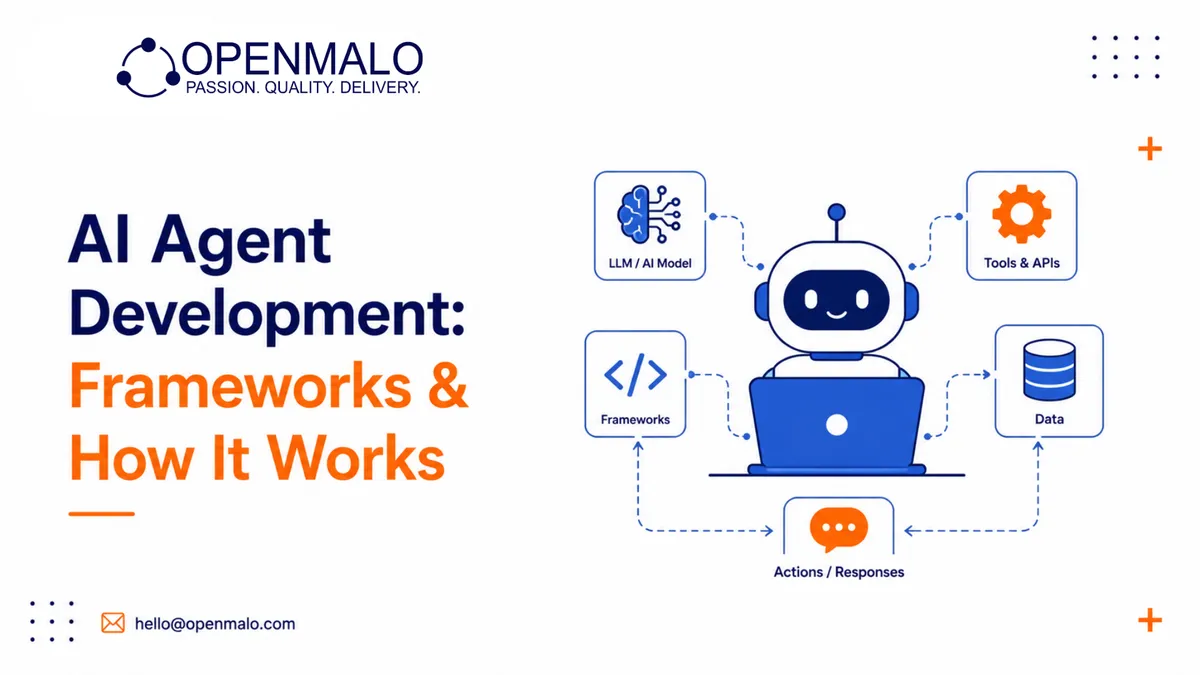
TL;DR: An AI agent uses an LLM as a reasoning engine to plan steps, call tools (APIs, databases, functions), observe results, and keep going until a task is done. Building one for production means choosing the right framework, defining safe tool access, adding evaluation and observability, and putting a human in the loop where the stakes are high.
AI agent development builds autonomous, LLM-powered systems that plan multi-step tasks, call APIs and tools, hold memory across sessions, and complete workflows end to end. In production — especially in regulated industries — agents add audit trails and human-in-the-loop guardrails so they can act safely.
This post sits under our pillar on AI agents vs chatbots.
What is AI agent development?
It's engineering a system where the LLM doesn't just answer — it decides what to do. The agent receives a goal, plans an approach, calls tools to act, reads the results, and iterates until the goal is met. The hard engineering is everything around the model: tool definitions, memory, error handling, guardrails and evaluation.
How do AI agents safely call external tools and APIs in production?
Letting an LLM call real APIs is powerful and risky, so production agents constrain it:
- Scoped tools — each tool has a strict, validated interface; the agent can't call anything it wasn't given.
- Permissions & least privilege — the agent acts with the minimum access needed, per user.
- Validation & confirmation — high-impact actions (payments, deletions) require checks or human approval.
- Audit trails — every tool call is logged for review and compliance.
- Human-in-the-loop — a person approves or can interrupt sensitive steps.
- Evaluation & observability — agents are tested and monitored so failures are caught early.
Why guardrails matter
An agent without guardrails is an unpredictable system with access to your tools. The engineering that makes agents trustworthy — validation, permissions, audit, human checkpoints — is exactly what separates a production agent from a demo. This matters most in regulated industries.
What frameworks are used for AI agents?
The framework choice depends on complexity, control and compliance needs. Common building blocks:
- LangGraph — graph-based control over complex, stateful agent workflows.
- AutoGen — multi-agent collaboration patterns.
- CrewAI — role-based teams of agents.
- Pydantic-AI — type-safe, structured agent outputs.
- Vercel AI SDK — agentic features in web apps.
- Anthropic MCP & OpenAI function calling — standardized tool access.
- Langfuse / Braintrust — evaluation and observability.
No single framework is "best" — the right one depends on how much control and auditability your use case demands.
What can AI agents actually do?
Real production agents handle work like:
- Processing transactions or orders across multiple systems.
- Triaging and resolving support tickets with tool access.
- Running research-and-summarize workflows over internal data.
- Automating back-office tasks — reconciliation, data entry, approvals.
For repetitive, rule-based work, compare with workflow automation and RPA; for question-answering, a RAG chatbot may be the simpler fit.