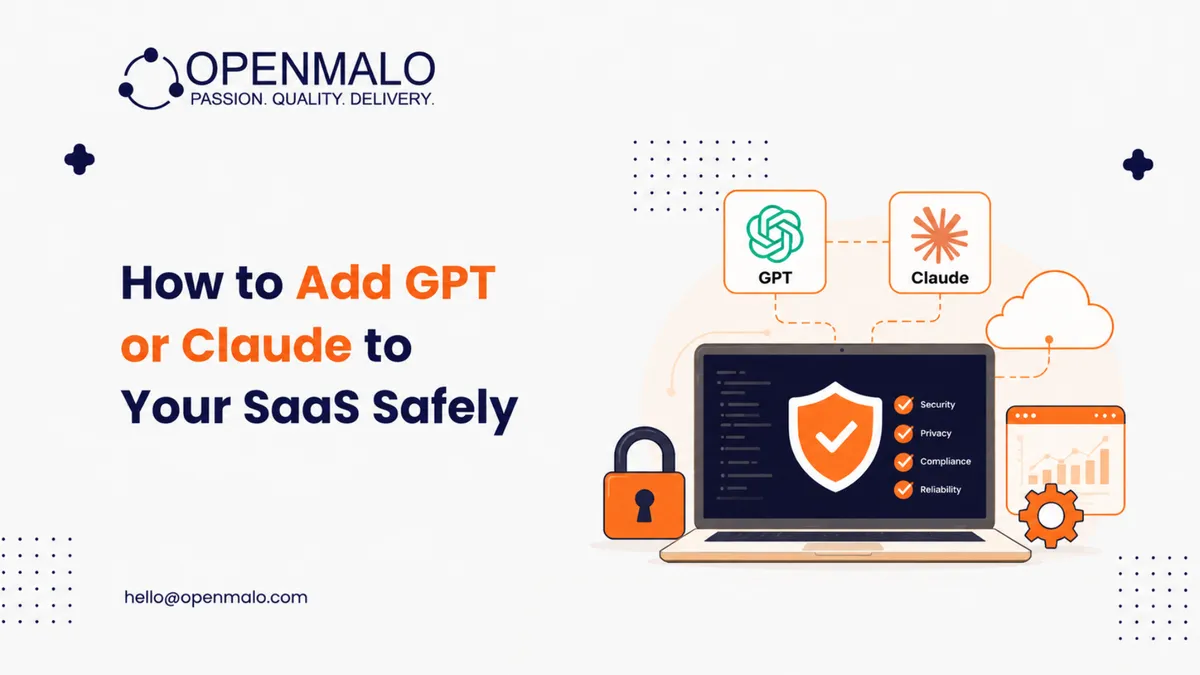
TL;DR: Don't bolt a raw LLM onto your app. Integrate it through an architecture that grounds answers in your data (RAG), enforces guardrails and permissions, controls cost and rate limits, handles failures gracefully, and is evaluated before launch. That's the difference between a feature users trust and a liability.
You add GPT or Claude to your SaaS safely by wrapping the model in guardrails: RAG grounding so it answers from your data, rate limiting and cost controls, fallback handling, and evaluation before launch. Done this way, an LLM improves your product without leaking data or hallucinating.
This is the pillar for our posts on generative AI integration services and NLP & conversational AI.
What does "adding GPT or Claude to your SaaS" actually involve?
It's not a single API call. A safe integration includes:
- RAG grounding — connect the model to your data so it answers from your facts. See RAG development.
- Guardrails — input/output filtering, permission checks, and limits on what the model can do or reveal.
- Rate limiting & cost control — caps and caching so usage doesn't spike your bill.
- Fallback handling — graceful behavior when the model errors, times out or is uncertain.
- Evaluation — measuring accuracy, hallucination and safety before shipping.
- Observability — monitoring quality and cost in production.
How do you stop an LLM from leaking data or hallucinating?
Two problems, two defenses:
- Data leakage: enforce permissions in retrieval (the model only sees what the user may see), avoid sending sensitive data you don't need, and for strict requirements run a self-hosted model so nothing leaves your perimeter.
- Hallucination: ground answers with RAG, instruct the model to cite sources or say "I don't know," and add evaluation to catch regressions before users do.
Why evaluation before launch is non-negotiable
Shipping an LLM feature without evaluation is shipping blind. A small evaluation harness — a set of real questions with known-good answers — tells you the accuracy and hallucination rate before customers find out the hard way, and catches regressions when you change prompts or models.
What is ChatGPT / foundation-model integration?
It's adding an LLM like ChatGPT or Claude to your SaaS safely — with guardrails, RAG grounding, rate limiting, cost control and fallback handling — so it improves your product without leaking data or hallucinating. Integration is via API, with evaluation added before launch. For a broader view of integrating any foundation model, see generative AI integration services.
How do you control LLM cost in production?
- Right-size the model — use a smaller model for simple steps, a large one only when needed.
- Cache — reuse answers to repeated questions.
- Cap usage — per-user and per-tenant rate limits.
- Trim context — send only the retrieved passages that matter, not entire documents.
- Monitor — track cost per feature so you optimize where it counts.