TL;DR: RAG gives an LLM access to your knowledge at answer time — best for facts, documents and fast-changing data. Fine-tuning bakes patterns into the model's weights — best for consistent style, structure or domain language. RAG is cheaper, faster to update and lower-risk, so it's the right first move for the large majority of projects.
For most business use cases, start with RAG. Use retrieval-augmented generation when answers must come from your facts and stay current; use fine-tuning when you need to change how the model writes — tone, format or specialized behavior. They solve different problems, and many production systems use both.
This post sits under our RAG development guide. For budgeting, see RAG application cost.
What's the real difference between RAG and fine-tuning?
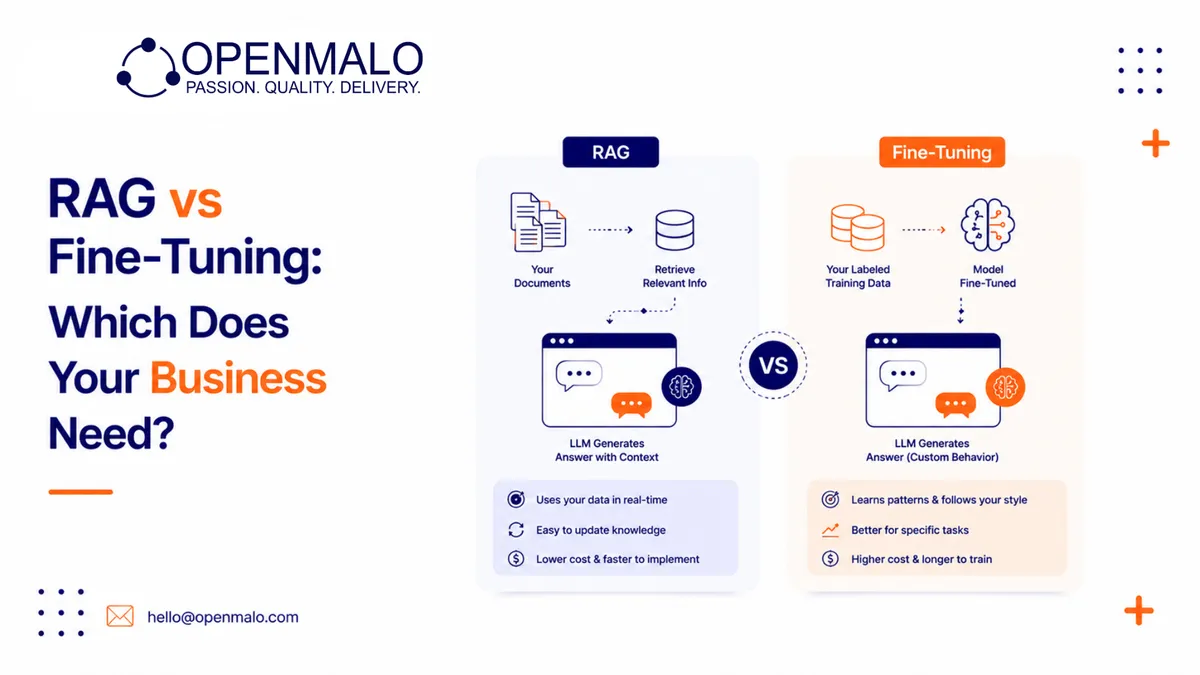
RAG retrieves relevant passages from your data and feeds them to the model as context — the knowledge lives outside the model and is looked up on demand. Fine-tuning retrains the model on examples so new behavior lives inside its weights.
| RAG | Fine-tuning | |
|---|---|---|
| Best for | Facts, documents, current data | Tone, format, specialized behavior |
| Update speed | Instant (change the data) | Slow (retrain) |
| Cost | Lower | Higher |
| Citations | Yes — can show sources | No native citations |
| Hallucination risk | Lower (grounded) | Unchanged on facts |
When should you use RAG?
Choose RAG when:
- Answers must reflect your documents, policies, products or prices.
- Information changes often and can't wait for retraining.
- You need citations and auditability (finance, healthcare, legal).
- You want to launch fast and iterate by updating data, not models.
Why would a business need RAG instead of just fine-tuning an LLM?
Because fine-tuning doesn't reliably teach facts — it teaches patterns. A fine-tuned model can still hallucinate specifics and won't know anything that happened after training. RAG injects the exact, current facts at answer time and can cite them, which is what most "the AI must be accurate" requirements actually need.
When should you use fine-tuning?
Choose fine-tuning when:
- You need a consistent voice or format (e.g. always return structured JSON, or match a brand tone).
- You're working in a specialized domain language the base model handles poorly.
- You want to reduce prompt length by teaching behavior the model would otherwise need instructions for.
- Latency or cost pushes you toward a smaller model that's been specialized for the task.
How do you decide between a custom model and a foundation model?
Default to a strong foundation model (GPT, Claude, Gemini, or open-source Llama/Mistral) and add RAG. Only build or heavily fine-tune a custom model when off-the-shelf options can't meet accuracy, latency, cost or compliance — for example when data can't leave your perimeter and you need a self-hosted LLM. The cost-effective path is usually: foundation model + RAG → add light fine-tuning if needed → custom model only as a last resort.
Can you use RAG and fine-tuning together?
Yes — and sophisticated systems often do. Fine-tune the model to reliably produce the right format and tone, then use RAG to feed it the right facts. The fine-tuning handles "how to answer," RAG handles "what's true right now." This combination gives you both consistency and accuracy.