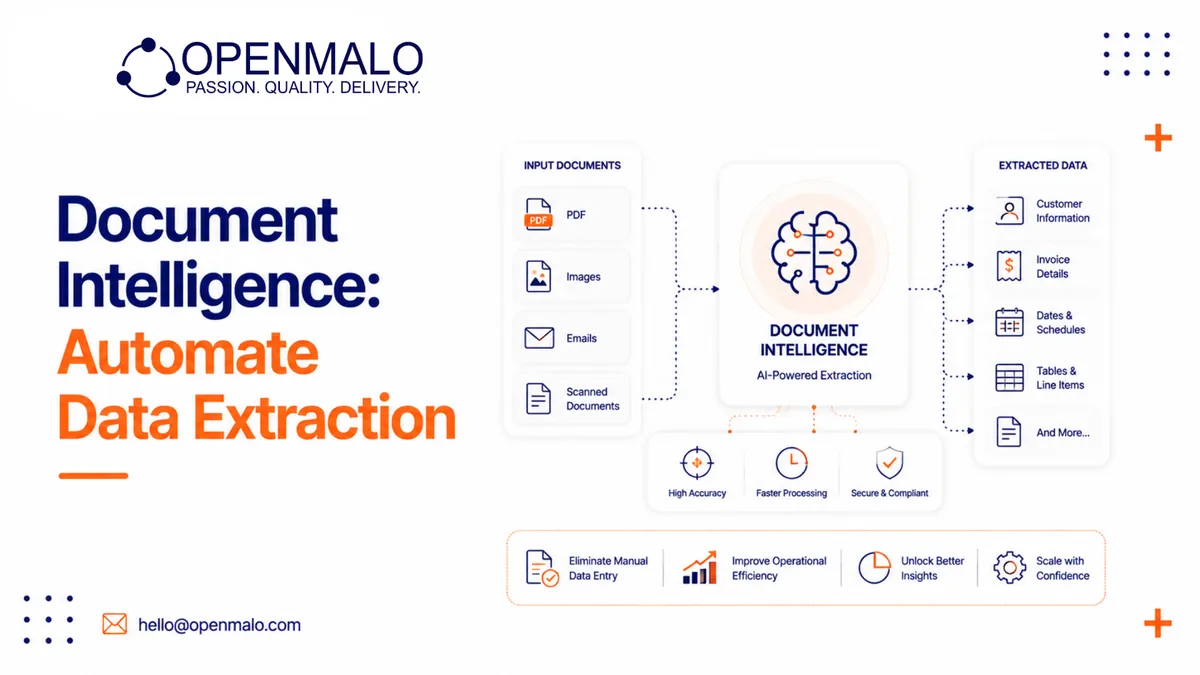
TL;DR: Document intelligence (intelligent document processing) reads documents the way a person would — recognizing the type, finding the relevant fields, and extracting them as structured data. It handles invoices, contracts, claims, forms and records, eliminating manual data entry and feeding the results straight into your workflows.
Document intelligence uses AI to read, classify and extract data from unstructured documents — invoices, contracts, claims, medical records — and route it into your systems. It replaces manual data entry and powers downstream automation, turning piles of paperwork into structured, usable data.
This post sits alongside our AI solution guides like computer vision and workflow automation.
What is document intelligence?
Document intelligence uses AI to read, classify and extract data from unstructured documents — invoices, contracts, claims, medical records — and route it into your systems. It combines OCR (reading text), classification (identifying the document type) and extraction (pulling the right fields), often with an LLM to handle variation and context. The result replaces manual data entry and powers downstream automation.
What types of documents can document intelligence extract and process?
A wide range, including:
- Invoices & receipts — amounts, line items, vendors, dates.
- Contracts — parties, terms, dates, clauses.
- Claims & forms — structured and semi-structured fields.
- Medical records — diagnoses, medications, results (with HIPAA controls).
- IDs & statements — verification and reconciliation.
It handles both clean digital documents and messier scanned ones, where OCR and AI together cope with varied layouts.
Why it beats template-based extraction
Older extraction relied on fixed templates that broke the moment a document's layout changed. AI-based document intelligence understands content and context, so it handles new formats and variation without re-templating for every vendor — which is what makes it practical at real-world scale.
Where does document intelligence deliver value?
- Finance & accounting — invoice and statement processing.
- Insurance — claims intake and adjudication support.
- Legal — contract review and data extraction.
- Healthcare — record digitization and structuring.
- Operations — any high-volume, manual data-entry bottleneck.
The extracted data typically feeds a workflow automation process or your core systems.
How accurate is document intelligence?
Accuracy depends on document quality and use case, and the right design includes confidence scoring and human review for low-confidence cases. Rather than aiming for unrealistic 100% automation, good systems automate the clear majority and route uncertain items to a person — which captures most of the savings while keeping errors in check. A POC measures achievable accuracy on your real documents.