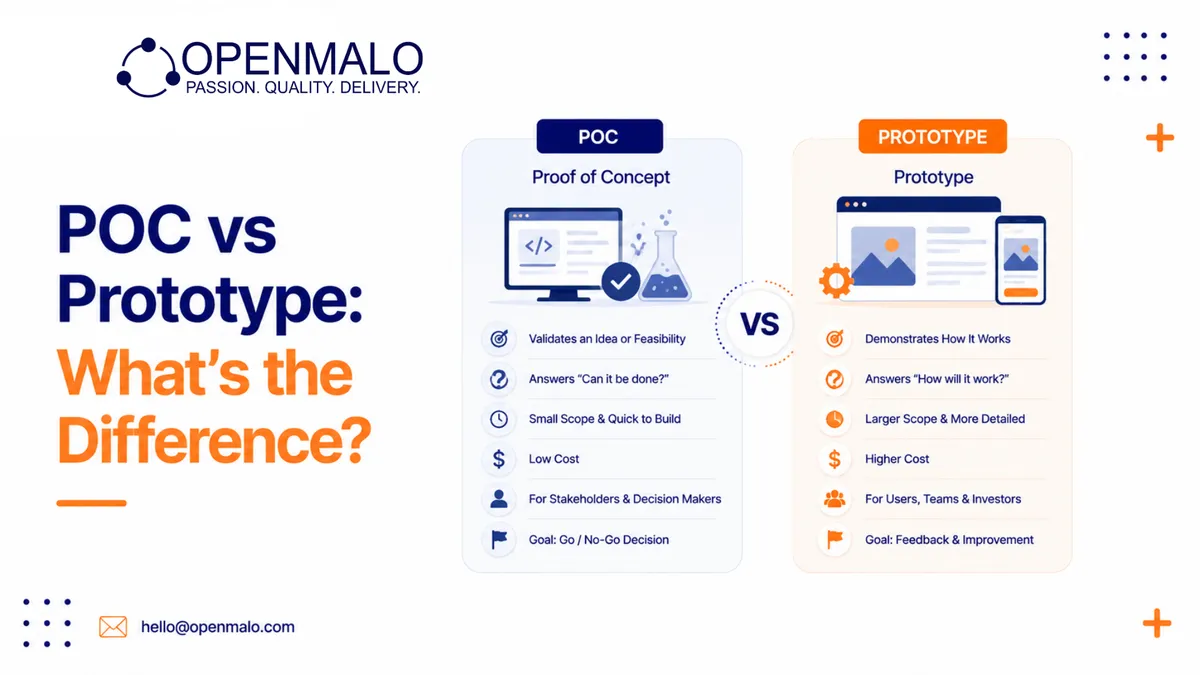
TL;DR: A proof of concept tests technical feasibility — will the AI be accurate enough, can the integration work — on a small scale. A prototype demonstrates the user experience and design. Both de-risk a build before you commit full budget, and for AI projects the POC is usually the critical one.
A POC (proof of concept) validates whether an idea — often an AI capability — is technically feasible and worth investing in, usually in 2–6 weeks. A prototype shows how the product would look and work. A POC answers "can it work?"; a prototype answers "how should it feel?"
This post sits under our pillar on going from idea to a live AI MVP.
What is a POC (proof of concept)?
A POC validates that an idea is technically feasible and worth building — typically in 2–6 weeks. For AI, it answers the make-or-break questions: is the model accurate enough on our data? Is the integration possible? Is it affordable at scale? A POC de-risks the build before you commit to a full product.
What is a prototype?
A prototype demonstrates how the product looks and behaves — the flows, screens and interactions — so stakeholders and users can react to something tangible. It validates desirability and usability rather than technical feasibility. See UX/UI design for where prototypes fit in product design.
POC vs prototype: the key differences
| POC | Prototype | |
|---|---|---|
| Answers | "Can it technically work?" | "How will it look and feel?" |
| Focus | Feasibility, accuracy, cost | UX, flows, design |
| Output | A working slice on real data | An interactive mockup |
| Best for | De-risking AI and integrations | Validating user experience |
| Timeline | 2–6 weeks | Days to a few weeks |
Which do you need first?
For an AI product, lead with a POC — feasibility is the biggest unknown and the most expensive thing to get wrong. For a product where the technology is proven but the experience is uncertain, lead with a prototype. Many teams do a lightweight prototype to align on the experience and a POC to prove the AI, then combine the learnings into the MVP.
How does a POC de-risk an AI project?
It turns "we think this will work" into evidence. By building a focused slice on your real data, a POC measures accuracy and cost, surfaces data problems early, and gives you a firm basis to budget the full build — or to decide not to proceed. That's far cheaper than discovering feasibility issues mid-build.