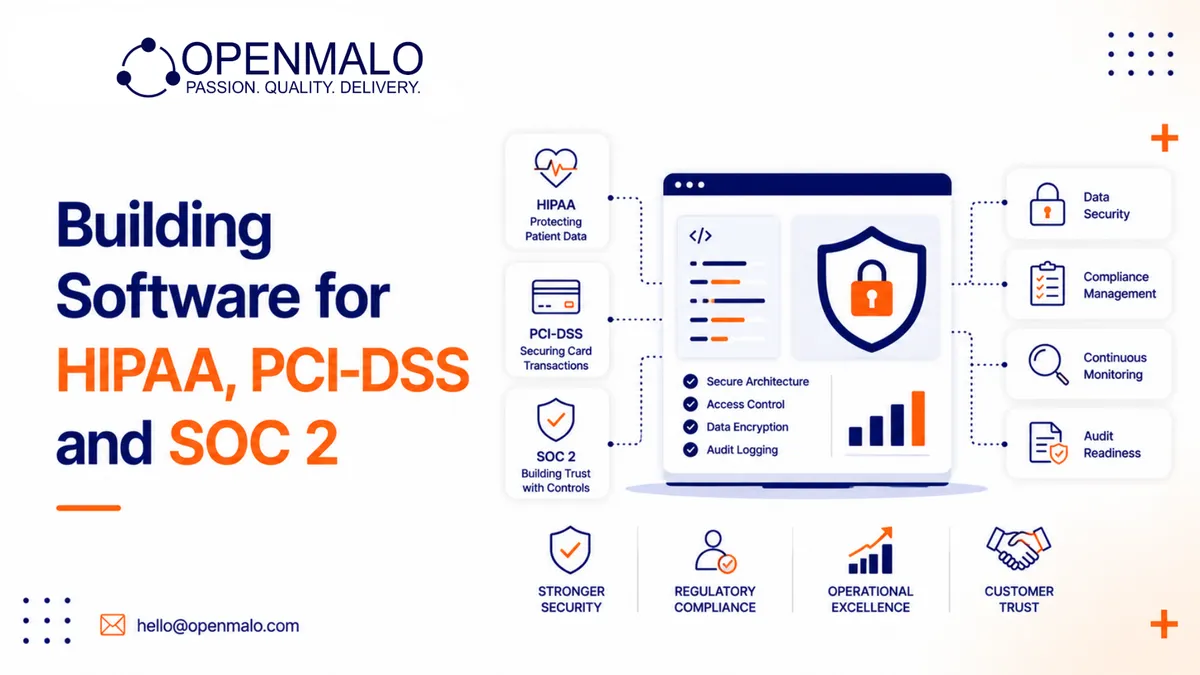
TL;DR: Building "under" HIPAA, PCI-DSS or SOC 2 means engineering the controls each framework requires — encryption, access control, audit trails, secure data handling — into the system from the start. A development partner builds to and aligns with these standards; the formal certification or attestation is issued by qualified auditors, not the developer.
Yes. You can build HIPAA-compliant healthcare software (BAA-ready), PCI-DSS-ready payment platforms, and SOC 2-aligned controls. These are the frameworks software is engineered against — a build partner aligns your system with the standards your industry and auditors require, while formal certification comes from independent assessors.
This post sits under our pillar on self-hosted LLMs in regulated industries. For the consulting side, see compliance management consulting.
What does "building under HIPAA, PCI-DSS and SOC 2" mean?
It means engineering software so it meets the technical and process requirements of each framework:
- HIPAA — protecting health information (PHI) in healthcare software, with a signable BAA. See healthcare software development.
- PCI-DSS — securing payment card data in FinTech and payment platforms.
- SOC 2 — implementing controls for security, availability and confidentiality, common for SaaS.
The work is compliant-by-design: controls built in from the start rather than retrofitted.
What controls do these frameworks require?
Across all three, the engineering centers on:
- Encryption — data protected in transit and at rest.
- Access control — least-privilege, role-based permissions.
- Audit trails — complete logs of who accessed what, when.
- Secure data handling — retention, residency and deletion done correctly.
- Network and infrastructure security — segmentation, hardening, monitoring.
For the strictest cases, sensitive data can stay entirely within your perimeter using a self-hosted LLM and private infrastructure.
What's the difference between "built to" a standard and "certified"?
This distinction matters and a trustworthy partner is explicit about it. A development partner engineers your software to meet a framework's requirements — for example HIPAA-compliant and BAA-ready, PCI-DSS-ready, or SOC 2-aligned. The formal certification, report or attestation (a SOC 2 report, a PCI assessment) is issued by independent qualified auditors and certifying bodies. The developer builds to and aligns with the standards; it does not act as the certifying body.
Why the wording protects you
Overstated claims — saying "certified" when the accurate term is "ready" or "aligned" — create legal and reputational risk for you with customers and regulators. A partner who states this line clearly is protecting the accuracy of the claims you'll make downstream.
Can you sign a BAA for healthcare projects?
Yes — HIPAA-compliant healthcare builds are designed to be BAA-ready, meaning a Business Associate Agreement can be signed to govern the handling of PHI. This is a baseline expectation for any partner handling protected health information. More in healthcare software development.