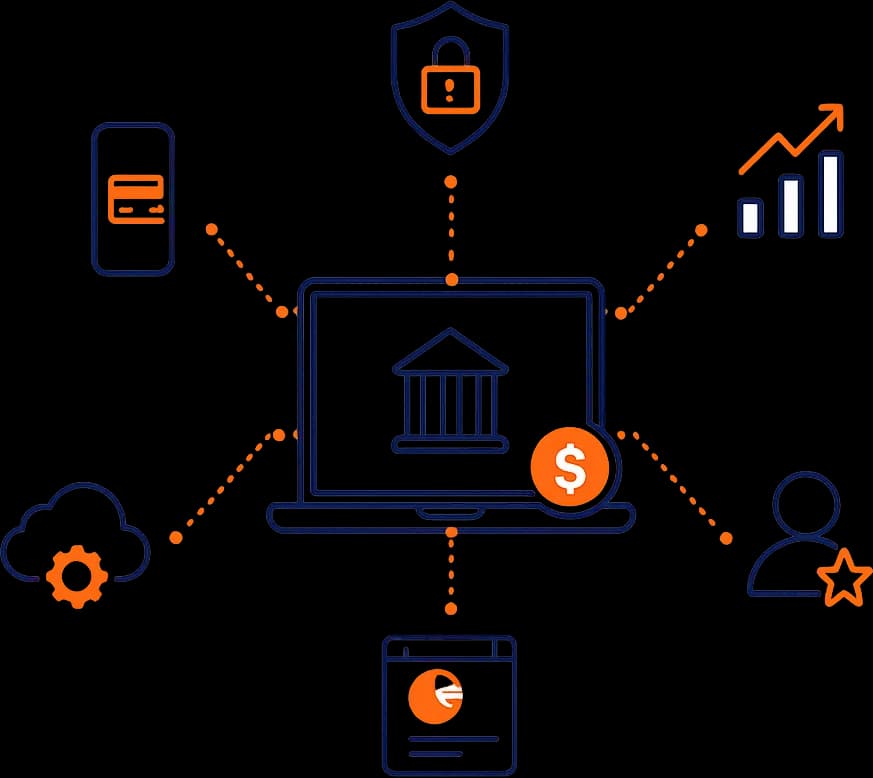
TL;DR: A FinTech software development company builds secure, compliant financial platforms — payments, lending/BNPL, KYC/AML, fraud detection and banking integrations. The defining requirement is regulatory and security engineering: PCI-DSS-ready architecture, alignment with RBI/SEBI guidelines, and strong fraud and data controls built in from the start.
FinTech software development builds the platforms that move and manage money — payment gateways, lending and BNPL, KYC-AML compliance tooling, fraud detection and banking integrations. For banks, NBFCs, payment processors and fintech startups, the work is engineered to be PCI-DSS-ready and aligned with regulatory guidelines like RBI and SEBI.
This is an industry-hub guide; for the underlying engineering see HIPAA/PCI/SOC 2 software and compliance consulting.
What does a FinTech software development company do?
It builds the software that powers financial services, including:
- Payment gateways — secure processing and settlement.
- Lending & BNPL — origination, underwriting and servicing.
- KYC / AML — identity verification and anti-money-laundering tooling.
- Fraud detection — real-time risk scoring (often with decision intelligence).
- Banking integrations — connecting to banks, rails and processors.
It serves banks, NBFCs, payment processors and fintech startups — and the common thread is that security and compliance are engineered in, not added later.
Is OpenMalo PCI-DSS compliant, and what does that mean for your platform?
OpenMalo engineers payment platforms to be PCI-DSS-ready — meaning the architecture and controls are built to meet PCI-DSS requirements (encryption, access control, network security, audit trails). It's important to be precise: formal PCI-DSS validation is performed by a Qualified Security Assessor or via the applicable self-assessment, not by the development partner. We build to the standard and align your platform with it; the certification itself comes through the official assessment process. See building to PCI-DSS.
Can you build under RBI, SEBI and other regulatory guidelines?
Yes — platforms are designed to align with RBI and SEBI guidelines and similar regulatory frameworks relevant to your product and market. As with PCI-DSS, the role is to engineer compliant-by-design systems that align with these guidelines; formal regulatory authorization or licensing of your business sits with you and the regulators. We help you build software that meets the technical and process expectations these frameworks set out.
Why precise compliance language matters in FinTech
In financial services, overstated compliance claims create real legal exposure. Saying a platform is "PCI-DSS-ready" and "aligned with RBI guidelines" — rather than "certified" or "regulated" — keeps the claims you make to customers, partners and regulators accurate. A partner who is careful with this language is protecting you.
How long does it take to launch a payment, lending or KYC platform?
It depends on scope, integrations and compliance, but the phased shape is consistent: a POC to validate the core flow and integrations in a few weeks, an MVP in roughly 8–12 weeks, and a full production platform in 12–16+ weeks once compliance engineering and banking integrations are included. You get a phased timeline after discovery rather than a single blind number.