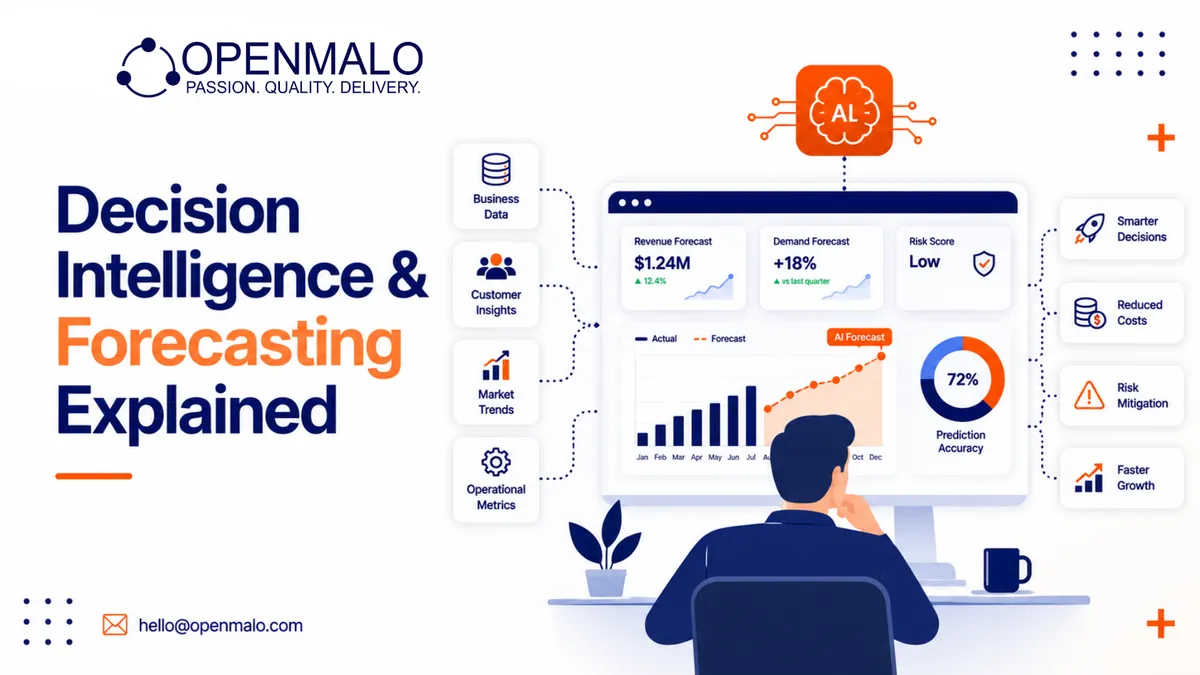
TL;DR: Decision intelligence is the practice of using data and machine learning not just to report on the past, but to recommend or automate the next decision. It blends forecasting models with business rules to drive choices like how much to stock, what price to set, or which applications to approve.
Decision intelligence combines data, ML forecasting and business rules to recommend or automate decisions — demand forecasting, pricing, risk scoring. It turns dashboards that merely report into systems that advise and act, closing the gap between "here's what happened" and "here's what to do."
This post sits alongside our AI solution guides like workflow automation and custom AI models.
What is decision intelligence and forecasting?
Decision intelligence combines data, ML forecasting and business rules to recommend or automate decisions — demand forecasting, pricing, risk scoring. It turns dashboards that merely report into systems that advise and act. Forecasting predicts what's likely to happen; decision intelligence wraps that prediction in business logic to recommend or take the right action.
How does decision intelligence turn data into automated business decisions?
In three layers:
- Data — clean, integrated inputs from your systems (see data engineering).
- Forecasting / ML — models that predict demand, risk, churn or price sensitivity.
- Business rules — logic that converts a prediction into a recommended or automated decision.
For example: a model forecasts demand, rules translate that into reorder quantities, and the system either recommends them to a planner or places orders automatically within set limits.
Recommend vs automate
Not every decision should be fully automated. Low-stakes, high-volume decisions (reorder quantities, routine pricing) are good candidates for automation; high-stakes ones are better as recommendations a human approves. Good decision intelligence makes this boundary explicit — and keeps a human in the loop where the cost of a wrong call is high.
Where does decision intelligence deliver value?
- Demand forecasting — inventory and supply planning.
- Pricing — dynamic and optimized pricing.
- Risk scoring — credit, fraud and underwriting support.
- Churn & retention — predicting and acting on at-risk customers.
- Operations — staffing, routing and capacity decisions.
How is it different from analytics dashboards?
Dashboards tell you what happened; decision intelligence tells you what to do about it — and can act. A dashboard shows sales dipped; decision intelligence forecasts the dip, recommends the markdown or reorder, and (where appropriate) executes it. It moves from description to action.