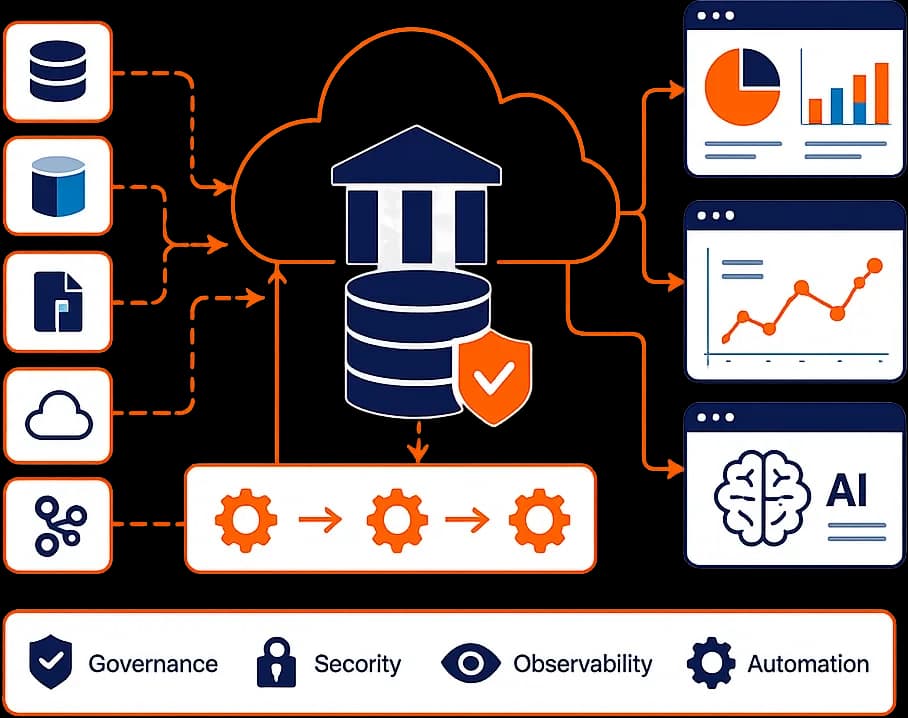
The "Modern Data Stack" (MDS) has undergone a radical transformation. If 2021 was the year of "collect everything" and 2023 was the year of "save money," 2026 is the year of Utility and Intelligence.
The sprawling, fragmented stacks of the past—where companies maintained 50 different micro-tools just to move a single row of data—have collapsed into more integrated, high-performance ecosystems. Today, the focus isn't just on moving data; it's on making that data AI-ready and instantly actionable.
If you are an engineering leader or a founder looking to build or migrate your data infrastructure this year, here is the blueprint of what actually works in a production environment.
1. The Shift from "Batch" to "Real-Time"
For years, the industry accepted "daily batches." Data would sit in a warehouse, 24 hours behind reality. In 2026, that lag is a competitive liability.
What Works Now: The modern stack has moved toward Stream Processing. Tools like Apache Flink or Confluent are no longer niche; they are foundational. Whether it's updating an AI agent on a user's latest behavior or detecting fraud in a fintech app, the data must flow in sub-seconds.
The goal is no longer just "ETL" (Extract, Transform, Load), but Continuous Integration of Data.
2. The Rise of the Vector-Relational Hybrid
The biggest change to the MDS in the last two years is the integration of Unstructured Data. Previously, your "Data Warehouse" (like Snowflake or BigQuery) handled numbers and strings, while your "Vector Database" (like Pinecone) handled AI data.
What Works Now: The separation is disappearing. Production stacks now favor Hybrid Engines. Platforms like Supabase (via pgvector) or specialized extensions for Snowflake allow you to store your customer's SQL metadata right next to their "semantic" embeddings. This simplifies your architecture—fewer tools mean fewer points of failure.
3. Data Contracts: The End of "Broken Pipelines"
One of the most expensive problems in data engineering was the "Upstream Break." A software engineer would change a column name in the app database, and 100 downstream dashboards and AI models would instantly fail.
What Works Now: Data Contracts. These are API-like agreements between the people producing the data and the people consuming it.
- Before a change is made to a database schema, the "contract" checks if it will break downstream AI agents or reports.
- If it does, the deployment is blocked.
- This shift from "fixing data" to "preventing bad data" has saved enterprise teams thousands of engineering hours.
4. The Semantic Layer: Giving AI a Dictionary
If you tell an AI agent to "Calculate the Churn Rate," it might use five different formulas depending on which table it looks at. This inconsistency is a "hallucination" waiting to happen.
What Works Now: A Universal Semantic Layer. By defining your business metrics (like Revenue, Churn, or LTV) in a single place (using tools like Cube or dbt Semantic Layer), you ensure that whether a human looks at a dashboard or an AI agent queries the data, they both get the same answer.
This is the secret sauce for making "Text-to-SQL" actually work in production.
5. Governance as Code (GaC)
With the 2026 regulatory environment (GDPR, India's DPDP, and the AI Act), manual data governance is impossible.
What Works Now: Governance as Code. Privacy policies, access controls, and data retention rules are now written in YAML or Python and version-controlled just like software.
- If a developer tries to move PII (Personally Identifiable Information) into an unencrypted bucket, the code itself rejects the move.
- Audit logs are generated automatically, making compliance a "background task" rather than a monthly crisis.
Key Takeaways
- Consolidation Wins: Stop buying 20 niche tools. Look for platforms that handle both relational and vector data.
- Real-time is the Standard: If your AI agent is making decisions on 24-hour-old data, it's already obsolete.
- Contracts are Non-Negotiable: Implement data contracts early to stop the "break-fix" cycle.
- The Semantic Layer is the AI's Brain: You cannot have reliable AI agents without a centralized definition of your business logic.
Conclusion
The Modern Data Stack of 2026 is leaner, faster, and much more "intelligent" than its predecessors. We have moved past the era of data hoarding and into the era of Data Hardening. By focusing on real-time flows, hybrid storage, and strict data contracts, you create an environment where AI doesn't just "exist"—it thrives. The companies winning today aren't those with the most data, but those with the most trustworthy data pipelines.
Is your data stack holding back your AI ambitions? At OpenMalo, we help mid-market companies and startups modernize their infrastructure for the agentic era. From Supabase migrations to real-time RAG pipelines, we build the tech that fuels your growth. Optimize Your Data Stack with OpenMalo