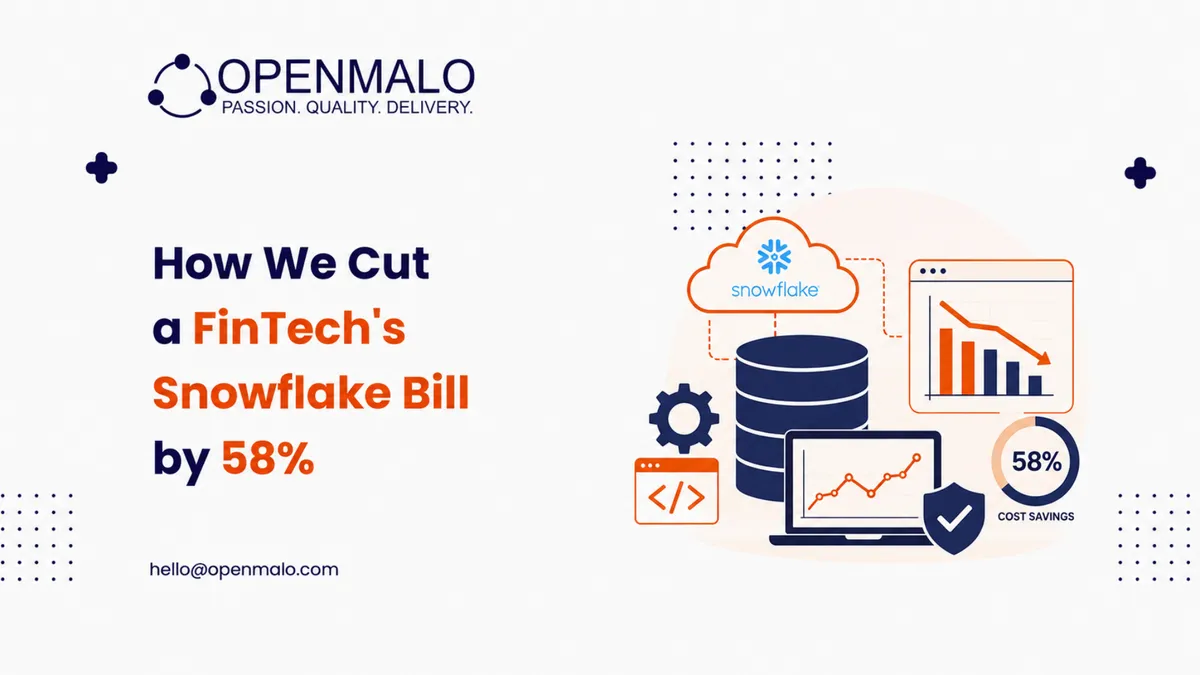
In the competitive FinTech landscape of 2026, data isn't just an asset—it's the engine of growth. But for many scaling enterprises, that engine can become dangerously expensive to fuel. Recently, OpenMalo Technologies partnered with a mid-market financial services firm that was facing a common but critical crisis: their Snowflake consumption costs were growing faster than their revenue.
With a major funding round on the horizon, their cloud spend had become a red flag on the balance sheet. They needed more than just a "patch"; they needed a complete structural overhaul of their data engineering practices.
By leveraging our 13+ years of expertise in cloud infrastructure and data hardening, we implemented a strategic FinOps playbook that reduced their monthly Snowflake spend by 58% in just one quarter. Here is the exact process we used to turn their data stack into a high-efficiency machine.
1. The Audit: Identifying the "Silent Spend"
At OpenMalo, we believe you can't optimize what you can't see. Our first step was a comprehensive audit of their Snowflake metadata. We discovered that nearly 40% of their credits were being consumed by warehouses that remained idle or were running "blind" queries.
The primary issues were:
- "Always-On" Mentality: Warehouses set to remain active long after queries finished.
- Redundant Processing: Re-calculating historical financial data that hadn't changed in months.
- Broad Scans: Analytical tools pulling entire tables instead of specific, indexed columns.
2. Strategy 1: Warehouse Rightsizing and Auto-Suspend Optimization
Many teams default to Large or X-Large warehouses because they fear slow performance. However, for most FinTech workloads—like daily reconciliation or risk reporting—concurrency is more important than raw size.
The OpenMalo Solution: We rightsized their warehouses to Multi-cluster Small configurations. Instead of one massive engine running constantly, the system now automatically spins up additional small clusters during peak morning hours and shuts them down instantly afterward. We also tuned the Auto-Suspend timer from 10 minutes down to 60 seconds, ensuring that the client only paid for active computation.
3. Strategy 2: Eliminating Inefficient Scans (The Columnar Rule)
Snowflake is a columnar database, meaning costs are directly tied to the number of columns you scan. We found that their internal dashboards were frequently executing SELECT * commands on tables containing hundreds of columns.
The OpenMalo Solution: We refactored their BI layer to utilize strict column selection. By enforcing Search Optimization Services for high-frequency point lookups (like searching for a specific Transaction ID), we allowed the system to find data without scanning the entire table. This single change reduced the data processed per query by over 65%.
4. Strategy 3: Transitioning to Incremental dbt Pipelines
The most significant drain on their budget was their transformation layer. The firm was using "Full Refresh" models, meaning every hour, they rebuilt their entire history of millions of transactions from scratch.
The OpenMalo Solution: Using dbt (data build tool), we refactored their core pipelines into Incremental Models. Now, the system only processes the new transactions that arrived in the last hour.
- Old Process: 50 minutes of compute time per hour.
- New Process: 3.5 minutes of compute time per hour.
- Total Impact: A massive drop in daily credit consumption with zero loss in data integrity.
5. Strategy 4: Intelligent Data Clustering and Tiered Storage
FinTechs are required by law to keep years of data, but they rarely need to query a transaction from 2021 in real-time.
The OpenMalo Solution:
- Clustering: We implemented clustering keys on transaction_date, allowing Snowflake to "prune" partitions and ignore irrelevant data during queries.
- Unloading Cold Data: For data older than 24 months, we utilized Apache Iceberg tables stored in private S3 buckets. This allowed the data to remain queryable via Snowflake but at a fraction of the native storage cost.
6. The Result: Sustainable Growth and Performance
Within 90 days, the results were undeniable:
- 58% Reduction in the total Snowflake monthly bill.
- 4x Faster dashboard loading times due to reduced warehouse contention.
- Clear Attribution: Each department now has a dedicated monitor showing their specific spend, fostering a culture of accountability.
Key Takeaways
- FinOps is Engineering: Cost optimization isn't just for accountants; it requires deep architectural knowledge.
- Incremental is Key: In 2026, rebuilding entire datasets is a legacy mistake. Move to incremental processing.
- Automate Governance: Use Resource Monitors to set hard caps on credit usage to prevent "runaway" queries from spiking your bill.
- Partner with Experts: Transforming a data stack requires a balance of speed and precision—something OpenMalo has perfected over a decade of delivery.
Conclusion
Cloud costs should never be a barrier to innovation. For our FinTech partner, this 58% saving meant they could redirect hundreds of thousands of dollars into building new AI features for their customers. At OpenMalo Technologies, we don't just build software; we build efficient, scalable digital ecosystems that respect your bottom line.
Is your cloud data spend spiraling out of control? Our team at OpenMalo Technologies can help you audit, optimize, and harden your data infrastructure for the next generation of growth. Book Your Cloud Cost Audit with OpenMalo Today