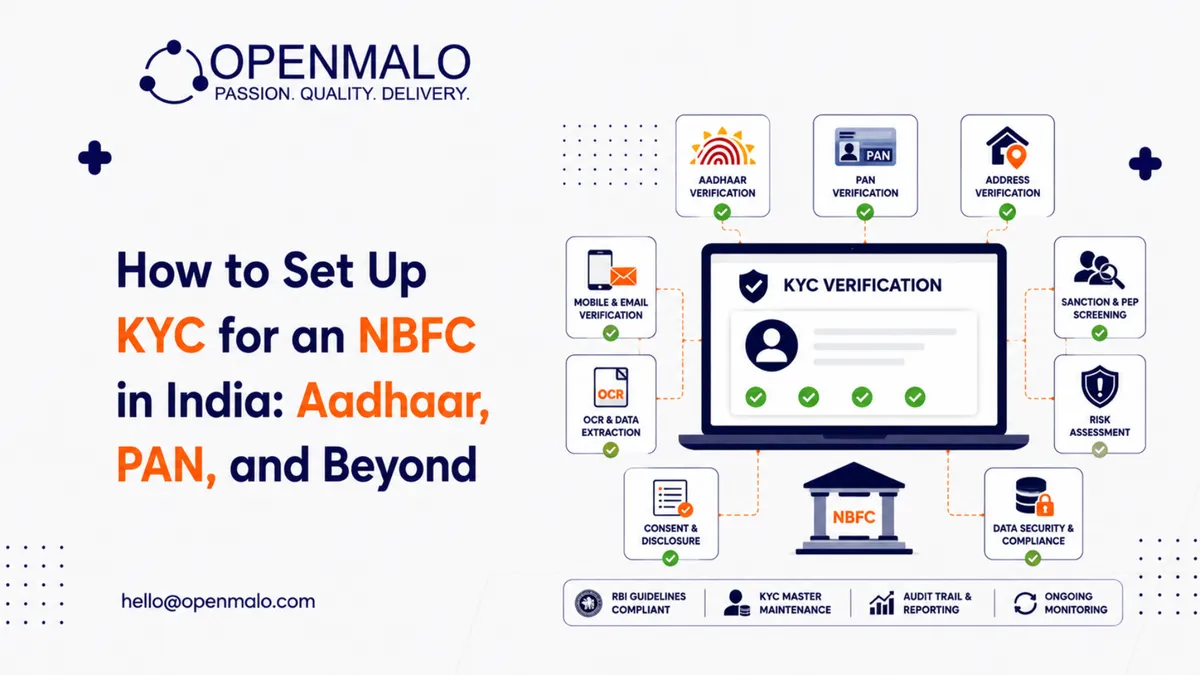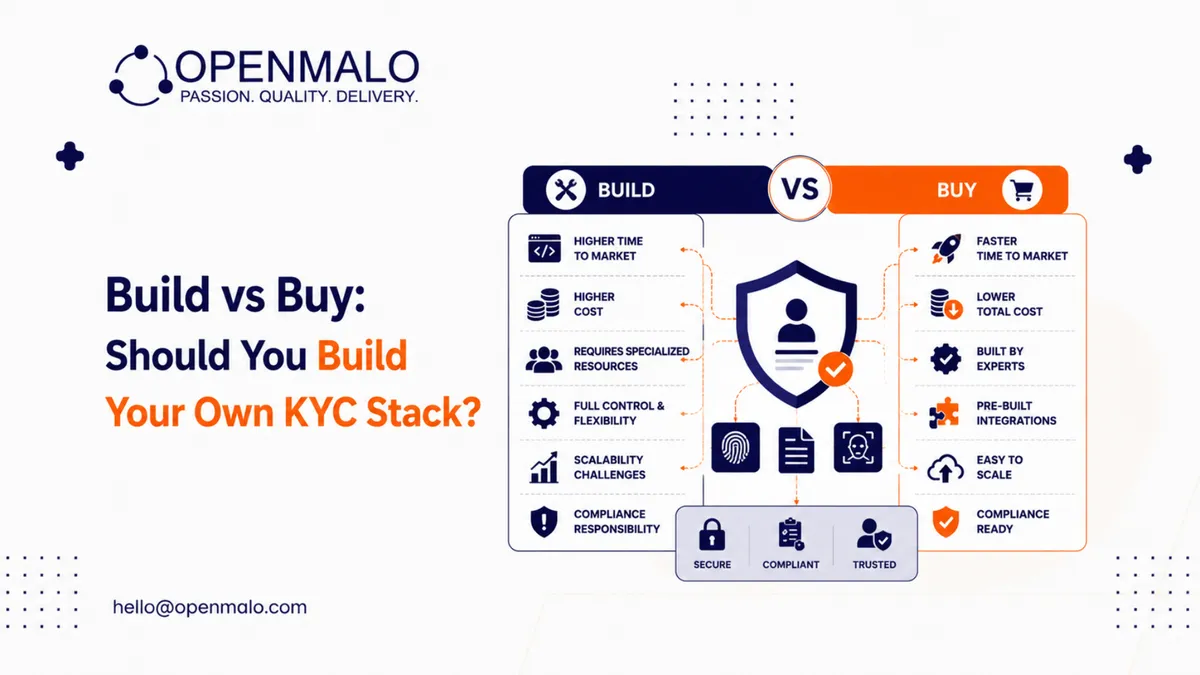
Quick answer: Building your own KYC stack means absorbing the engineering cost of integrating Aadhaar, PAN verification, V-CIP, CKYCR, DigiLocker, document OCR, name-match fuzzy matching, fraud signals — plus permanent operational overhead for policy maintenance, audit support, and regulatory change tracking. Buying means paying per-verification SaaS pricing that bundles all of this with sharper SLAs. For most Indian fintechs in the 0 to 500,000 verifications per year band, buy wins on five-year TCO. Above that, a hybrid pattern often wins.
The build-vs-buy question for KYC is asked badly more often than not. Founders frame it as “we have engineers, we can build it” — which is true but irrelevant. The real question is: across a five-year horizon, will building your own KYC stack cost less than buying, and will it leave you better positioned strategically? For most Indian fintechs the honest answer is no.
Here is the framework we use at OpenMalo when a client asks us to help them decide.
The five questions that decide it
- Is KYC a competitive moat for you? If your product’s value proposition is fundamentally about novel onboarding (e.g., a digital identity product itself), build. If KYC is plumbing that gets a customer to the actual product, buy.
- What’s your transaction volume? Below a meaningful monthly verification volume, per-verification SaaS pricing wins. Above it, the unit economics of building can flip — but only if you maintain the stack well. Most teams don’t.
- Do you have the compliance and security capacity to host this in-house? The build option means you absorb every regulatory change, every UIDAI API tweak, every CERT-In notification. That’s a permanent ops cost, not a one-time build cost.
- What’s your time-to-market constraint? Build = 6 to 12 months realistic timeline. Buy = 2 to 6 weeks. If your business needs to be live yesterday, the decision is made for you.
- Will you regret the integration debt later? If you build now and need to switch later, the migration cost is 70% of the original build. A bought solution can be swapped (with effort) for another bought solution.
True cost comparison — across five years
Build option, realistic line items:
- Engineering build (core integrations): substantial first-year FTE equivalent
- Security audit and CERT-In empanelment: annual
- UIDAI sub-KUA partnership fees + per-call costs
- V-CIP agent infrastructure or BPO (if doing live V-CIP in-house)
- CKYCR upload pipeline maintenance
- Regulatory change implementation (RBI / UIDAI / CBDT issue regular updates)
- Document storage and retention infrastructure
- Compliance officer time
- Bug fixes and edge-case handling (long tail, never ends)
Buy option, realistic line items:
- Per-verification SaaS price (varies by method mix)
- Integration engineering (one-time, modest)
- Vendor management overhead (procurement, contracts, periodic reviews)
- Backup vendor relationship (best practice)
For most fintechs in the 0 to 500,000 verifications per year band, buy wins on five-year TCO. Above that band the math gets interesting, and a hybrid pattern (build the routing layer, buy individual verification rails) often wins.
The hybrid pattern that scales
A pattern we’ve delivered at OpenMalo for higher-volume fintechs:
- You build the routing, ledger, and consent layer — these are the components that touch your business logic
- You buy individual verification rails from specialised providers — Aadhaar via one sub-KUA, V-CIP from another, document OCR from a third
- You retain switch-ability — every rail has a fallback vendor wired in, so you can re-negotiate without rebuilding
This costs more than a single-vendor buy in steady state but is much more defensive on the vendor-leverage axis, and lets you optimise per rail.
Compliance is not transferable
One myth worth puncturing: buying a KYC vendor does not transfer the compliance liability. You remain responsible for the regulatory obligations of your products. The vendor is responsible for what they contract to deliver. If your vendor fails an audit, you fail an audit. Pick vendors on compliance track record, not just price.
When build genuinely wins
There are real cases. We’ve helped clients build their own when:
- The product is itself a KYC / digital identity platform
- The volume is very high and the unit economics tip
- The geographic footprint requires non-Indian compliance frameworks that no Indian vendor handles well
- The risk profile demands a level of control that vendor SLAs don’t provide
If none of these apply to you, the answer is buy.
CTA: OpenMalo’s KYC onboarding module is the buy option that gives you the build-grade flexibility — pre-built integrations with the option to swap rails as you scale. See the module →
Closing
The right way to ask build-vs-buy isn’t “can we build it?” It’s “five years from now, will we be glad we did?” For KYC, in the Indian fintech context, the answer for most teams is to buy a solid platform now and revisit the question only when volume genuinely makes it interesting.