In 2026, the lending landscape is no longer just about calculating risk—it is about ensuring fairness. As AI agents take over real-time credit decisions, regulators in the US (SEC), India (DPDP Act), and Europe are holding financial institutions to unprecedented standards of ethical accountability.
A model that is highly accurate but discriminates against certain demographics is not just an ethical failure; it is a multi-million dollar legal liability. At OpenMalo Technologies, we specialize in "Hardening AI"—taking sophisticated models and wrapping them in the rigorous governance, transparency, and bias-mitigation frameworks required for the modern enterprise.
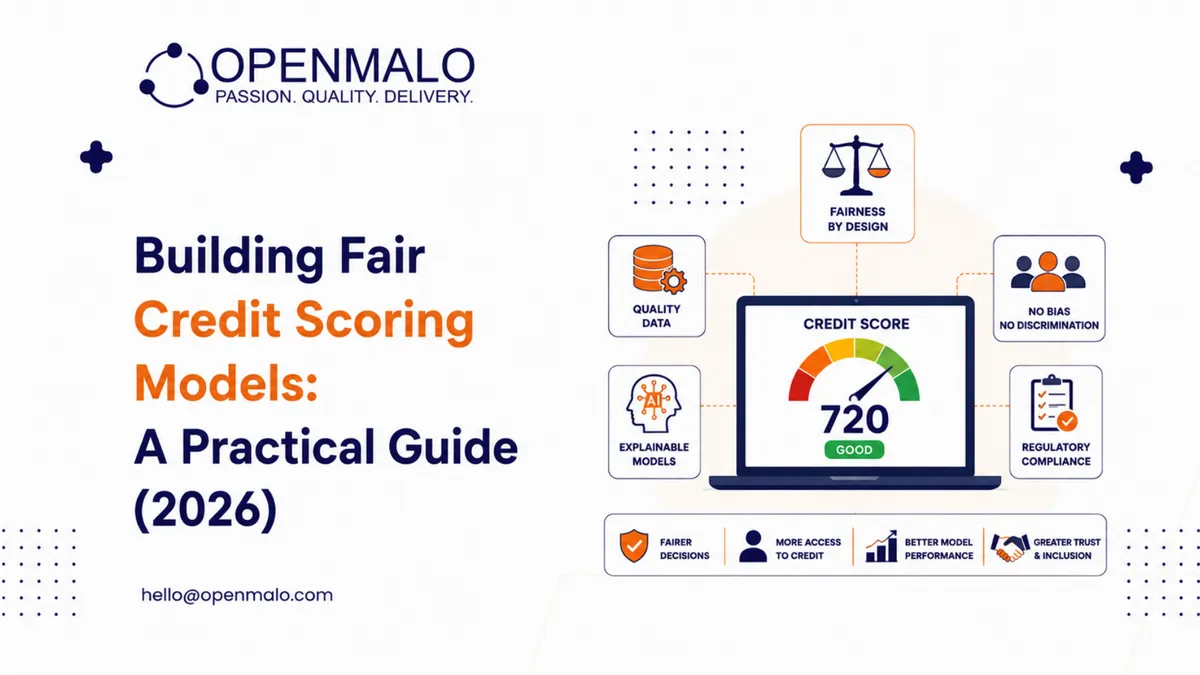
This guide provides a technical and strategic blueprint for building credit scoring models that are both predictive and profoundly fair.
1. The New Definition of "Fairness" in 2026
In the past, "fairness" often meant "Fairness through Unawareness"—simply removing sensitive attributes like gender, race, or caste from the dataset.
In 2026, we know this doesn't work. AI is an expert at finding proxy variables. If you remove "Race" but keep "Zip Code," a sophisticated model will still learn to discriminate based on historical housing patterns. True fairness today is active and intentional, requiring lenders to prove that their outcomes—not just their inputs—are equitable across different groups.
2. The Hidden Sources of Algorithmic Bias
Bias usually enters your credit model through one of three doors:
- Historical Data Bias: If a community was historically denied credit, a model trained on that data will "learn" that they are high-risk, perpetuating a cycle of exclusion.
- Feature Selection Bias: Using alternative data like "Social Media activity" or "Smartphone type" can unintentionally penalize lower-income segments who may use older devices or lack a digital footprint.
- Sampling Bias: If your training data primarily features urban, high-income applicants, the model will struggle to accurately score rural or "thin-file" borrowers.
3. Techniques for Mitigating Bias (Pre- and Post-Processing)
At OpenMalo, we implement a multi-layered approach to ensure your models are resilient and fair.
A. Pre-processing: Re-weighting the Data
Before training starts, we use Synthetic Data Generation (GANs) to balance the dataset. If a certain demographic is underrepresented, we generate high-fidelity synthetic examples to ensure the model learns their risk patterns just as accurately as the majority group.
B. In-processing: Adversarial Debiasing
We can train a second "adversary" model alongside the credit scorer. The credit scorer tries to predict risk, while the adversary tries to "guess" the sensitive attribute (like gender) from the scorer's predictions. If the adversary succeeds, the scorer is penalized, forcing it to find features that are truly predictive of risk without being tied to protected classes.
C. Post-processing: Equalized Odds
After the model generates scores, we adjust the decision thresholds. Instead of one single "cutoff" for everyone, we tune the thresholds to ensure that the False Positive Rate is equal across all demographic groups.
4. Explainability (XAI): Turning the Black Box into a Glass Box
Regulators now demand a "Right to Explanation." If an AI denies a loan, the institution must be able to provide the specific reasons why.
What Works Now:
- SHAP and LIME: These techniques break down exactly how much each feature (e.g., income, payment history, debt-to-income ratio) contributed to a specific "Reject" or "Approve" decision.
- Counterfactual Explanations: "If your income were $5,000 higher, your loan would have been approved." This provides actionable feedback to the customer, building trust and compliance.
5. Regulatory Compliance: DPDP, GDPR, and the AI Act
Building a fair model is now a prerequisite for legal operation.
- In India: The Digital Personal Data Protection (DPDP) Act requires explicit consent and limits data usage to the "specified purpose." You cannot use a customer's data for credit scoring if they only consented to it for a KYC check.
- In the EU: The AI Act classifies credit scoring as "High-Risk AI," requiring rigorous documentation, human oversight, and mandatory impact assessments.
Key Takeaways
- Proxy Variables are Dangerous: Simply removing sensitive data isn't enough; you must actively monitor for "hidden" correlations.
- Accuracy vs. Fairness: There is often a trade-off. A slightly less accurate model that is 100% fair is better for your brand and your legal team than a "perfect" model that discriminates.
- Human-in-the-Loop: Automated decisions should always have a "circuit breaker" where a human credit officer can review and override anomalous AI decisions.
- Hardening is a Journey: Fairness isn't a "one-and-done" checkbox. It requires continuous monitoring for Model Drift as society and data change.
Conclusion
Fairness in credit scoring is no longer just a "nice-to-have" CSR initiative; it is a core technical requirement for production-grade finance. By moving from reactive "bias checking" to proactive Fairness Engineering, lenders can expand credit access to underserved populations while staying strictly within global regulatory guardrails.
At OpenMalo Technologies, we believe the best AI is the one everyone can trust. We don't just build models; we build the ethical infrastructure that allows your business to scale with confidence.
Is your AI credit scoring model ready for a 2026 audit? OpenMalo Technologies helps financial institutions build, harden, and audit ethical AI frameworks. Let's build a fairer future together.