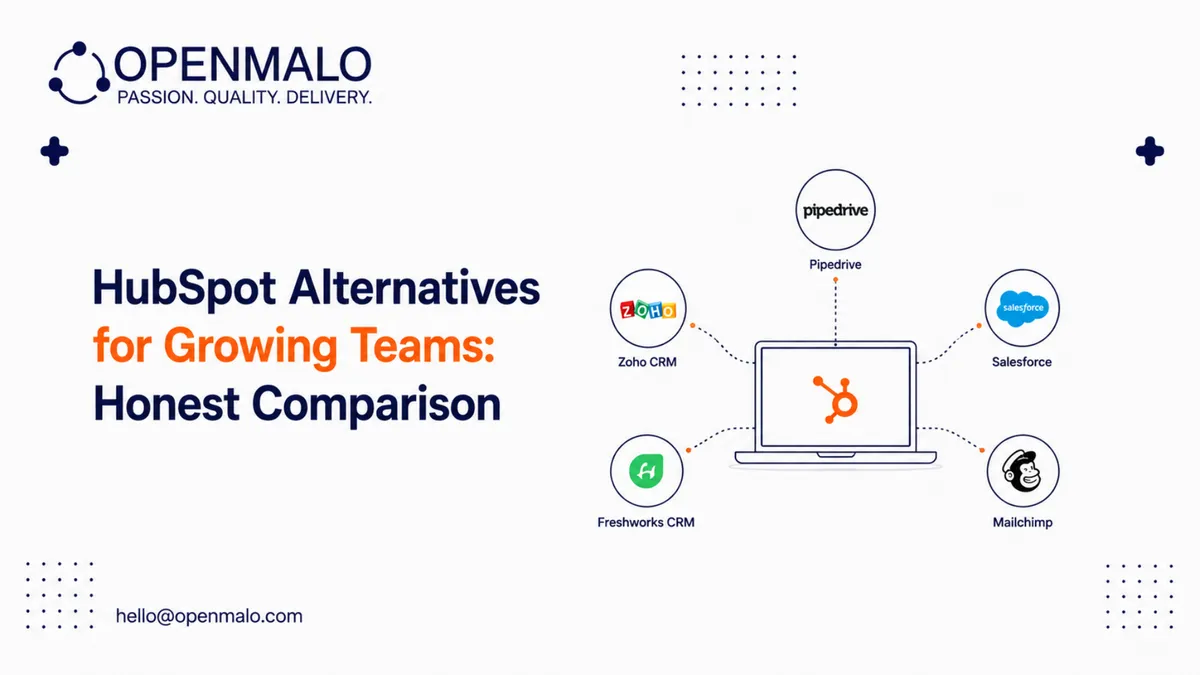
Quick answer: The strongest HubSpot alternatives in 2026 are ActiveCampaign (best automation depth at SMB pricing), Brevo (formerly Sendinblue, strongest email + SMS + WhatsApp in one), Zoho One (lowest TCO with integrated suite), Klaviyo (e-commerce specialist), Salesforce Marketing Cloud (enterprise top-end), EngageBay (all-in-one budget option), and Mailchimp (still credible for SMB email-focused use cases). The right pick depends on the pressure that brought you here — cost, feature gap, or workflow.
HubSpot is excellent. It is also expensive at scale, opinionated about workflow, and not always the right fit for the team that originally chose it. If you're at the point of asking "what's an alternative to HubSpot?" you're usually facing one of three pressures: cost has scaled past comfortable, a feature gap is hurting operations, or the team has outgrown the workflow HubSpot imposes. Each pressure points to a different alternative.
In plain language: the strongest HubSpot alternatives in 2026 are ActiveCampaign (best automation depth at SMB pricing), Brevo (formerly Sendinblue, strongest email + SMS + WhatsApp in one), Zoho One (lowest TCO with integrated suite), Klaviyo (e-commerce specialist), Salesforce Marketing Cloud (enterprise top-end), EngageBay (all-in-one budget option), and Mailchimp (still credible for SMB email-focused use cases). Each wins specific use cases.
Honest decision matrix
| Alternative | Sweet spot | Strength | Watch-out |
|---|---|---|---|
| ActiveCampaign | SMB to mid-market with automation needs | Deepest automation tooling at price point; CRM-light included | UI density steeper learning curve than HubSpot |
| Brevo (Sendinblue) | India / EMEA teams wanting email + SMS + WhatsApp | Multi-channel native; transactional + marketing combined | Less polished CRM; fewer integrations than HubSpot |
| Zoho One / Marketing Plus | Cost-sensitive multi-tool buyers | Lowest TCO; integrated suite if you adopt broadly | Best-in-class loss vs. specialist tools; UI inconsistency |
| Klaviyo | E-commerce, especially Shopify | Best-in-class e-commerce automation and analytics | Less suited to non-e-commerce; pricing scales steeply |
| Salesforce Marketing Cloud | Enterprise | Maximum flexibility, integration, scale | Highest TCO; implementation effort; over-engineered for SMB |
| EngageBay | Bootstrapped SMBs | All-in-one CRM + marketing + service at budget pricing | Feature depth lighter than specialised options |
| Mailchimp | Email-first SMB | Brand recognition, ease of use, decent automation | Less suited to multi-channel or complex automation |
Pick by the pressure that brought you here
Cost pressure. HubSpot's Professional / Enterprise tiers scale steeply with contacts and seats. If you're paying for Pro / Enterprise and using maybe half the features, consider:
- ActiveCampaign for automation parity at lower price
- Zoho Marketing Plus for integrated marketing at a fraction of cost
- EngageBay for the budget end
The math test: list your top 10 used features, find the alternative that covers them at a lower tier, model the migration cost (data, automations, training) against 18 months of savings.
Feature pressure — e-commerce. HubSpot's e-commerce automation is fine but Klaviyo is better. If your business is product-led and your top automations are post-purchase, abandoned cart, win-back, the case for Klaviyo is strong.
Feature pressure — multi-channel India. HubSpot's SMS / WhatsApp story in India is integrated via partners, not native. Brevo (formerly Sendinblue) does email + SMS + WhatsApp natively in one platform — fewer moving parts.
Feature pressure — enterprise integration. If you've outgrown HubSpot's customisation ceiling, Salesforce Marketing Cloud is the next stop. The investment is real; for genuinely enterprise needs the flexibility justifies it.
Workflow pressure. HubSpot has strong opinions about how marketing should work. Some teams thrive in this; some feel constrained. ActiveCampaign is more flexible without becoming Salesforce-heavy.
What you'll lose moving off HubSpot
Honest list:
- CMS / website integration — HubSpot's all-in-one with hosting / blog / CMS is genuinely good
- Brand recognition in onboarding and integration ecosystems
- Service Hub — strong help desk tooling not always matched elsewhere
- Reporting templates that work out of the box
- Community and content — HubSpot's documentation and education are best-in-class
A move requires you to either replace these with separate tools (often net-cheaper) or accept the gap.
What you'll gain
- Lower cost (typically, depending on alternative)
- Better fit-for-purpose for your specific use case
- Less feature bloat
- (Sometimes) faster execution
Migration realities
A HubSpot → alternative migration involves:
- Data export and re-import — contacts, lists, deals, properties
- Automation rebuild — flows / workflows / sequences don't auto-translate
- Form and landing page rebuild — typically a manual lift
- Integration reconnect — every tool connected to HubSpot needs to be reconnected
- Team retraining — material time investment, especially for non-technical users
- Reporting recreation — saved reports, dashboards
Budget weeks to months depending on complexity. The savings have to be real and sustained to justify.
When to stay on HubSpot
The honest answer most teams overlook: sometimes the right move is to stay. HubSpot is staying because:
- The all-in-one integration delivers genuine compound value
- Your team's productivity on HubSpot is high; migration disrupts
- The migration cost exceeds the 18-month savings differential
- The features you're considering elsewhere are nice-to-haves, not pain points
Re-evaluate your tier, drop unused seats, prune unused features, and the cost pressure can often be addressed without migration.
CTA: OpenMalo's marketing automation module is the right fit when you want HubSpot-style functionality without the HubSpot price point — pre-built around Indian channel norms (WhatsApp, SMS, email). See the module →
Closing
HubSpot alternatives are abundant, and the "best alternative" depends entirely on the pressure that made you ask. Diagnose the pressure first, match the alternative to it, and run the migration math honestly. Switch when the math works; stay when it doesn't.