Quick answer: Six attribution models matter — last-click, first-click, linear, time-decay, position-based (U-shaped), and data-driven. Data-driven is the modern default for accounts with enough conversion volume; last-click suits short-cycle paid channels; position-based fits B2B SaaS. None is universally correct. The teams that decide well don’t fall in love with one model — they triangulate MTA + MMM + incrementality tests, and accept some uncertainty is inherent.
Attribution is the model your team uses to assign credit for a conversion to the marketing touches that preceded it. The model you pick shapes how channels look in reports, how budget gets allocated, and which campaigns survive the next planning cycle. Most teams pick a model by default — usually whatever GA4 or their CRM defaults to — without examining what the choice actually says about their business.
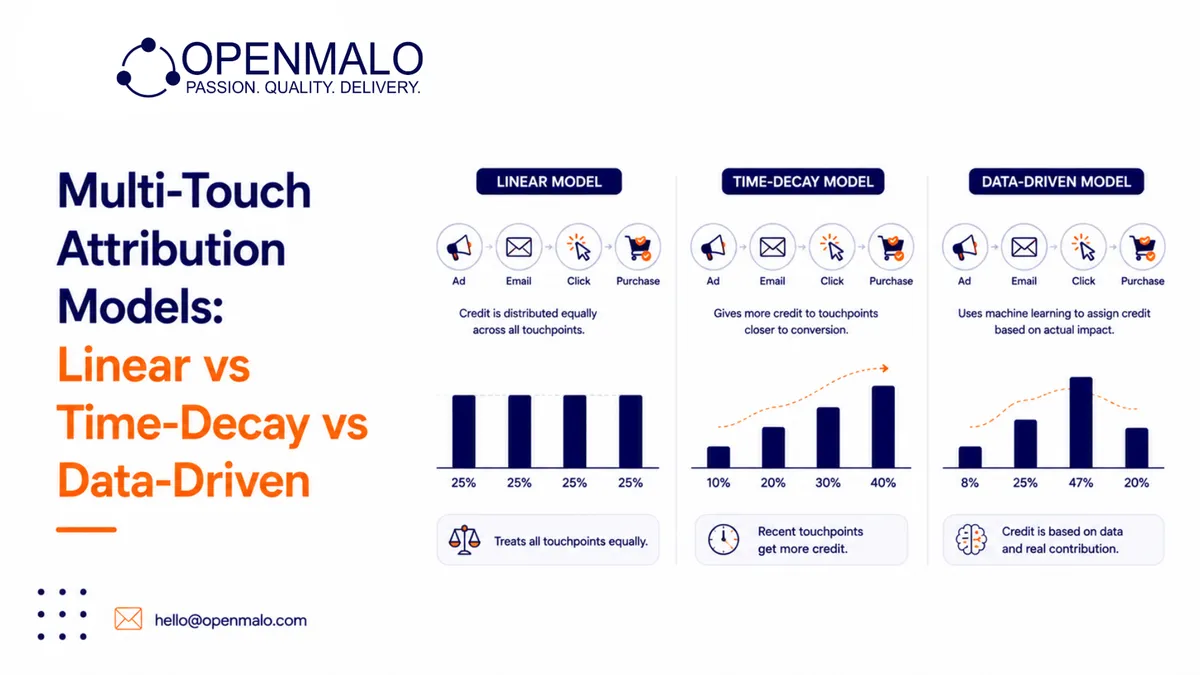
In plain language: last-click credits the final touch before conversion (simple, biased toward bottom-funnel); first-click credits the first touch (biased toward top-funnel); linear spreads credit equally across all touches; time-decay weights later touches higher; position-based (U-shaped) gives more credit to first and last with the middle sharing the rest; data-driven uses your actual conversion paths to learn which touches genuinely move the needle. Each has a use case; none is universally correct.
The six models that matter
| Model | How it assigns credit | Strength | Weakness |
|---|---|---|---|
| Last-click | 100% to the last touch | Simple; matches platforms’ default reporting | Ignores all the work that built the consideration |
| First-click | 100% to the first touch | Rewards top-funnel | Ignores everything that closed the deal |
| Linear | Equal across all touches | Acknowledges every touch | Treats a brand awareness touch and a checkout touch the same |
| Time-decay | Recent touches get more credit | Matches intuitive sales-cycle thinking | Still arbitrary in the decay curve choice |
| Position-based (U-shaped) | More to first and last; less to middle | Balances discovery and closing | Mid-funnel touches systematically undervalued |
| Data-driven (DDA) | Algorithmic based on your data | Reflects your actual conversion patterns | Requires sufficient data volume; black-box explainability |
Why GA4’s default matters
Google Analytics 4 made data-driven attribution the default for non-paid-platform reports a couple of years ago. For most accounts with enough conversion volume, this is a reasonable default — the algorithm uses your funnel data to assign credit based on actual contribution.
The catch: GA4’s data-driven model is only as good as the data you feed it. If your tracking pipeline is degraded (see the server-side vs client-side playbook), DDA is learning from incomplete paths and producing biased outputs.
GA4 has continued to evolve attribution availability and defaults; confirm current state before publishing.
When to use which model
Last-click — for paid channels where the final touch is the click being measured, or for early-stage businesses with very short consideration cycles.
First-click — when you want to give brand and discovery credit (often in awareness-led brand reports), or when assessing the lifetime value of acquisition channels.
Linear — rarely. It treats unequal things as equal. Most teams that pick linear are picking it because it’s politically safe, not because it reflects reality.
Time-decay — for considered purchases where recency genuinely matters more than discovery, and where a smooth decay curve fits your sales cycle better than discrete weights.
Position-based — for considered purchases where you genuinely believe both first and last touches deserve outsized credit (B2B SaaS, large purchases).
Data-driven — for any business with enough conversion volume that the algorithm has data to learn from. This is the default modern recommendation.
Multi-touch attribution is not media mix modelling
Two different methodologies, often confused:
- Multi-touch attribution (MTA) — uses user-level conversion path data to assign credit (what we’ve been discussing)
- Media mix modelling (MMM) — uses aggregate channel spend and revenue over time, statistically modelling channel contribution; does not require user-level data
MTA is degrading as user-level signal degrades (see post-cookie reality). MMM is enjoying a renaissance because aggregate data still works. Many serious marketers now run both: MTA for paid channels with click-level data, MMM for the overall mix.
The honest limitations of attribution
Every attribution model has flaws by construction:
- You only see conversion paths within your tracking — offline conversations, word-of-mouth, brand reputation are invisible
- You see only the conversions that completed — not the ones a channel almost won
- You apply credit retroactively, but budgets are spent prospectively
- Cross-device attribution remains hard in a post-cookie world
Don’t make budget decisions on a single attribution model. Triangulate:
- MTA for "which touches were involved in completed conversions"
- MMM for "which channels drove overall outcomes over time"
- Incrementality / lift tests for "what does this channel actually cause vs. correlate with"
- Marketing efficiency ratio at the channel level
- Sales pipeline qualitative signal
The reporting cadence that works
A pragmatic reporting stack:
- Weekly — channel spend and headline outcomes (revenue, signups, qualified leads)
- Monthly — MTA-based channel performance + MMM-based mix view
- Quarterly — incrementality test results + budget rebalancing
- Annually — full attribution model review; confirm the model still fits the business
What goes wrong
- Picking a model because it makes a channel look good. This is political, not analytical. Pick by methodological fit.
- Ignoring data quality. Server-side tracking + identity stitching is upstream of attribution; if the data is degraded, every model is wrong.
- Treating attribution as decision-making. It is one input, not the answer.
- Running MTA without MMM. In a post-cookie world, this leaves a large blind spot.
- Never re-running the assessment. As channels mature and decline, the right model shifts.
CTA: OpenMalo’s marketing analytics module ships with MTA + MMM-ready data foundations, so you can apply attribution models with your real data — not modelled fragments. See the module →
Closing
Attribution is a question, not an answer. Different models tell you different things about the same business. The teams that decide well don’t fall in love with one model; they run several, triangulate, and accept that some uncertainty is inherent. The goal isn’t to be right about attribution. It’s to make better budget decisions than the team without attribution.