Quick answer: Client-side tracking runs in the browser via JavaScript and loses 30–60% of conversions to ad blockers, iOS ATT, and browser privacy restrictions. Server-side tracking captures events on your backend and forwards them to ad platforms via Conversions API (Meta), Enhanced Conversions (Google Ads), and equivalents — recovering double-digit-percent data uplift. The hard part is identity stitching and consent management, not the tagging itself.
The shift from client-side to server-side tracking is no longer optional for serious marketers. Apple’s App Tracking Transparency removed a huge slice of user-level signal from the iOS ecosystem; browser-level tracking restrictions (Safari ITP, Firefox ETP, Chrome’s evolving cookie posture) have eaten into the rest. The teams still running pure client-side tracking are operating on a fraction of the data they had three years ago — and they’re often unaware of how big the gap has grown.
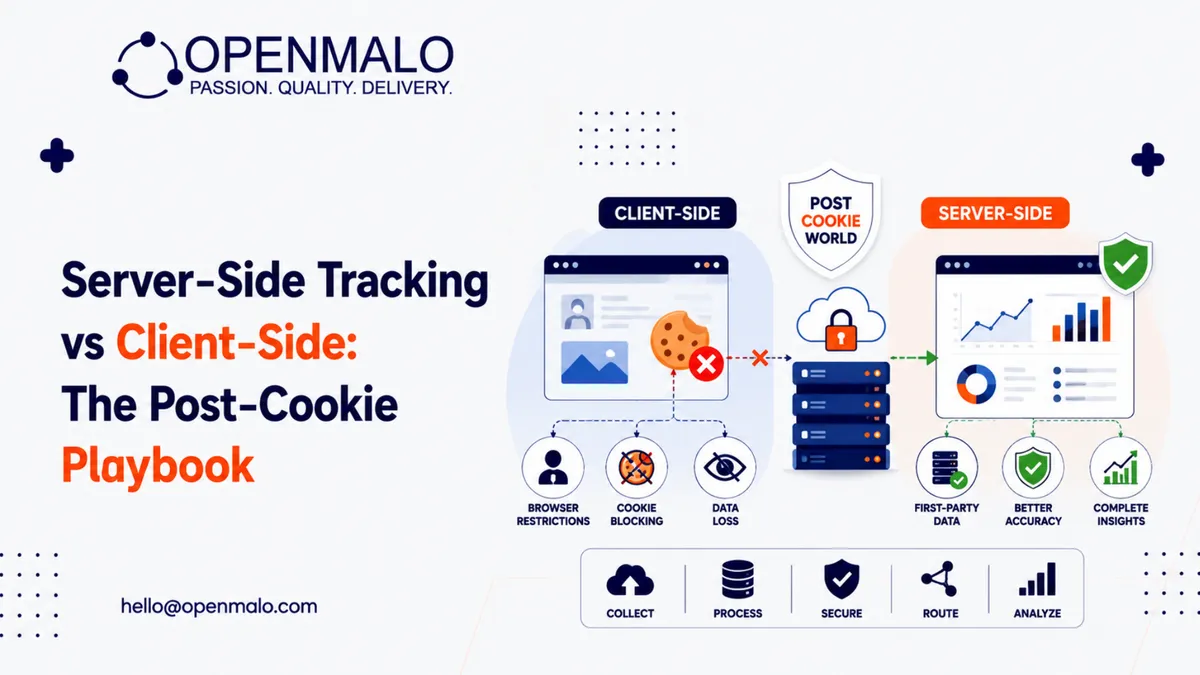
In plain language: client-side tracking runs in the user’s browser via JavaScript tags and writes data to first- and third-party endpoints. It is easy to deploy but is subject to ad blockers, browser privacy protections, and platform restrictions that increasingly limit data quality. Server-side tracking captures events on your server (after the user’s action lands on your backend) and forwards them to ad platforms via their server-to-server APIs — Conversions API (Meta), Enhanced Conversions (Google Ads), the equivalent on every major platform. It is harder to deploy but recovers a substantial portion of the data client-side has lost, and it gives you control over what gets shared.
What changed and why it matters
Three independent forces eroded client-side tracking:
- iOS ATT — users opt out of tracking on iOS apps and (effectively) browsers; the device IDFA goes dark
- Browser cookie restrictions — third-party cookies dying in Safari and Firefox; Chrome’s posture has evolved through multiple announcements and changes
- Ad blockers — 15 to 30%+ of audiences in some markets block trackers
The aggregate effect for many advertisers: 30 to 60% of conversions go unattributed in pure client-side measurement, depending on the audience mix and platforms. The ad platforms model the gaps with statistical inference, but the resolution is poor.
Re-confirm the current state of Chrome’s third-party cookie posture before publishing — Google has revised the deprecation plan multiple times.
The server-side recovery — what it actually does
When you fire events server-side via Conversions API / Enhanced Conversions:
- The event hits the ad platform with the user-identifying signals you choose to share (hashed email, hashed phone, click ID, etc.)
- The platform matches the event to its user model with much higher confidence than browser-only signals allowed
- Attribution and optimisation models train on a much fuller dataset
- Ad blockers cannot intercept (the event is server-to-server)
- Browser privacy restrictions don’t apply (the event isn’t browser-mediated)
The data-recovery uplift for advertisers transitioning from pure client-side to server-side typically lands in the double-digit-percent range — sometimes much higher in iOS-heavy or ad-block-heavy audiences. Your mileage varies; measure your own.
Server-side GTM — the practical pattern
Google Tag Manager Server-Side is the most common way to implement this without writing custom server code:
- Server container — a GTM container running on a server you control (Cloud Run, App Engine, or a self-hosted Node.js)
- Client tagging — your existing client GTM continues, but forwards events to the server container instead of directly to ad platforms
- Server tags — fire from the server container to each platform’s server API (Conversions API, Enhanced Conversions, etc.)
- First-party endpoint — the server container runs on your subdomain (e.g.,
tracking.yourbrand.com), giving you first-party-context cookies and longer browser-set cookie lifetimes
This pattern lets you keep the development model your team is used to (GTM UI, tags, triggers) while moving the actual data delivery to server-to-server.
What server-side does not fix
- It does not let you track users who explicitly opt out — and shouldn’t
- It does not magically restore deterministic cross-device identity
- It does not exempt you from privacy obligations (DPDP, GDPR, CCPA)
- It does not work without identity signal — you need at least one user identifier per event (email, phone, click ID, login ID)
Identity stitching — the underrated lever
Server-side tracking is only as good as the identifiers you can attach to events. The teams that win:
- Capture email at every viable point (newsletter signup, account creation, checkout)
- Hash emails server-side before sending to ad platforms (SHA-256 lowercased)
- Capture and persist click IDs (
gclid,fbclid, etc.) into the user record - Use first-party login IDs as the durable identifier
- Maintain a clean event schema with
user_idon every event
A pristine server-side pipeline with no identity attached to events is worse than a client-side pipeline with good identity. Solve identity first; then send via server.
Consent management — first, always
DPDP Act 2023 in India, GDPR in the EU, and assorted state laws in the US require:
- Capture consent before processing
- Send only data the user consented to share
- Respect withdrawal of consent
- Maintain audit trails
Wire consent into the server-side pipeline as a hard gate. Events from non-consented users don’t go to ad platforms; events from withdrawn-consent users get suppressed. Build it once, well.
The architecture pattern that wins
- First-party data lake — every event lands in your first-party data store first
- Identity resolution — every event has a
user_idresolved against your customer table - Consent gate — every event is checked against the consent state before downstream forwarding
- Server-side tagging — forwarding to ad platforms via server APIs
- Reverse ETL — pushing audiences from the data lake to ad platforms
The advantages compound: you own the data, you control consent, you can switch ad platforms without re-tagging, and you build a customer model that compounds.
What this realistically takes
A server-side migration for a mid-size advertiser typically requires:
- A server container setup (low cost; mostly engineering time)
- Identity resolution work (often the biggest lift)
- Event schema cleanup
- Consent management integration
- Per-platform server tag implementation
- Validation and reconciliation against the prior client-side data
Several engineer-weeks for a clean implementation; longer where identity and consent need work.
CTA: OpenMalo’s marketing analytics module ships the first-party data lake, identity resolution, consent gate, and server-side tagging architecture as a pre-built foundation. See the module →
Closing
Server-side is no longer a sophistication-tier upgrade — it is the baseline for marketing teams that want to keep buying ads with measurable return. Make the move deliberately, solve identity and consent first, and you’ll have an asset that compounds value as the platforms continue tightening client-side signal.