In 2026, the industrial "wow factor" of a camera spotting a defect has faded. Manufacturers in India, Dubai, and Detroit no longer ask if the technology works—they ask if it is "Hardened." The hype cycle of 2024–2025 led to many failed pilots where "fragile" models, trained in sterile labs, collapsed when faced with the vibrating conveyors, fluctuating LED glares, and oily lenses of a real production floor.
At OpenMalo Technologies, we specialize in moving vision from "experimental" to "bulletproof." In 2026, high-performance quality inspection is defined by three shifts: the move from rule-based to vision transformers, the use of generative AI for synthetic training, and the integration of multimodal sensing.
1. The Failure of Rule-Based Vision in 2026
Traditional machine vision relied on "Pixel Counting" and fixed thresholds. If a scratch was 5 pixels wide, it was a defect. But real-world manufacturing is messy. A slight change in ambient light or a new batch of raw materials would trigger hundreds of "False Rejects," forcing operators to shut down the line or, worse, turn the system off entirely.
The 2026 Shift: We have moved from "Detecting Pixels" to "Understanding Intent." Modern vision systems don't just look for a line; they understand what a "scratch" looks like across different surface textures and under varied lighting.
2. Architecture Pillar 1: Vision Transformers (ViT) & Foundation Models
In 2026, the industry has moved beyond standard CNNs (Convolutional Neural Networks) for complex inspections.
- Vision Transformers (ViT): Unlike CNNs that look at local patches, Transformers look at the Global Context of an image. This allows the AI to understand that a "discoloration" in the corner is acceptable if it's a reflection of the machine frame, but a defect if it's on the part itself.
- Multimodal Inspection: Leading systems now combine 2D color images with 3D LiDAR or Hyperspectral imaging. This allows the AI to see "under the skin" of a product—detecting micro-fractures in metal or moisture levels in food packaging that are invisible to the naked eye.
3. Architecture Pillar 2: Synthetic Data & The "Rare Defect" Solution
The biggest bottleneck in AI inspection has always been data. To train a model to find a "cracked engine block," you traditionally needed 1,000 photos of real cracked blocks. But a good factory doesn't produce 1,000 defects.
The 2026 Solution: Generative AI.
We now use Digital Twins and GenAI to create "Synthetic Defect Libraries." We take a "perfect" 3D CAD model and ask the AI to generate 5,000 variations of what a crack, a dent, or a surface blemish would look like. This "Synthetic-to-Real" (Sim2Real) training allows us to deploy highly accurate models on Day 1, even for rare failure modes.
4. Architecture Pillar 3: Edge-Native Real-Time Rejection
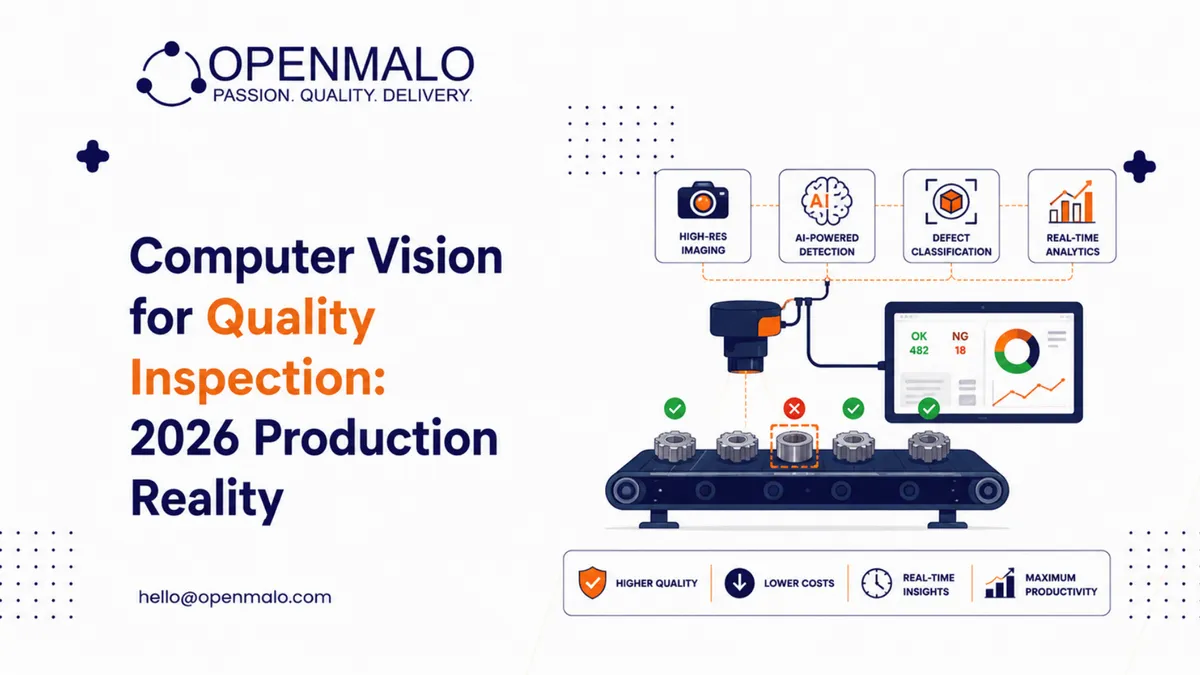
At production speeds of 600 units per minute, there is no time to send images to the cloud.
- Latency is the Enemy: In 2026, the inference happens directly at the "Rugged AI Edge." Industrial PCs equipped with specialized NPUs (Neural Processing Units) process frames in under 10 milliseconds.
- PLC Integration: A hardened system doesn't just "flag" a defect; it sends a direct signal to the PLC (Programmable Logic Controller) to fire a physical "piston" or "air blast" that removes the defective unit from the line instantly.
5. The OpenMalo Hardening Checklist
Before moving an inspection station from pilot to production, we verify these 4 "Hardening" points:
- Vibration Resilience: Is the camera mount isolated from the machine's resonance?
- Environmental Shielding: Are the lenses protected by "Air Knives" to prevent dust and oil buildup?
- Lighting Sovereignty: Is the station enclosed in a "Light Box" to eliminate interference from factory floor windows?
- Concept Drift Monitoring: Is there a "Human-in-the-Loop" dashboard where an inspector can re-verify flagged items to continuously "teach" the model?
Key Takeaways
- Context > Contrast: 2026 AI understands the part, not just the pixels.
- Synthetic Data is Required: You cannot wait for real defects to happen to train your AI.
- Edge is Non-Negotiable: If the internet goes down, your quality control shouldn't.
- ROI is in the "Escapes": The value isn't just in replacing an inspector; it's in preventing a single high-cost recall.
Conclusion
Computer vision for quality inspection has finally matured past the hype. In 2026, it is a robust, predictable component of the modern "Smarter Factory" ecosystem. By combining advanced Vision Transformers with synthetic training and edge-native hardware, manufacturers can achieve a level of consistency that was humanly impossible just a few years ago. At OpenMalo Technologies, we don't just provide the "eyes"—we provide the hardened intelligence behind them.
Is your quality inspection station still throwing false alarms? OpenMalo Technologies specializes in hardening industrial vision systems for high-throughput production.