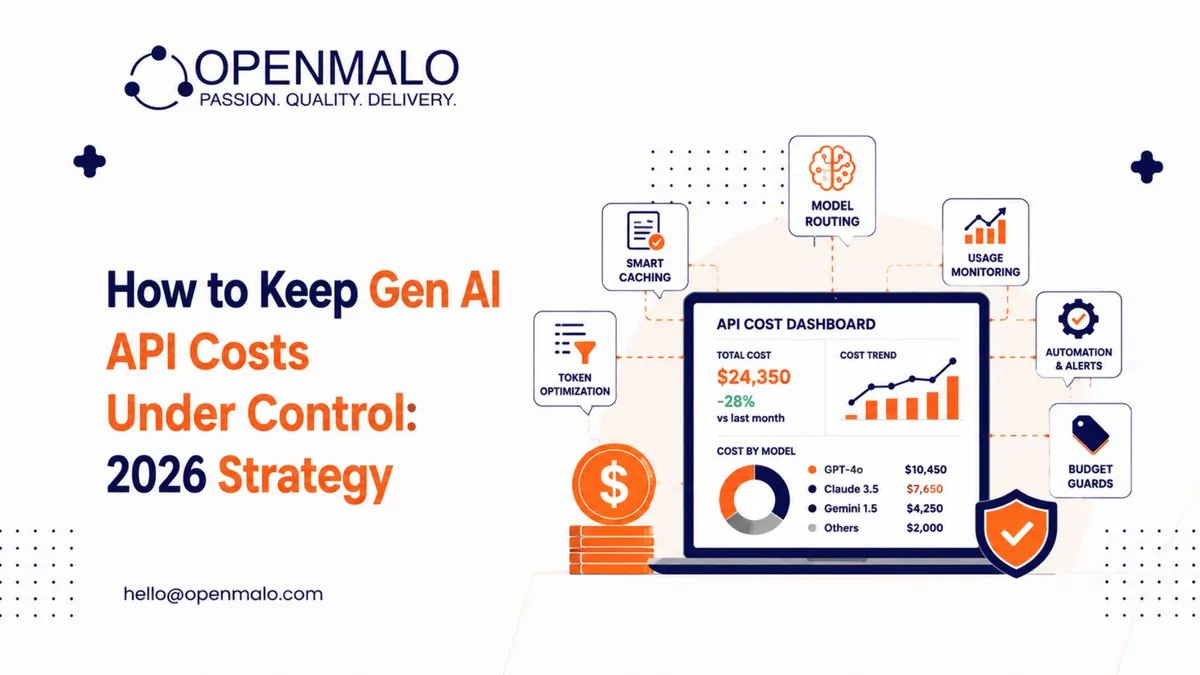
In 2026, the initial "gold rush" of generative AI has transitioned into a cold reality: Inference costs are the new cloud bill. As enterprises move from single-prompt experiments to complex agentic workflows, many are blindsided by "Token Shock"—monthly API invoices that scale faster than revenue. At OpenMalo Technologies, we've seen that running every query through a flagship "frontier" model is like using a luxury jet to deliver a pizza. It works, but the unit economics are unsustainable.
To build a "Hardened AI" stack, you must treat tokens as a finite resource. By implementing architectural guardrails—routing, caching, and fine-tuning—businesses in our Rajkot, US, and UAE hubs are reducing their "Cost-per-Task" by up to 80% without sacrificing quality.
1. The "Model Cascade": Tiered Routing Architecture
The most expensive mistake in 2026 is a "one-model-fits-all" strategy. A hardened architecture uses a Model Router to triage requests based on complexity.
| Tier | Model Type (Example) | Task Complexity | Savings Potential |
|---|---|---|---|
| Tier 1: Gatekeeper | Llama-3 8B / Claude Haiku | Classification, Intent Detection | 90% cheaper |
| Tier 2: Workhorse | GPT-4o-mini / Gemini Flash | Data Extraction, Summarization | 60% cheaper |
| Tier 3: Expert | GPT-4o / Claude 3.5 Sonnet | Complex Reasoning, Multi-step Logic | Baseline |
The Workflow: A Tier 1 model analyzes the incoming query. If the intent is simple (e.g., "Check order status"), it handles the task. Only if the query is "High-Reasoning" does the router escalate it to a Tier 3 model.
2. Semantic Caching: The Cost-Free Token
Traditional caching requires an exact text match, which rarely happens in natural language. In 2026, we use Semantic Caching.
Instead of looking for the same words, a semantic cache uses vector embeddings to look for the same meaning. If User A asks, "How do I reset my password?" and User B asks, "Forgotten password, what's the fix?", the system recognizes they are 95% similar. The response is served instantly from the cache for $0.00 in API fees, reducing high-volume FAQ costs by nearly 70%.
3. Prompt Engineering for Profit: Pruning and Compression
Every word in your "System Prompt" is a tax you pay on every single call.
- The "Instruction Bloat" Problem: Many teams use 2,000-token system prompts to cover every edge case.
- The Fix: We implement Prompt Pruning. By moving "Few-Shot" examples into a separate RAG (Retrieval-Augmented Generation) step or using "Prompt Compression" algorithms, we reduce input token counts by 30-40% while maintaining the exact same output quality.
4. Agentic Guardrails: Stopping the "Loop" of Death
Autonomous agents can sometimes get "stuck," calling an API 50 times in a row to solve a minor error. Without guardrails, a single user session can cost hundreds of dollars.
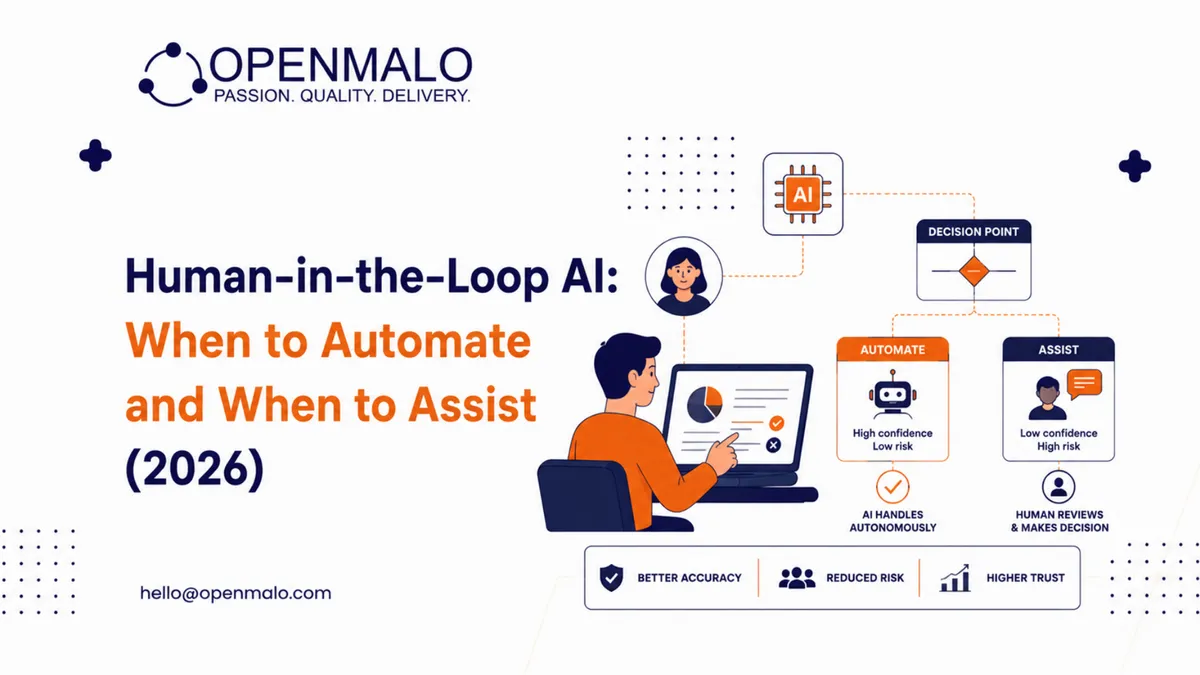
- Hard Ceilings: Implement a maximum "Turn Limit" (e.g., 5 turns) for any agentic loop.
- Kill Switches: If the AI hasn't reached a "Confidence Threshold" after three attempts, it must perform a Warm Handoff to a human rather than continuing to burn tokens.
5. Fine-Tuning: The Long-Term ROI Play
For high-volume, specific tasks (e.g., legal drafting or medical coding), fine-tuning a smaller model is almost always more profitable than "Pro-Prompting" a large one.
- The Efficiency Gain: A fine-tuned 8B parameter model can often outperform a general-purpose 175B parameter model on a specific domain task.
- The Result: You pay for the "Intellect" of a massive model but the "Price" of a tiny one.
Key Takeaways
- Classify Before You Call: Never let a query hit a frontier model without being triaged first.
- Cache the Meaning: Semantic caching is the fastest way to slash costs on repetitive customer interactions.
- Prune Your Prompts: Treat every system token like a line item on your budget.
- Agentic Governance: Set hard limits on autonomous loops to prevent runaway "Token Drain."
Conclusion
In 2026, "Hardened AI" is as much about financial discipline as it is about technical capability. By treating API costs as unit economics rather than just "IT spend," you can build a sustainable, scalable AI engine that drives profit, not just hype. At OpenMalo Technologies, we specialize in refactoring fragile AI prototypes into cost-optimized production machines.
Is your AI bill spiraling out of control? OpenMalo Technologies provides full AI Cost Audits and architecture hardening to reduce your inference spend by up to 80%.