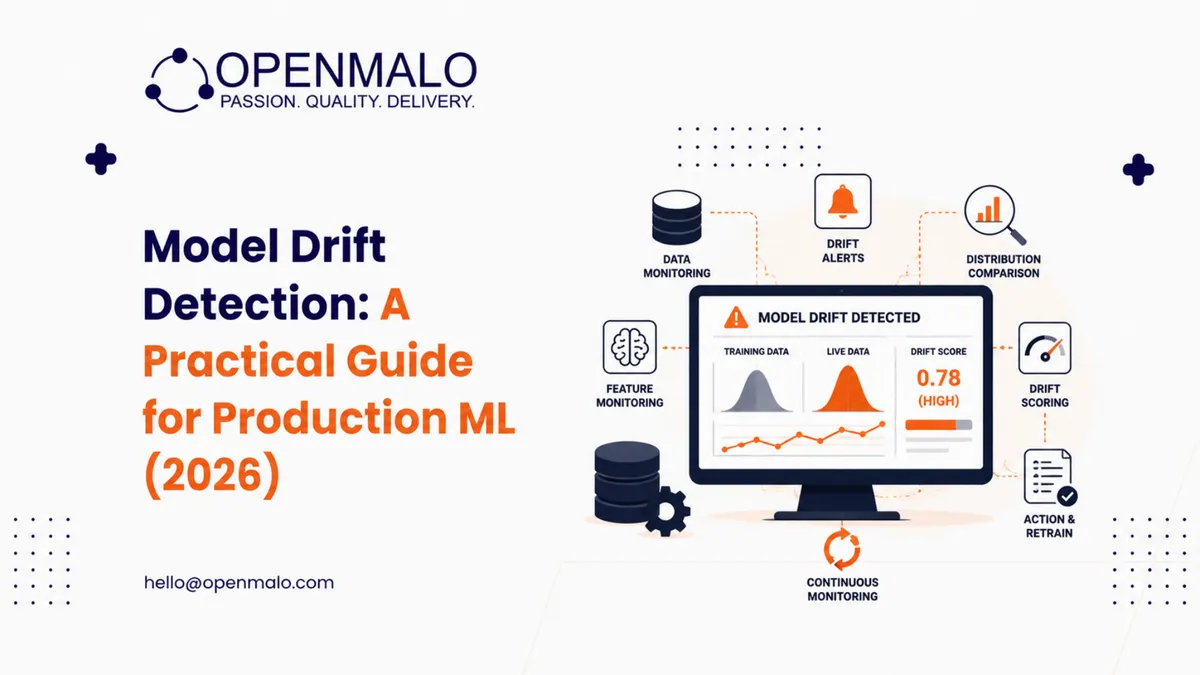
In 2026, the most dangerous failure in AI isn't a crash—it's "Silent Failure." This happens when your model continues to serve predictions with 100% technical uptime, but the accuracy of those predictions has decayed because the real world has changed. This phenomenon is known as Model Drift.
At OpenMalo Technologies, we specialize in building "Hardened" agentic systems. We've seen that in high-stakes sectors like Fintech and HealthTech, drift isn't just a performance metric; it's a compliance risk. If your credit scoring model hasn't been calibrated for the 2026 economic shift, you aren't just losing money—you're likely violating the "Accuracy" principle of India's DPDP Act.
1. The Two Faces of Drift: Concept vs. Data
Understanding why your model is failing is the first step toward hardening it.
- Data Drift (Feature Drift): The statistical properties of your input data have changed. Example: A HealthTech model trained on data from younger demographics suddenly receives queries from an aging population. The "shape" of the incoming data no longer matches the training set.
- Concept Drift: The relationship between the input and the output has changed. Example: In a fraud detection model, what "looked" like a fraudulent transaction in 2024 (e.g., a high-value cross-border transfer) may be a standard consumer behavior in 2026. The "concept" of fraud has evolved.
2. Detection Metrics: Beyond the Accuracy Score
In production, you often don't have the "Ground Truth" (labels) immediately. If you're predicting a loan default, you won't know if you were right for months. Therefore, we use Proxy Metrics to detect drift in real-time:
- Population Stability Index (PSI): Measures how much the distribution of a variable has shifted over time. A PSI > 0.2 generally indicates a "Hardened" need for intervention.
- Kullback-Leibler (KL) Divergence: A mathematical way to measure how one probability distribution differs from a second, reference distribution.
- Jensen-Shannon Divergence: A smoothed, symmetric version of KL Divergence, often preferred for production stability.
- Kolmogorov-Smirnov (K-S) Test: A non-parametric test used to determine if two datasets come from the same distribution.
3. The "Hardened" Detection Workflow
At OpenMalo Technologies, we implement a three-tier monitoring strategy:
- Statistical Baseline: We capture the "Summary Statistics" (mean, variance, quartiles) of your training data.
- Windowed Comparison: We compare the statistics of the last hour, day, and week of production data against that baseline.
- Alerting Thresholds: We set "Soft" alerts (investigate) and "Hard" alerts (trigger automated retraining or fallback to a heuristic model).
4. Automated Remediation: The Retraining Loop
Detection is useless without Action. In 2026, the gold standard is the Automated Retraining Pipeline:
- Trigger: The drift detection monitor hits a "Hard" threshold.
- Data Sampling: The system automatically pulls the most recent "Labeled" data.
- Validation: The new model is trained and compared against the old one in a Champion-Challenger (A/B) test.
- Gatekeeping: If the new model performs better on recent data without losing edge-case accuracy, it is promoted to production.
5. The OpenMalo Technologies Approach: Agentic Monitoring
We believe monitoring shouldn't just be a dashboard; it should be an Agent. Our agentic workflows at OpenMalo Technologies utilize specialized monitors that don't just alert you—they provide a "Root Cause Analysis." If drift is detected, the agent identifies exactly which feature (e.g., user_location or transaction_velocity) is the culprit, allowing for surgical fixes rather than blind retraining.
Key Takeaways
- Drift is Inevitable: No model stays accurate forever in a dynamic world.
- Monitor Inputs, Not Just Outputs: If your inputs shift, your outputs will eventually follow.
- Automate the Response: By the time a human notices a 5% drop in accuracy, the business cost is already significant.
- Compliance Matters: Under the DPDP Act, "stale" models that provide inaccurate personal assessments are a regulatory liability.
Conclusion
A model in production is a living entity. Without a "Hardened" drift detection strategy, you are flying blind. By moving from manual checks to automated, statistical monitoring, you ensure your AI remains an asset, not a silent liability. At OpenMalo Technologies, we bridge the gap between "Fragile Prototypes" and "Production-Ready" agentic systems.