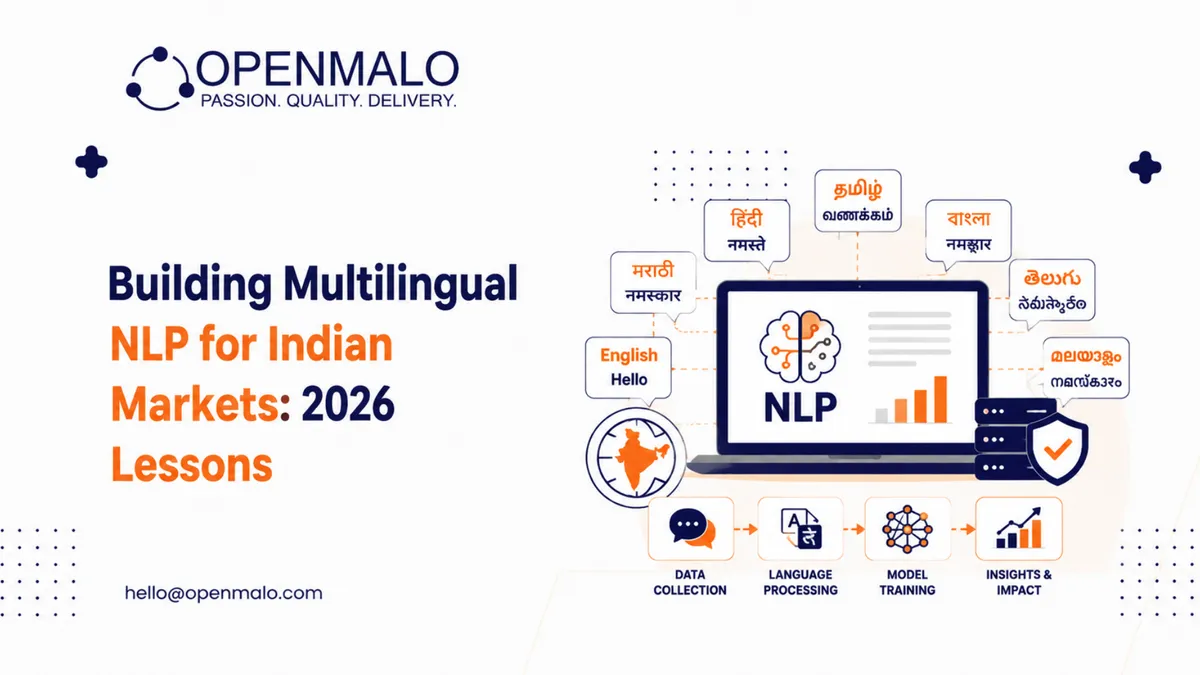
India is not a single market; it is a linguistic continent. In 2026, as the "next billion users" move from video consumption to voice and text interaction, the demand for high-performance multilingual natural language processing (NLP) has reached a fever pitch. However, building for the Indian context is fundamentally different from building for the US or EU.
At OpenMalo Technologies, headquartered in the heart of Gujarat with a global engineering footprint, we have spent years "hardening" NLP models for the unique linguistic nuances of the Indian subcontinent. We've learned that standard English-centric LLMs, even when "fine-tuned," often collapse when faced with the reality of Indian syntax and cultural context.
Here are the critical lessons learned from the front lines of Indian NLP deployment in 2026.
1. The "Code-Switching" Reality: The Rise of Hinglish & Gujarati-English
In 2026, pure-language interaction is a myth in urban India. Users don't just speak Hindi; they speak Hinglish. They don't just speak Gujarati; they mix it with English technical terms. This is known as Code-Switching.
Lesson Learned: If your model is trained on formal Sanskritized Hindi, it will fail to understand a user saying, "Mera refund process kab start hoga? Process track nahi ho raha." (When will my refund process start? I can't track the process.)
The Hardening Fix: We use Transliteration-Aware Embeddings. Our models are trained specifically on "Romanized" Indian languages, allowing the AI to treat "Dhanyavad" and "Thank you" as semantically identical within the same sentence.
2. Low-Resource Challenges: Beyond Hindi and Tamil
While models for Hindi and Tamil have matured, languages like Odia, Assamese, or even specific dialects of Gujarati remain "low-resource." There simply isn't enough high-quality digital text to train a massive LLM from scratch.
Lesson Learned: Direct translation (English -> Odia) often leads to "robotic" or grammatically incorrect outputs.
The Hardening Fix: We utilize Cross-Lingual Transfer Learning. By training a model on high-resource "sibling" languages (like Bengali for Odia tasks), we can "transfer" the grammatical understanding to the lower-resource language with significantly less data.
3. Tokenization Efficiency: The Hidden Cost of Indian Scripts
Tokenization is how an AI breaks down a sentence. Most global models (like GPT-4) are optimized for Latin scripts. When they encounter Devanagari or Gujarati scripts, they often use 3x to 5x more tokens to represent the same word.
The Reality: This makes Indian-language AI significantly more expensive and slower to run.
The Hardened Strategy: At OpenMalo Technologies, we deploy models with Native Byte-Pair Encoding (BPE) specifically optimized for Indic scripts. This reduces token counts by up to 40%, directly lowering API costs and latency for our clients.
4. Cultural Nuance: Sentiment, Sarcasm, and "Honorifics"
Indian languages are deeply rooted in social hierarchy. The way you speak to a "Bhai" (brother) is different from how you address "Sahib" (sir).
Lesson Learned: A chatbot that uses the "Tu" (informal) pronoun when the customer expects "Aap" (formal) will immediately destroy brand trust.
The Hardening Fix: We implement Honorific Classifiers. The AI detects the social context of the user's input and adjusts its "Politeness Level" in real-time to match the cultural expectation of the specific region.
5. The OpenMalo Technologies Multilingual Stack: 4 Layers of Success
To ensure our partners in the Indian market succeed, we build our NLP pipelines using a 4-layer "Hardened" approach:
- Normalization Layer: Handles the messiness of Romanized text and common spelling variations.
- Semantic Layer: Identifies the intent regardless of which mix of languages (e.g., Hindi + English) is used.
- Regional Adaptation: Fine-tunes the tone and vocabulary for specific Indian states (e.g., UP Hindi vs. Bihar Hindi).
- Privacy/Compliance Layer: Ensures all processing adheres to the DPDP Act, especially when handling voice data in local dialects.
Key Takeaways
- Don't ignore Romanization: Most of your users will type Indian languages using the English keyboard.
- Optimization = ROI: Use Indic-native tokenizers to stop "overpaying" for compute.
- Transfer Learning is the Key: You don't need billions of words if you use the right "language siblings."
- Trust the Context: Cultural nuance and honorifics are more important for retention than raw grammatical perfection.
Conclusion
Building NLP for the Indian market in 2026 is no longer an "optional" feature—it is the core of the digital economy. It requires a move away from "one-size-fits-all" global models toward hardened, locally-aware architectures. At OpenMalo Technologies, we pride ourselves on building the bridges that allow technology to speak the language of the people, from the bustling streets of Mumbai to the industrial hubs of Rajkot.
Ready to unlock the true potential of the Indian market? OpenMalo Technologies specializes in building hardened, multilingual NLP solutions that truly understand the complexity of Bharat.