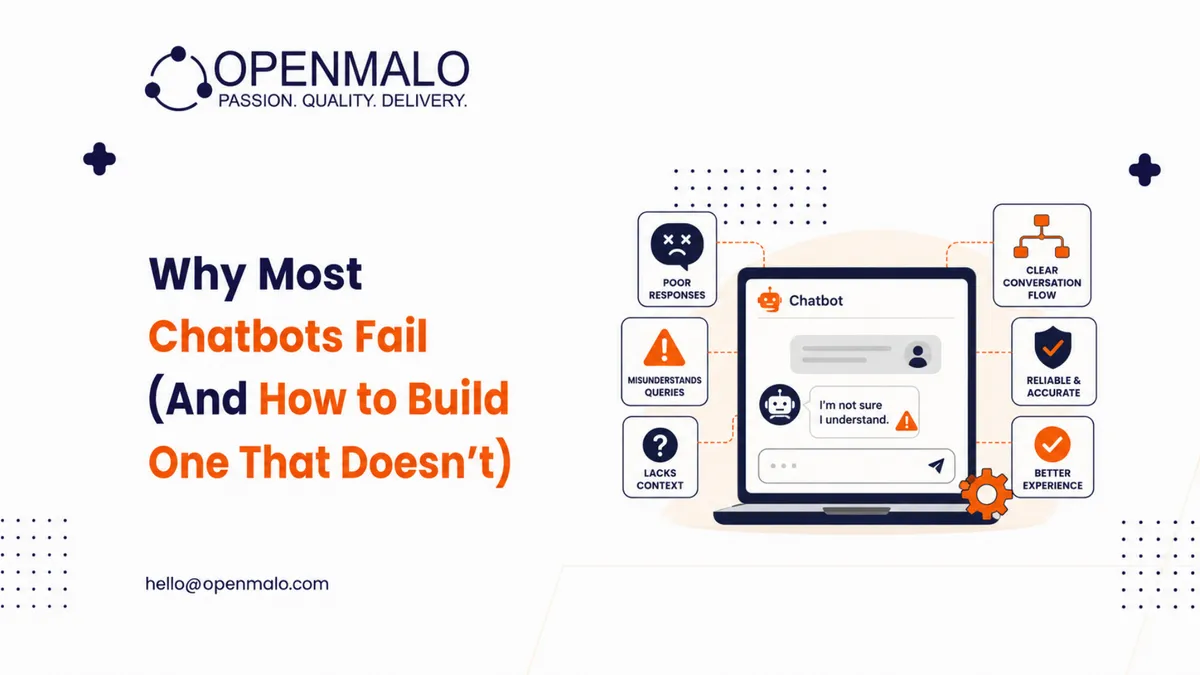
By 2026, the novelty of a "chatting robot" has worn off. Customers and employees alike have zero patience for bots that go off-script, hallucinate fake policies, or trap them in infinite loops of "I'm sorry, I didn't get that." Despite the hype around Generative AI, nearly 60% of chatbot projects still fail to move beyond the pilot phase or provide a measurable return on investment.
At OpenMalo Technologies, we specialize in the "Hardened AI" approach. We've seen that chatbots don't fail because the LLM is "dumb"—they fail because the scaffolding around the LLM is fragile. To build a bot that survives the real world, you must move from "Chat-as-an-Interface" to "Agent-as-an-Architecture."
1. The 3 Deadly Sins of Chatbot Design
Why do expensive AI projects end up as "Digital Paperweights"? Most failures stem from three core mistakes:
- The "Knowledge Gap" (Hallucination): Providing an LLM with a massive folder of PDFs and hoping it "figures it out." Without a structured RAG (Retrieval-Augmented Generation) pipeline, the bot will eventually invent a refund policy that doesn't exist.
- The "Context Blindspot": Treating every message like a first date. If a user says "Where is my order?" and then follows up with "When will it arrive?" a failing bot treats the second question as a brand-new inquiry, forcing the user to repeat themselves.
- The "Dead-End" Experience: No clear path to a human. When the AI reaches the limit of its knowledge, it should perform a "Warm Handoff"—packaging the transcript and intent for a human agent—rather than giving a generic error.
2. The "Hardened" Architecture: Beyond Simple RAG
In 2026, a successful bot isn't just a prompt; it's a multi-layered system.
| Layer | Responsibility | Why It Prevents Failure |
|---|---|---|
| Guardrails | Content Filtering | Prevents the bot from discussing competitors or legal advice. |
| Orchestrator | Intent Recognition | Decides if the user needs a "Search," an "Action," or a "Human." |
| Vector DB | Knowledge Grounding | Ensures the AI only speaks using your verified data. |
| Memory | State Management | Remembers the user's name and the context of the last 10 messages. |
At OpenMalo Technologies, we advocate for Grounded Reasoning. By citing its sources (e.g., "According to Section 4 of the Handbook..."), the bot builds trust and allows for easy auditing.
3. Human-in-the-Loop: The Safety Valve
A chatbot should never be a "black box." A hardened deployment includes a Supervisor Dashboard.
- Confidence Thresholds: If the AI is only 60% sure of an answer, it should automatically route the query to a human for approval before sending it to the customer.
- Active Learning: Every time a human corrects the bot, that data is fed back into the fine-tuning loop, making the bot smarter for the next 1,000 users.
4. Actionable Intelligence: Moving from Responding to Doing
The biggest ROI in 2026 comes from Agentic Workflows. A bot that just answers a question about a return is a FAQ bot. A bot that processes the return, updates the CRM, and emails the shipping label is an Enterprise Agent. To achieve this, we integrate your chatbot brain directly into your "Nervous System"—connecting it via secure APIs to your SAP, Salesforce, or custom internal databases.
5. The OpenMalo 5-Step Success Framework
We use this roadmap to ensure every bot we build for our US, UAE, and Indian partners is production-ready:
- Knowledge Audit: Identifying "Authoritative Sources" and purging conflicting data.
- Conversation Design: Mapping out the "Happy Path" and the "Escalation Path."
- RAG Pipeline Optimization: Tuning the retrieval engine for speed and accuracy.
- Red-Teaming: Trying to "break" the bot with prompt injections or trick questions.
- Analytics Loop: Monitoring "Deflection Rate" and "CSAT" (Customer Satisfaction) daily.
Key Takeaways
- Logic Over Lyrics: A helpful bot beats a "witty" bot every time.
- Integration is King: If your bot can't access your data, it can't solve real problems.
- Expect the Edge Cases: Users will ask weird things; have a "Fallback" strategy ready.
- Trust is Earned: Show citations. Be transparent that it's an AI.
Conclusion
Chatbots fail when they are treated as "Tech Experiments" rather than "Business Products." In 2026, the "Hardened" approach—prioritizing integration, security, and human oversight—is the only way to build a conversational agent that actually scales. At OpenMalo Technologies, we don't just build bots; we build the intelligent agents that power your business's future.
Tired of "dumb" chatbots? OpenMalo Technologies builds hardened, agentic AI solutions that deliver 90%+ resolution rates.