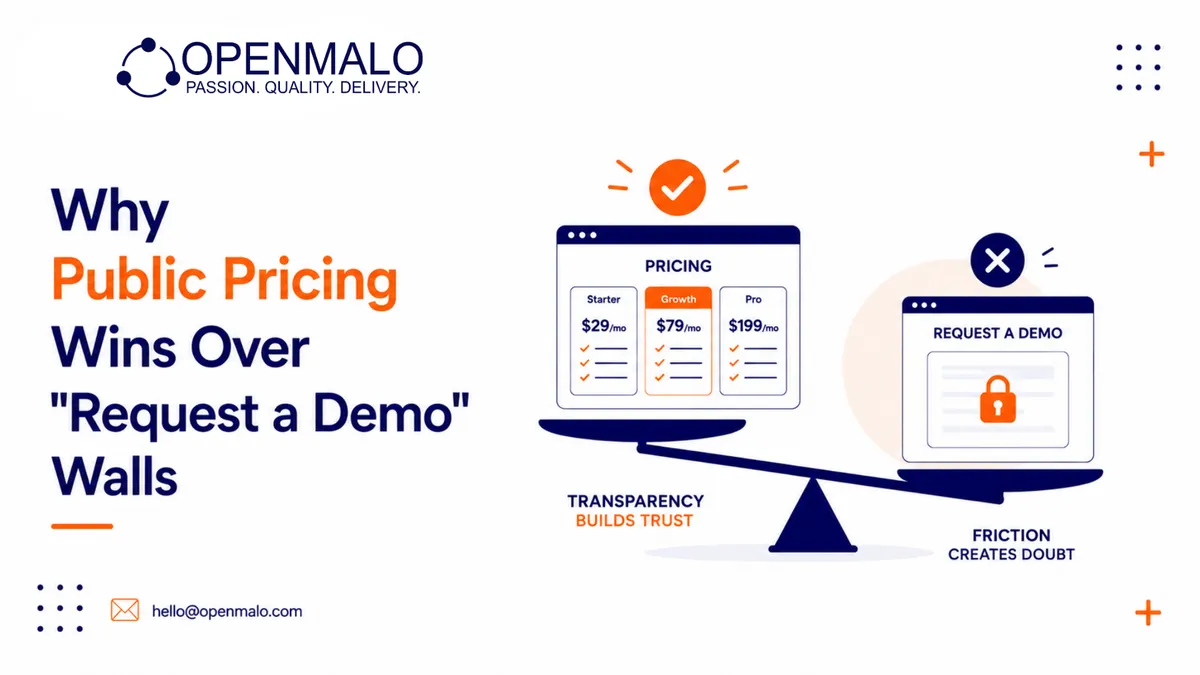
Quick answer: Public pricing wins because it shortens sales cycles, removes a major friction point in evaluation, builds trust by signalling you have nothing to hide, captures buyer intent at the moment of research, drives SEO traffic for cost-related keywords, and lets your product market itself to the long tail you can't afford to sales-qualify. It loses only in a few specific segments — true enterprise sales, deeply consultative implementations, and products where the price is genuinely buyer-specific.
The "Request a Demo" wall is one of the oldest reflexes in SaaS marketing — and one of the least examined. Hiding pricing behind a sales call worked when buyers had limited information and salespeople had unique knowledge. In 2026, buyers research extensively before they will speak to a human, and the demo wall now functions less as qualification and more as a friction tax on prospects who would have happily paid you. For most SaaS in most segments, public pricing wins.
In plain language: public pricing wins because it shortens sales cycles, removes a major friction point in evaluation, builds trust by signalling that you have nothing to hide, captures buyer intent at the moment of research, drives SEO traffic for cost-related keywords, and lets your product market itself to the long tail you can't afford to sales-qualify. It loses only in a few specific segments — true enterprise sales, deeply consultative implementations, and products where the price is genuinely buyer-specific.
What buyers actually do when they hit a demo wall
The behaviour pattern, well-documented across SaaS analytics:
- Buyer searches for "[product] pricing"
- Lands on your pricing page
- Sees "Contact us for pricing" or "Request a demo for pricing"
- Hits back, returns to search results
- Clicks the next vendor's link
- If that vendor has public pricing, evaluates them first
- If your product comes up later in evaluation, the demo request happens — but the buyer's mental model has been shaped by competitors who showed up
The demo wall doesn't qualify buyers; it just defers when you enter the consideration set, often disadvantageously.
The SEO consequence
"[Product] pricing" and "[Product] cost" are extraordinarily high-intent searches. They sit at the bottom of the funnel. Buyers searching them have a clear purchase intent.
A pricing page with no actual pricing:
- Ranks worse for the keyword (no content matches the query)
- Has a high bounce rate (which Google reads as a signal of irrelevance)
- Doesn't capture featured snippets or pricing-related rich results
- Loses to competitors who do show prices
A pricing page with actual pricing:
- Ranks well for the high-intent keyword
- Has lower bounce because the answer is on the page
- Can capture pricing-related schema markup
- Becomes a free, compounding acquisition channel
The trust consequence
In a market where buyers research three to seven alternatives before talking to anyone, hiding pricing reads as:
- "We charge what we think you'll pay" (price discrimination)
- "We need to sell you before you see the price" (high-pressure tactics)
- "We don't have confidence in our pricing"
None of these are good positioning. The vendors that publish pricing benefit from the opposite read: "they're confident in their pricing; the price is what the page says; the conversation can be about fit, not haggling."
Conversion impact — what the data shows
The published industry data on this is consistent: SaaS that adopts public pricing typically sees an increase in self-serve conversions and a decrease in demo request volume — but with a higher quality bar on the demos that do come through. Net inbound business often grows because the self-serve / product-led tier captures buyers who never would have requested a demo.
The specific numbers vary by category. Run your own test. Track:
- Pricing page conversion rate (signup, trial, demo, contact)
- Sales cycle length (demo to closed-won)
- Demo show-up rate
- Demo to closed-won conversion rate
When the demo wall is still right
It is right when:
- You sell true enterprise (six-figure ACV+) where every deal is custom-priced
- Implementation is deeply consultative and the product genuinely doesn't apply to most prospects
- Your pricing is so variable per customer that publishing a number would be misleading
- You're in a heavily regulated niche where you need to qualify prospects before sales engagement (rare)
- You have such high inbound volume that demo wall serves as needed throttling
Outside these cases, "request a demo" usually persists as inertia, not strategy.
The hybrid model that works for most SaaS
Many successful SaaS companies do both:
- Public pricing on standard tiers — clear, transparent, all features and limits listed
- "Contact sales" for enterprise — for the deals that genuinely need custom pricing
This captures the SEO and trust benefits of public pricing while preserving the consultative path for the enterprise segment.
How to design a pricing page that actually converts
The pricing pages that compound:
- Tier names that map to user types, not generic "Starter / Pro / Enterprise"
- Specific feature lists per tier, not vague "advanced features"
- Specific limits, not "unlimited*" with an asterisk that means "up to a fair-use cap we won't tell you"
- An interactive cost calculator for usage-based components
- Comparison-to-alternative if you're confident in your positioning
- An FAQ addressing the questions sales teams hear most often
- Schema markup —
Product+Offer+AggregateRatingwhere applicable - Clear "talk to sales" path for enterprise, separate from the self-serve tier flows
- Annual vs monthly pricing, with the math shown
The pricing page is often your highest-intent page. Treat it like the conversion machine it is.
What this looks like at OpenMalo
We publish module-level pricing on each /products/... page. The buyer for an OpenMalo module has typically researched the alternative builds and the alternative vendors before they land on us. Hiding pricing would force them to a demo wall they didn't want; publishing it converts the qualified self-serve traffic that's the most efficient acquisition channel we have.
CTA: Browse the OpenMalo modules — each page lists features, capabilities, and pricing transparently. See the module →
Closing
The demo wall is an artefact of an era when sales teams had asymmetric information. That era is over. In 2026 the buyer has researched more than your most senior salesperson can offer in a first demo. Pricing transparency is no longer a competitive advantage — it's table stakes for serious SaaS. The vendors that lead with it are the vendors that compound the most inbound volume; the vendors that hide it ship friction to every prospect who would have happily paid.