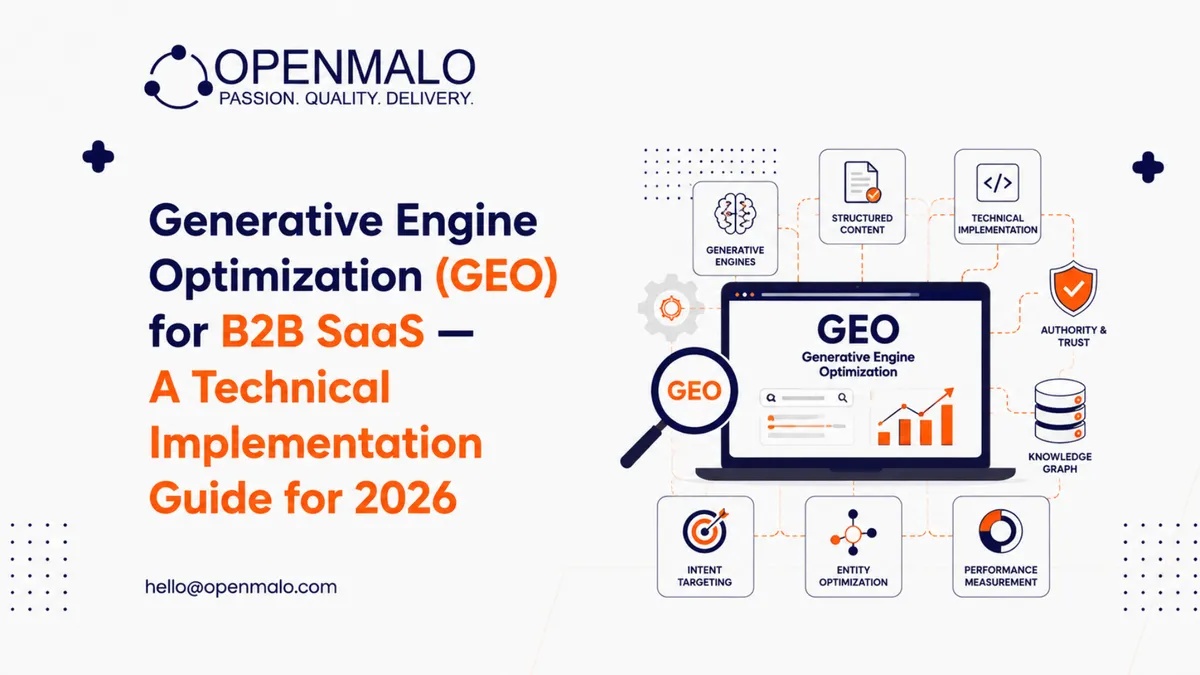
Quick answer: GEO for B2B SaaS comes down to four moves: (1) restructure top-of-funnel content so the first 200 words directly answer the buyer's question, (2) add Article, FAQPage, and Organization schema correctly, (3) build a third-party citation plan (G2, Reddit, Substack, YouTube, niche review sites — not just your own blog), and (4) instrument LLM citations so you can measure what is working. Most B2B SaaS sites in 2026 are doing none of these well.
Generative Engine Optimization is the practice of structuring content and digital signals so that AI-powered search platforms — ChatGPT, Google AI Overviews, Perplexity, Gemini, Claude, Copilot — retrieve, cite, and recommend your brand when answering a buyer's question.
It is not a replacement for SEO. Traditional Google search still drives the majority of B2B research traffic in 2026. It is a parallel discipline, with overlapping but distinct tactics. The biggest mistake most B2B teams make is assuming their existing SEO content already does GEO work. It almost never does.
According to industry data published in early 2026, ChatGPT crossed 800 million weekly users, AI search adoption nearly doubled in six months, and roughly 47% of brands still have no GEO strategy at all. For B2B SaaS, this is the rare moment when first-mover advantage is genuinely available — not because the tactics are secret, but because most competitors are not executing them yet.
Why B2B SaaS is the highest-leverage vertical for GEO
Three reasons B2B SaaS gets disproportionate ROI from GEO compared to consumer or local:
- Your buyers already use AI search to research vendors. A 2026 survey of B2B technology buyers found 64% had used ChatGPT or a similar tool in their last vendor evaluation.
- Your sales cycles are long enough that AI mentions compound. A buyer who hears your name from ChatGPT in week 1 is more likely to book a demo in week 6.
- Your category pages and comparison content are exactly what AI engines want to cite. Practical, structured, comparison-heavy content is GEO gold.
The four-pillar GEO implementation framework
Here is the framework we run with B2B SaaS clients at OpenMalo. Each pillar is independently testable.
Pillar 1 — Content structure (the cheapest, highest-leverage move)
AI engines extract answers from content that is structured to be extracted. That means:
- The first 200 words of every article directly answer the primary query — no ramp-up, no industry-trend intro.
- Every comparison or "how to" gets a TL;DR or "Quick answer" block at the top (yes, like the one at the top of this article).
- Tables, numbered lists, and short paragraphs beat long prose for citation rate.
- Headings should be questions or claims, not topics. "How long does a SOC 2 Type II audit take?" beats "SOC 2 Audit Timeline."
This single change has produced 3–8× citation rate improvements in our client cohort.
Pillar 2 — Schema (the technical foundation)
You need at minimum:
Organizationschema withsameAslinks to your social and review profiles.Articleschema on every blog post withauthor,datePublished,dateModified.FAQPageschema on FAQ sections (this is the single most cited schema type by AI engines in 2026).ProductorSoftwareApplicationschema on your product pages.BreadcrumbListschema on category and content pages.
Validate with Schema.org's validator and Google Rich Results Test. Common errors: missing image, missing mainEntityOfPage, invalid author.url.
Pillar 3 — Authority and citations (the hardest, slowest, most durable)
AI engines do not rank your content; they synthesize from the content they trust. Trust is built off-domain. The B2B SaaS authority stack in 2026 looks like:
- G2 and Capterra reviews — frequently cited; AI engines treat these as ground truth for product ratings.
- Reddit — disproportionately cited by ChatGPT and Perplexity. Active, helpful subreddit presence matters.
- YouTube product walkthroughs — both your own and third-party. Transcripts get indexed and synthesized.
- Substack and independent newsletters in your category.
- Wikipedia if your category has a relevant page (link from existing entries; do not create your own page).
- Niche analyst content — Forrester / Gartner / category-specific analyst reports.
A practical rule: target 15–25 fresh third-party mentions per quarter for the first year of a serious GEO program. Volume matters; freshness matters more than vintage.
Pillar 4 — Measurement (the discipline most teams skip)
You cannot optimize what you do not measure. The 2026 GEO measurement stack:
- AI referral traffic in GA4 — segment by
utm_sourceandReferer(chatgpt.com, perplexity.ai, gemini.google.com, copilot.microsoft.com). - Brand mention monitoring — tools like Profound, Athena, Otterly, or simple manual prompt testing weekly across the major AI engines.
- Branded search lift — a leading indicator of AI mentions; watch GSC for unbranded → branded query trajectory.
- Citation rate — for your top 20 priority queries, what percentage of AI-engine answers cite or mention your brand? Track monthly.
Five GEO mistakes that kill B2B SaaS results
- Optimizing for keyword volume instead of buyer questions. "Marketing automation software" gets searched. "Best marketing automation for a 12-person Series A startup with HubSpot already in place" is what your buyer actually asks ChatGPT.
- Hiding behind gates. Gated whitepapers do not get cited. AI engines cannot read them.
- Marketing-team-only strategy. GEO requires engineering (schema, performance), product (PLG signals AI engines pick up), and customer success (G2/Capterra review velocity). A solo marketing initiative will stall.
- Treating GEO as one-and-done. AI engines re-crawl and re-synthesize. A page that ranks today and is not refreshed loses citations within 90 days.
- Assuming your ICP uses ChatGPT only. Test across all five major engines monthly. Citation patterns differ meaningfully.
How OpenMalo helps
OpenMalo's content + technical SEO team runs end-to-end GEO programs for B2B SaaS clients, including schema implementation, content restructuring, citation acquisition, and monthly measurement. We have shipped 280+ projects across SaaS, fintech, and healthtech in 13+ years. Book a 30-minute GEO audit.