In 2026, legacy systems are no longer just "old software"—they are massive anchors holding back your company's ability to deploy Agentic AI and meet DPDP Act compliance. When it's time to move from a monolithic architecture to modern microservices, you face a fork in the road: Do you rip the band-aid off with a Big Bang migration, or do you slowly overtake the old system using the Strangler Fig Pattern?
At OpenMalo Technologies, we advocate for the Engineering of Trust. For most enterprise-scale systems in 2026, trust is built through incremental, "hardened" releases rather than one-night-only gambles.
1. The Big Bang: High Stakes, High Reward?
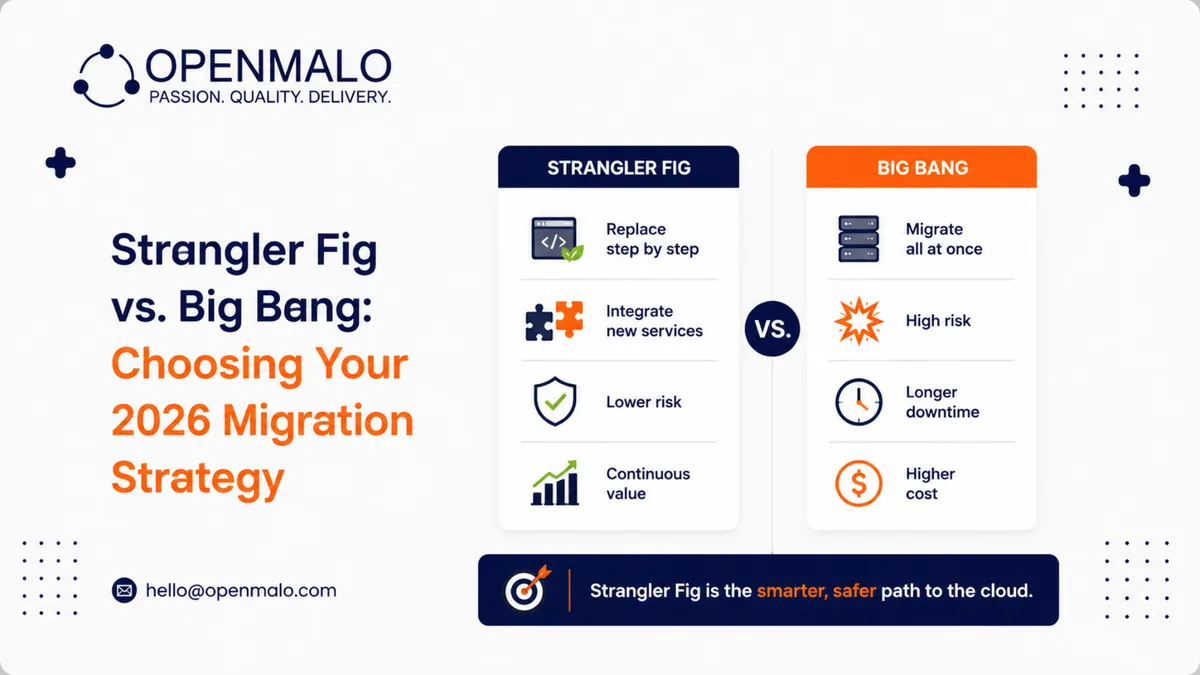
The Big Bang strategy involves developing a brand-new system behind the scenes and switching all users over at a single point in time.
- The Appeal: It offers a "clean slate." You aren't hampered by legacy debt during the build. Once the switch is flipped, the old system is gone, and you don't have to maintain two codebases.
- The 2026 Reality: This is increasingly rare for business-critical apps. Why? Because the "Switch-Over" is a massive single point of failure. If the new system fails to handle production load on day one, your entire business goes offline.
Verdict: Best for small, low-risk applications or startups where "fail fast" is an acceptable outcome.
2. The Strangler Fig Pattern: The 2026 Gold Standard
Named after the Australian tree that grows around its host and eventually replaces it, the Strangler Fig Pattern is the preferred method for modernizing complex monoliths at OpenMalo Technologies.
- The Mechanism: You place a Facade (Reverse Proxy) in front of your monolith. As you build new microservices, you "strangle" the old system by routing specific traffic to the new services.
- The Advantage: It delivers Continuous ROI. You don't wait two years for a release. You launch the "Payments" module today, the "User Auth" module next month, and the "AI Agent" layer the month after.
- DPDP Readiness: This allows you to modernize your data handling module-by-module to meet 2026 Indian regulatory standards without rebuilding the entire stack.
3. Direct Comparison: Risk, ROI, and Resilience
- Risk Level: Big Bang = Extreme (Systemic failure potential); Strangler Fig = Low (Isolated to specific modules).
- Time-to-Value: Big Bang = Delayed (Only after project completion); Strangler Fig = Immediate (As each module goes live).
- Deployment: Big Bang = All-at-once; Strangler Fig = Incremental/Phased.
- Maintenance: Big Bang = Single system focus; Strangler Fig = Requires maintaining "Parallel" systems.
- Compliance: Big Bang = Hard to audit until the end; Strangler Fig = Audit-ready at every module release.
4. Which Strategy Fits Your Business Context?
Choose Strangler Fig if:
- Your system is Business-Critical (Downtime = Massive Revenue Loss).
- You need to show Stakeholder ROI quickly.
- The system is a large, complex monolith with many "unknown" dependencies.
- You are migrating to an Agentic AI architecture where you need to test autonomous workflows in isolation.
Choose Big Bang if:
- The application is small or "End-of-Life" but needs a total refresh.
- The legacy technology is so old (e.g., COBOL) that building a proxy/bridge is technically impossible.
- You have a dedicated, long-term budget and can afford a 12-24 month "dark" period before launch.
5. The OpenMalo Technologies Migration Roadmap
When we handle a migration, we follow a "Hardened" protocol:
- Slicing the Monolith: We identify "Bounded Contexts" (e.g., Orders, Users, Inventory).
- The Interception Layer: We deploy an API Gateway to act as the Strangler Facade.
- The Anti-Corruption Layer (ACL): We build adapters so the new microservices can "talk" to the old database without inheriting its bad habits.
- The Sunset Phase: Once 100% of traffic is routed to the new services, we decommission the monolith.
Key Takeaways
- Incremental is Invincible: Small, frequent wins build more trust than one giant "launch."
- The Proxy is Key: Your migration is only as strong as your routing layer.
- Data Synchronization is the Hardest Part: Managing two databases during a Strangler migration requires a "Hardened" synchronization strategy.
- Don't Forget the "Decom": Many Strangler projects fail because they never actually turn off the old system, leading to permanent double maintenance.
Conclusion
In 2026, the Strangler Fig Pattern isn't just a technical choice; it's a risk management strategy. It allows you to modernize at the speed of business while ensuring your system remains as reliable as the day it was first built. At OpenMalo Technologies, we help you navigate this transition, ensuring your journey from monolith to microservices is seamless, secure, and "Hardened."