In 2026, the "User Story" has become the most misunderstood artifact in the SDLC. With the rise of Vibe Coding and AI-assisted development, many product owners have fallen into the trap of writing stories so vague that they lead to "Architectural Drift." A developer doesn't want a "story"—they want a Hardened Specification wrapped in a user-centric narrative.
At OpenMalo Technologies, we specialize in the "Engineering of Trust." We've found that the difference between a high-velocity sprint and a "Merge Hell" nightmare usually comes down to the quality of the backlog. Here is the 2026 framework for writing user stories that turn developers into your biggest fans.
1. The Death of "As a User...": Moving to Intent-Based Stories
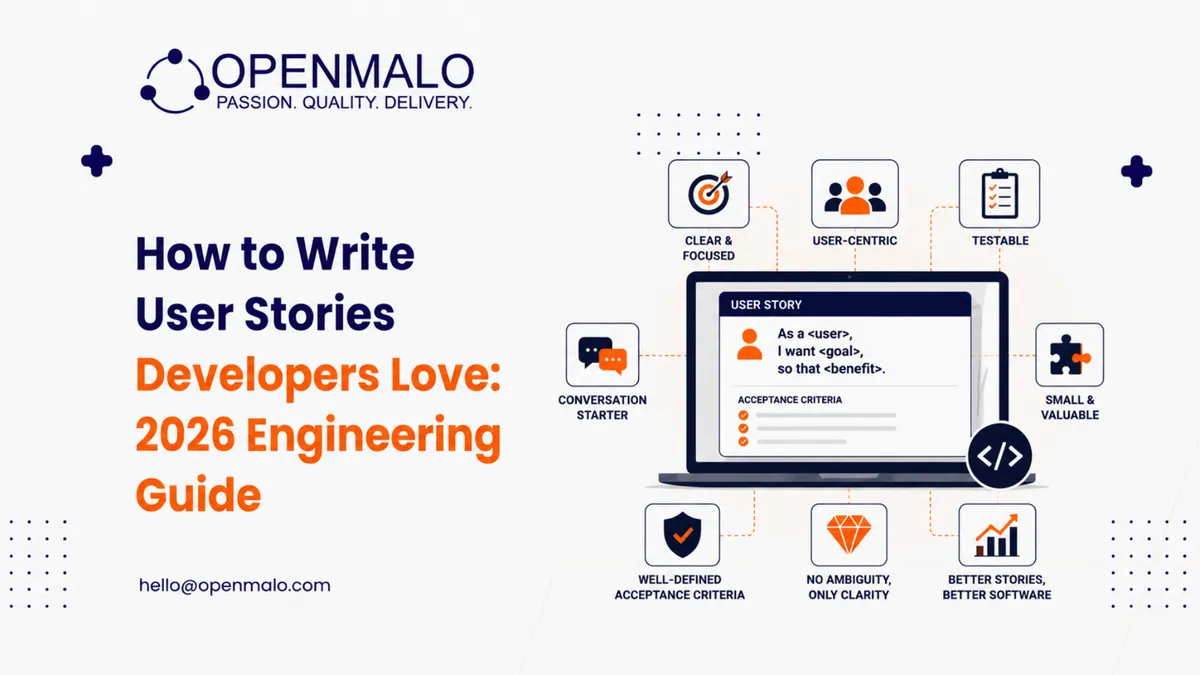
The classic template "As a [persona], I want [feature], so that [value]" is often too thin for 2026's complex systems.
- The Problem: It focuses on the "Who," but often skips the "Hardened Logic."
- The 2026 Shift: Focus on Job Stories. Instead of focusing on the person, focus on the Situation and the Motivation.
- Old: "As a user, I want to reset my password."
- New: "When I realize I've forgotten my credentials, I want a secure, zero-knowledge recovery flow so I can regain access without compromising my PII under DPDP Act standards."
2. The "Hardened" Anatomy of a Story
A story developers love consists of three non-negotiable layers:
A. The Narrative (The Intent)
Keep this brief. It sets the emotional and business context. Why are we doing this? Who is it hurting if we don't?
B. Acceptance Criteria (The Boundaries)
This is the "Contract." ACs define the "Definition of Done." In 2026, ACs must cover more than just the happy path.
C. Technical Context (The "Plumbing")
Don't tell them how to code, but tell them where the constraints are.
- Example: "Must integrate with the existing AuthV4 service" or "Max API latency: 200ms."
3. Acceptance Criteria: The Gherkin Standard
In 2026, BAs and POs must write ACs that are Test-Ready. We use the Given/When/Then (Gherkin) format to eliminate ambiguity.
- Given: The initial state (e.g., "The user is on the payment page").
- When: The action taken (e.g., "The user clicks 'Pay' with an expired card").
- Then: The expected outcome (e.g., "The system triggers a validation error and logs a 'soft-fail' in the audit trail").
4. The 2026 Edge: Agentic Constraints
As we build more Agentic AI systems at OpenMalo Technologies, your user stories must now include "Agentic Guardrails."
- The Constraint: If the story involves an AI agent, you must specify the Permission Scope.
- Example AC: "The AI Agent shall have 'Read-Only' access to the user's ledger for this calculation and cannot initiate a 'Write' operation without a secondary 2FA trigger."
5. The OpenMalo Technologies "Definition of Ready" Checklist
Before a story enters a sprint, it must pass our "Hardened" audit:
- Independent: Can it be shipped on its own?
- Negotiable: Is there room for the developer to suggest a better technical path?
- Valuable: Does it move a business metric (not just a "Vibe")?
- Estimable: Does the team actually understand it well enough to put a number on it?
- Small: Can it be completed in 3-5 days?
- Testable: Is there a clear "Pass/Fail" criteria?
Key Takeaways
- Stop the Guesswork: If a developer has to ask 5 questions to understand the story, the story isn't ready.
- Focus on the "Edge": 80% of your ACs should focus on what happens when things go wrong (errors, timeouts, compliance breaches).
- Include Data Sovereignty: In 2026, mention if the data involved falls under DPDP Act requirements.
- Collaborate, Don't Dictate: The best stories are refined during a "Three Amigos" session (PO, Dev, QA).
Conclusion
Writing user stories is the act of translating business dreams into engineering reality. In 2026, the "Engineering of Trust" starts with a clear, hardened backlog. At OpenMalo Technologies, we help you bridge that gap, ensuring your developers spend their time building value rather than chasing clarity.