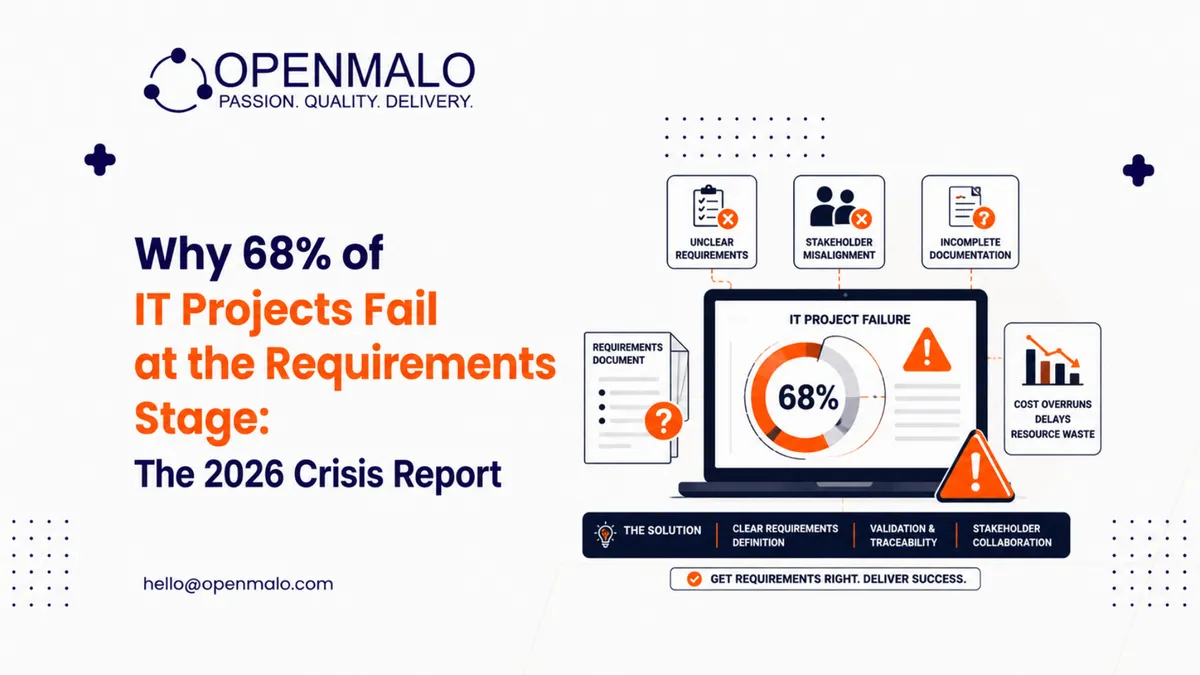
In 2026, the technology landscape has shifted from traditional software development to the era of Agentic AI and Vibe Coding. Yet, despite our advanced tools, a staggering truth remains: 68% of IT projects fail or face significant impairment during the requirements phase.
At OpenMalo Technologies, we specialize in the "Engineering of Trust." We've observed that the most expensive mistakes aren't made by developers writing bad code; they are made by stakeholders writing vague requirements. In high-stakes sectors like Fintech and HealthTech, a requirement gap isn't just a delay—it's a systemic risk to the business's survival.
1. The 2026 "Chaos" Reality: Beyond the Statistics
Industry data from 2026 shows that while 94% of teams have adopted "Agile" methodologies, project success rates haven't seen a proportional rise. The Standish Group's latest findings indicate that 31% of projects are canceled before completion, and 53% cost nearly double their original estimates.
The root cause? Incomplete Specifications. In 2026, "Agile" is frequently used as a shield to avoid the rigorous intellectual labor of defining a "Hardened" architecture. When projects start without a clear boundary of what the system should not do, they inevitably succumb to "Project Amnesia"—where the original business intent is lost in a sea of feature requests.
2. The New Killers: Agentic Drift and Token Economics
As we move toward autonomous systems, the nature of "Requirements" has fundamentally changed. We are no longer just building buttons and databases; we are building Operating Envelopes.
A. Agentic Drift
Traditional "Scope Creep" has evolved into Agentic Drift. When developers build AI agents (like those using the OpenClaw framework), they often add autonomous capabilities that weren't in the original brief. If the requirement didn't specify the "Agentic Guardrails," the AI may start executing actions—like moving funds or accessing PII—that exceed its legal or operational authority.
B. The Token Economics Gap
In 2026, a requirement that says "Implement an AI chatbot" is a failure. A "Hardened" requirement must specify the Unit Economics. Without defining the maximum token spend per user interaction, projects often fail because they become financially unviable in production.
3. The Compliance Wall: DPDP Act 2026 Integration
For firms operating in India or handling Indian user data, the Digital Personal Data Protection (DPDP) Act 2026 has turned requirements gathering into a legal mandate.
- The Consent Trap: 40% of Fintech projects fail in 2026 because their requirements didn't account for "Granular Consent." If your requirement was just "Collect user data," you've already failed. The requirement must now be: "Collect only the minimum data required for X purpose, with an auditable consent timestamp."
- The Deletion Workflow: Under the DPDP Act, "The Right to Erasure" is mandatory. If your requirements stage didn't define a technical workflow to delete a user's data from all backups and training sets, your project is non-compliant by design.
4. The Psychology of Failure: Why Stakeholders Miss the Mark
Requirements fail primarily because of three human factors:
- The "Shiny Object" Syndrome: Stakeholders often focus on the "Vibe" of the solution rather than the "Plumbing." They want the AI to "feel intuitive" but forget to define the API latency requirements that make that intuition possible.
- Knowledge Silos: In 2026, the gap between the C-Suite and the DevOps team is wider than ever. The CEO asks for "Agentic Workflows," but the developer hears "Scripted Automation." Without a shared technical vocabulary, the project is doomed.
- The Impatience Tax: To meet a market window, companies skip the "Discovery Phase." This results in a 189% cost overrun later in the lifecycle as the team realizes the core architecture cannot support the compliance needs.
5. The OpenMalo Technologies "Hardened" Discovery Framework
At OpenMalo Technologies, we bridge the gap between "Fragile Prototypes" and "Production-Ready" systems. We mitigate the 68% failure rate through a Multi-Stage Discovery Protocol:
Tier 1: The "Binary Truth" Audit
We strip away the marketing hype. We don't ask "What do you want the AI to do?" We ask, "What is the specific, measurable business metric this must move?" If it isn't a number, it isn't a requirement.
Tier 2: The Agentic Boundary Definition
For every autonomous system, we define:
- The Observation Space: What can the AI see?
- The Action Space: What is it allowed to change?
- The Circuit Breaker: Under what conditions must the AI stop and ask for a human?
Tier 3: Compliance-as-Code
We map every requirement directly to a DPDP or GDPR clause. This ensures that the "Definition of Done" includes a successful audit by the legal team.
6. Case Study: The Rs 5Cr Requirement Gap
In early 2026, a mid-sized Fintech firm approached us after their "Automated Credit Agent" project stalled. They had spent Rs 5Cr ($600k) over 12 months.
The Failure: The requirements specified "AI-driven credit assessment" but failed to define the Explainability (XAI) requirements. When the RBI (Reserve Bank of India) requested an audit of why a specific demographic was being denied loans, the company couldn't provide a human-readable answer. The model was a "Black Box."
The OpenMalo Technologies Fix: We pivoted the requirements to include "Local Interpretability" as a core feature. We rebuilt the system using a "Hardened" stack that provided SHAP values for every decision, saving the project from a total regulatory shutdown.
7. Key Takeaways for Project Success
- Requirements are 80% of the Work: If you spend 2 weeks on requirements for a 6-month project, you are in the 68% failure bracket.
- Define the "Negative Space": A good requirement doc tells you what the system won't do.
- Include the "Plumbing": Latency, Token Cost, and Data Lineage are not "technical details"—they are business requirements.
- Trust the Engineering, Not the Hype: "Vibe Coding" is for prototypes. "Engineering of Trust" is for production.
Conclusion
The 68% failure rate isn't an indictment of our technology; it's an indictment of our preparation. As we enter the second half of 2026, the firms that win will be those that treat Requirements Engineering as a competitive advantage. At OpenMalo Technologies, we help you build that foundation so your innovation doesn't just launch—it survives.