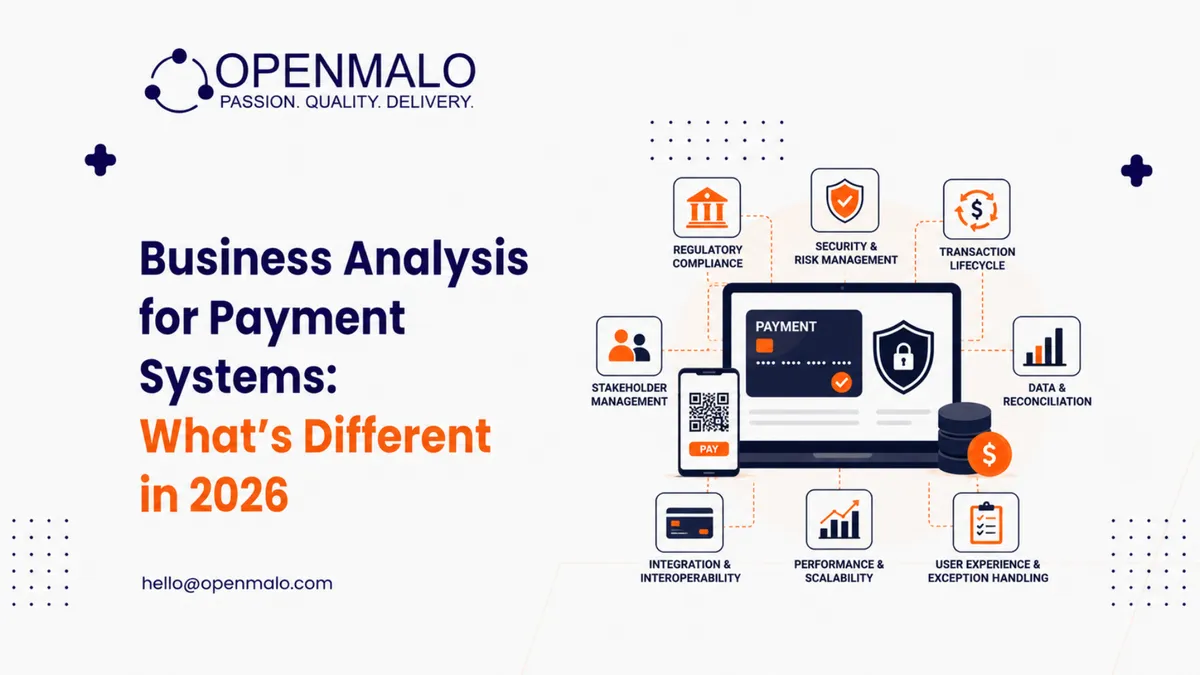
In 2026, the global movement toward Real-Time Payments (RTP) and Cross-Border Interoperability has fundamentally altered the role of the Business Analyst (BA). In a standard IT project, a requirement error leads to a bug; in a payment system, a requirement error leads to a financial catastrophe, regulatory sanctions, or a total collapse of consumer trust.
At OpenMalo Technologies, we treat payment systems as "Mission Critical Infrastructure." The Business Analysis phase isn't just about documenting user stories; it's about the Engineering of Trust. When handling millions of transactions, "Good Enough" is a failure state.
1. The "Zero-Latency" Requirement: Real-Time Everything
In traditional systems, "Batch Processing" was the safety net for BAs. You had time to reconcile. In 2026, the baseline is Instant.
- The Difference: A payment BA must define requirements for Atomic Transactions. This means the transaction either happens completely across all ledgers in milliseconds or fails gracefully without "vanishing" the money.
- The "Hardened" Metric: You are no longer measuring "System Uptime"; you are measuring "Settlement Finality" under peak load.
2. ISO 20022: The New Language of Money
By 2026, ISO 20022 has become the global standard for electronic data interchange between financial institutions.
- What's Different: Traditional BAs used to focus on "Fields." Payment BAs must focus on "Rich Metadata."
- The Advantage: ISO 20022 allows for structured data—carrying everything from invoice details to tax IDs within the payment message itself. The BA's job is to ensure that this metadata is mapped correctly to prevent "Broken Payments" during cross-border hops.
3. The Compliance Triad: DPDP, PCI-DSS 4.0, and DORA
Payment systems are the most regulated environments in the world. A BA must navigate three overlapping "Hardened" guardrails:
- DPDP Act (India): Requirements must specify "Purpose Limitation." If a user pays for a subscription, you cannot use that payment metadata for "Credit Scoring" without explicit, separate consent.
- PCI-DSS 4.0.1: The focus has shifted from static security to Continuous Monitoring. The BA must define requirements for automated "Integrity Checks" on all payment pages.
- DORA (EU/Global): Requirements must include an "Exit Strategy." If your primary cloud provider goes down, how does the payment gateway failover in under 15 minutes?
4. Edge Case Engineering: The 0.01% That Breaks the System
In a retail app, an edge case affects one user. In a payment system, an edge case (like a "Race Condition" where two systems try to debit the same account simultaneously) can cause a Systemic Ledger Imbalance.
The BA's Focus: You must spend 40% of your time on "Exception Workflows."
- What happens during a partial timeout?
- How do we handle a reversal on a cross-currency trade if the exchange rate moved?
- How does the system respond to a "Doubtful Transaction" state?
5. Agentic Payments: The Rise of Machine-to-Machine (M2M)
The biggest shift at OpenMalo Technologies in 2026 is the requirement for Autonomous AI Agents to pay each other.
- The "KYA" (Know Your Agent) Protocol: A BA must now define "Wallet Limits" for AI agents.
- The Requirement: "The AI agent can authorize fuel payments up to Rs 5,000 without human intervention, but requires a Multi-Sig (human) approval for anything higher." This is a "Hardened" requirement that combines security, logic, and financial risk management.
Key Takeaways
- Ledger Integrity is God: If the numbers don't balance to zero at the end of every millisecond, the system is broken.
- Regulatory is a Functional Requirement: In payments, compliance isn't a "non-functional" constraint; it is the core of the product.
- Metadata is the Value: Moving money is easy; moving the information about the money is where the profit lies.
- Simulate the Disaster: A payment BA must write requirements for the "Worst Day," not the "Best Day."
Conclusion
Business Analysis for payment systems requires a shift from "Feature-Driven" thinking to "Resilience-Driven" engineering. In 2026, the successful BA is part-architect, part-lawyer, and part-economist. At OpenMalo Technologies, we provide the hardened frameworks to ensure that your payment innovation is as secure as it is seamless.