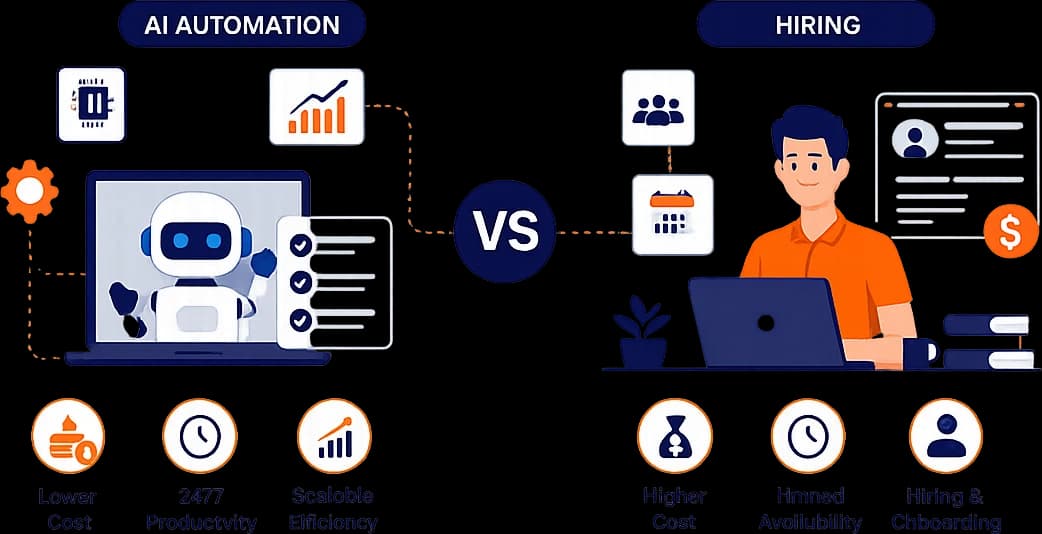
Every founder eventually stares at the same spreadsheet: a hire that will cost $70,000 a year, or an automation that costs $20,000 to build. Most businesses make this decision with inaccurate numbers on both sides. They underestimate the true cost of a hire. They overestimate the complexity of AI automation.
57% of U.S. SMBs are now investing in AI - up from 36% in 2023. The ones leading are not the ones with the biggest budgets. They are the ones who did the maths first.
The True Cost of a Hire Nobody Talks About
A $60,000 salary does not cost $60,000. Once you add benefits (typically a 30% burden), mandatory training budget, recruitment fees, and onboarding time, that number is closer to $80,000-$95,000 in year one.
And that is before accounting for:
- Recruitment: job postings, recruiter fees, interview time - $4,000-$12,000 per hire.
- Onboarding: new employees reach full productivity after 3-6 months. That gap has a cost.
- Churn risk: average tech role tenure is under 3 years. Every departure restarts the cycle.
- Management overhead: every hire requires supervision. That time is not free.
The roles most exposed to automation - data entry, Tier-1 support, lead follow-up - also happen to be the roles with the highest churn. You are not just comparing cost. You are comparing cost plus stability.
The True Cost of AI Automation
Off-the-shelf AI tools ($20-$500/month)
ChatGPT Plus, Microsoft Copilot, Zapier AI. Low barrier. Best for individual productivity: writing, scheduling, basic data work. Not suitable for custom business-specific workflows.
Custom AI agent or integration ($25,000-$150,000 to build)
Purpose-built AI that integrates with your CRM, helpdesk, or operations stack. This is where real workflow automation lives - customer service, lead qualification, invoice processing, report generation. Recurring operational costs: $500-$5,000/month depending on volume.
In-house AI specialist ($80,000-$180,000/year + overhead)
Only makes sense when AI is genuinely core to your product. For most SMBs deploying AI to automate workflows, this is overkill. You need a build partner, not a full-time AI engineer.
The Head-to-Head: 4 Business Functions
Customer Service Tier-1 Support
Human cost: $45,000-$60,000/year per agent. AI cost: $15,000-$40,000 to deploy. 95% of SMBs using AI for customer service report improved response quality. The verdict: automate Tier-1. Deploy humans for escalations and relationship-sensitive cases.
Lead Qualification and Follow-Up
Human cost: $55,000-$75,000/year for an SDR. AI cost: $20,000-$50,000 for a CRM-integrated agent. McKinsey data puts revenue uplift from AI in sales at 3-15%, with 10-20% improvement in sales ROI. The verdict: automate qualification and initial outreach. Use humans for relationship-building and negotiation.
Data Entry and Report Generation
Human cost: $35,000-$50,000/year. AI cost: $5,000-$20,000. Zero creative requirement, high volume, low variability. The verdict: automate immediately. This is the clearest ROI case in the entire business.
Strategy and Complex Decision-Making
No automation here. AI is useful for data synthesis and pattern recognition, not for replacing judgment on novel situations. The verdict: augment your best people with AI. Do not replace their thinking.
The Numbers That Close the Argument
The average SMB worker saves 5.6 hours per week using AI tools. Managers save 7.2 hours. At a $40/hour loaded cost, that is $11,648-$14,976 in recovered productivity per person, per year. SMBs report direct cost savings of $500-$2,000/month from AI implementations - that is $6,000-$24,000/year in savings from a tool costing $100-$300/month.
The ROI maths on well-targeted automation is not subtle. The operative phrase is well-targeted. Automation that solves the wrong problem delivers zero ROI regardless of cost.
How to Audit Your Workflows Before You Decide
Before you compare costs, answer these four questions for every workflow you are considering:
- Does this task follow a predictable, repeatable pattern? If yes: automation candidate.
- Does this task require judgment on genuinely novel situations? If yes: keep humans involved.
- What is the volume? High-volume and predictable equals the highest ROI for automation.
- What happens when it goes wrong? High-stakes errors need human oversight regardless of automation level.