In 2026, the era of the "clumsy forgery" is over. Fraudsters now use sophisticated Generative AI to create bank statements, utility bills, and IDs that are visually perfect—free from the jagged edges or pixelated fonts that once gave them away. Today, an industrial-scale fraud ring can generate 1,000 "clean" documents in minutes via API, each with a unique identity but a shared, synthetic origin.
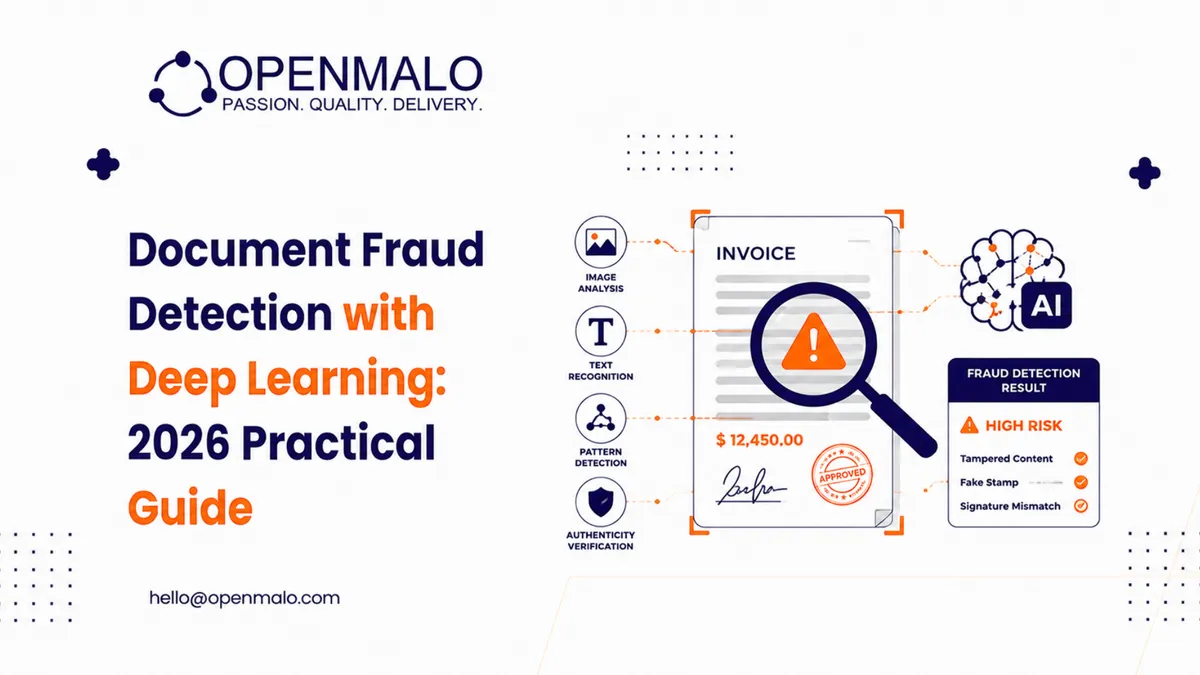
To counter this, OpenMalo Technologies advocates for a "Hardened Detection" approach. We no longer just look at the document; we look through it. By leveraging deep learning architectures like CNNs, GANs, and Transformers, enterprises can detect anomalies at the metadata, structural, and forensic levels that are invisible to the human eye.
1. The 2026 Fraud Archetype: Why Visual Checks Fail
Traditional Optical Character Recognition (OCR) and rule-based systems were built to catch mistakes. But modern GenAI Forgeries don't make mistakes. They have perfect margins, matching logos, and consistent font weights.
The real threat in 2026 is the "Pristine Fake." Because these documents are generated holistically by a model rather than edited in Photoshop, they lack "clone-stamp" artifacts. To catch them, we must shift our focus from content to context and composition.
2. Architecture Pillar 1: CNN-Based Forensic Analysis
Convolutional Neural Networks (CNNs) remain the workhorse of fraud detection, but their application has evolved. We use specialized layers designed to suppress the document's content (the text) and highlight the Noise Patterns and Compression Signatures.
- Double Quantization Detection: When a fraudster saves a JPEG multiple times (e.g., after a slight edit), the AI detects a mathematical "double compression" signature that is impossible in an original document.
- Error Level Analysis (ELA): AI models identify parts of an image that have different compression levels, revealing where a date or a name might have been digitally inserted.
- GAN-Generated Texture Analysis: Deep learning models can now identify the specific "fingerprint" left by GANs (Generative Adversarial Networks), such as overly smooth gradients or non-human micro-textures in background patterns.
3. Architecture Pillar 2: Metadata & File Structure Analysis
A document is more than an image; it is a data file. Forgeries often fail not on the "face" of the document, but in the Metadata.
- Temporal Inconsistency: If a bank statement claims to be from 2023 but the PDF metadata shows it was created using "Adobe Acrobat 2026" last Tuesday, the system triggers an immediate hard block.
- Format Hopping: Fraudsters often convert PDFs to JPEGs and back to PDFs to "strip" metadata. Our deep learning models detect these "Print-to-PDF" signatures as high-risk behavioral signals.
- Software Traces: Detecting hidden traces of editing software (like Canva or Pixelmator) embedded in the file's XML structure, even after the fraudster attempts to "sanitize" the file.
4. Architecture Pillar 3: Graph-Based Network Detection
Fraud rarely happens in isolation. Organized rings reuse templates. Graph Neural Networks (GNNs) allow us to see the connections between seemingly unrelated applications.
- Cluster Identification: If 50 different applicants from different regions all submit utility bills with the exact same logo-to-margin ratio (to the nanometer), they are likely using the same automated forgery tool.
- Template Farming: AI identifies when a document matches a known "forgery farm" template—even if the names and numbers have been changed.
5. The Implementation Roadmap: 5 Steps to Hardening
At OpenMalo Technologies, we follow this 5-step process to harden document verification for our partners:
- Ingest & Classify: Use a specialized model (like LayoutLM) to understand the document type and expected structure.
- Forensic Scan: Run CNN-based noise and compression analysis to check for digital tampering.
- Metadata Audit: Cross-reference the file history against the document's stated timeline.
- Signal Aggregation: Use a "Confidence Scorer" to weigh all anomalies. A single "Print-to-PDF" might be an accident; combined with a metadata mismatch, it's fraud.
- Human-in-the-Loop (HITL) Escalation: Route "Edge Cases"—where the AI is only 70% sure—to a human expert who can review the specific forensic alerts.
Key Takeaways
- Pixels Lie, Math Doesn't: Deep learning looks at the mathematical consistency of the file, which GenAI cannot yet perfectly replicate.
- Metadata is a Goldmine: Most forgeries fail in the "hidden" data before the AI even reads the text.
- Think in Networks: Detecting one fake is good; detecting the template used for 1,000 fakes is better.
- Hardening is a Journey: Fraudsters evolve daily; your detection models must be retrained continuously on the latest GenAI forgery samples.
Conclusion
Document fraud detection in 2026 is an arms race between generative and discriminative AI. To stay ahead, businesses must move beyond "reading" documents and start "interrogating" them. By combining forensic deep learning with structural and network analysis, you can build a defense that is as automated and sophisticated as the fraud itself.
Is your current verification system blind to GenAI fakes? OpenMalo Technologies specializes in deploying hardened, deep-learning-based fraud detection for global enterprise workflows.