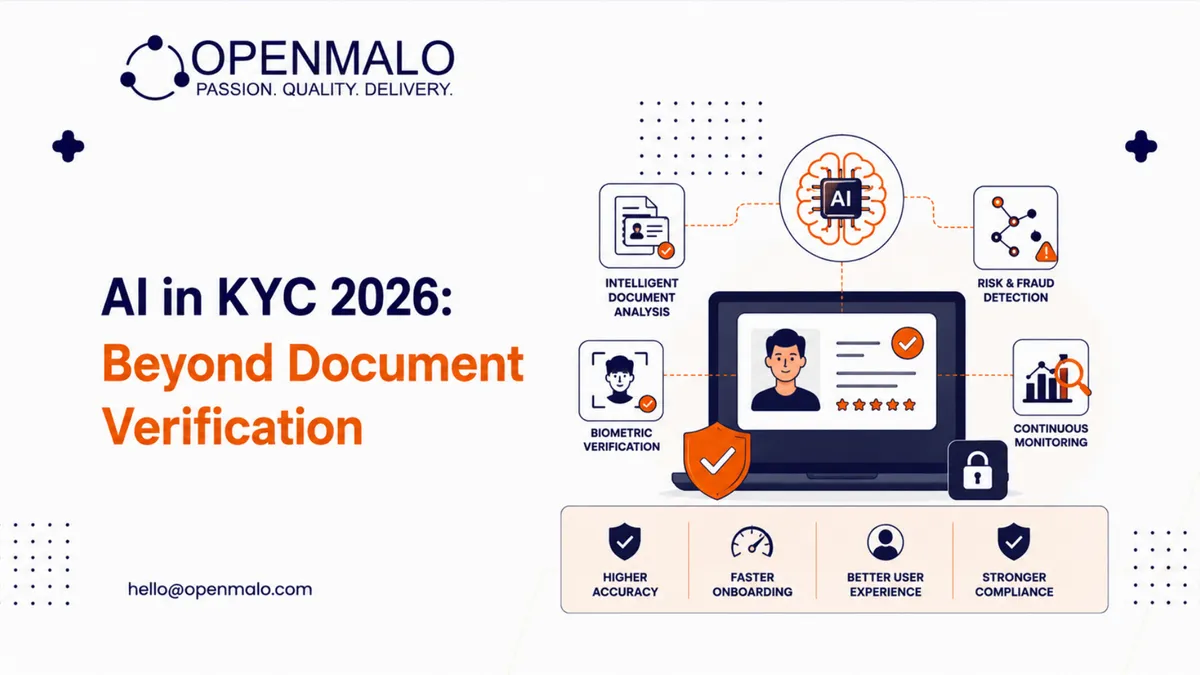
In the fintech landscape of 2026, the traditional "selfie-plus-ID" combo has become a baseline, not a breakthrough. As deepfakes become more sophisticated and regulatory frameworks like India's Digital Personal Data Protection (DPDP) Act hit full enforcement, the industry is moving toward a more holistic, invisible, and resilient form of identity assurance.
At OpenMalo Technologies, we have observed a critical shift among our global partners: the most successful platforms are no longer just "verifying documents"—they are verifying personhood. By moving beyond static OCR (Optical Character Recognition) and into real-time behavioral and network analysis, enterprises are reducing onboarding fraud by up to 60% while slashing friction for legitimate users.
This guide explores the three "Hardened" pillars of AI-driven KYC in 2026.
1. Passive Liveness: The End of "Blink to Verify"
By early 2026, "Active Liveness" checks—which ask users to smile, blink, or turn their heads—have largely been retired. These methods were not only friction-heavy but also increasingly vulnerable to "injection attacks" where a deepfake is fed directly into the video stream.
The 2026 Standard: Passive Liveness. Modern systems now analyze subtle, involuntary cues in a single frame or a short, silent video capture. These include:
- Subsurface Scattering: Analyzing how light reflects off living human skin versus a high-resolution screen or a silicone mask.
- Micro-movements: Detecting the tiny, rhythmic pulses of blood flow in the face (Eulerian Video Magnification).
- 3D Depth Perception: Using AI to confirm the physical "volume" of a head without requiring expensive LiDAR hardware.
At OpenMalo, we prioritize these "invisible" checks because they maintain a high conversion rate—users simply take a natural photo, while the AI performs the heavy lifting in the background.
2. Graph Analytics: Uncovering Synthetic Identity Networks
Fraudsters in 2026 rarely use just one stolen ID. They use Synthetic Identities—frankenstein-like personas built from a mix of real and fake data. A traditional KYC check might pass a synthetic ID because the "document" itself is technically valid.
Graph-Based Identity Resolution changes the game. By modeling relationships between entities as nodes and edges, AI can spot:
- Mule Clusters: Identifying 50 accounts that all share the same physical address or device fingerprint, even if the names are different.
- Velocity Anomalies: Detecting when a single "reputable" phone number is being used to verify multiple accounts across different regions in a short window.
- Link Analysis: Connecting a new applicant to a previously banned fraudster through shared "hidden" metadata like IP subnets or behavioral typing patterns.
3. The DPDP Paradigm: Consent-First Architecture
In India, the DPDP Act of 2026 has fundamentally changed how KYC data is stored. It is no longer acceptable to keep "everything forever."
Hardened Compliance Requirements:
- Purpose Limitation: You must prove that the biometric data collected was only used for KYC and not for secondary marketing or profiling.
- Automated Deletion: AI systems must now be architected to automatically "purge" sensitive PII (Personally Identifiable Information) once the verification purpose is complete or the consent is withdrawn.
- Explainable Decisions: If an AI rejects a user, you must be able to provide a "human-readable" reason for that rejection to satisfy regulatory audits.
4. Beyond Onboarding: The KYC + KYB + KYA Era
KYC is no longer a one-time event. In 2026, identity is dynamic:
- KYB (Know Your Business): Automating the verification of complex corporate structures and Ultimate Beneficial Owners (UBOs) via graph neural networks.
- KYA (Know Your Agent): Verifying the identity of AI-enabled "autonomous agents" that are increasingly acting on behalf of human users in financial transactions.
- Continuous Monitoring: AI-driven "re-KYC" that triggers a fresh check only when it detects a significant change in the user's behavioral risk profile (e.g., a sudden login from a high-risk country).
Key Takeaways
- Friction is a Choice: Passive liveness allows you to be secure without being annoying.
- Context over Content: A valid ID card is meaningless if it is linked to a network of 500 other "valid" cards using the same email.
- Compliance as a Feature: DPDP-ready architectures aren't just a legal burden; they are a trust-builder for your users.
- AI vs. AI: As fraud becomes agentic, your KYC must be equally autonomous and adaptive.
Conclusion
The future of KYC is ambient. It is a system that works silently in the background, making "yes" decisions instantly for 99% of users while aggressively "hard-blocking" the 1% of sophisticated bad actors. At OpenMalo Technologies, we specialize in building these hardened identity layers—ensuring your platform is compliant, secure, and ready for the complex identity landscape of 2026.
Ready to move beyond basic document checks? OpenMalo Technologies provides the engineering expertise to deploy DPDP-compliant, AI-driven KYC systems for the next generation of fintech.