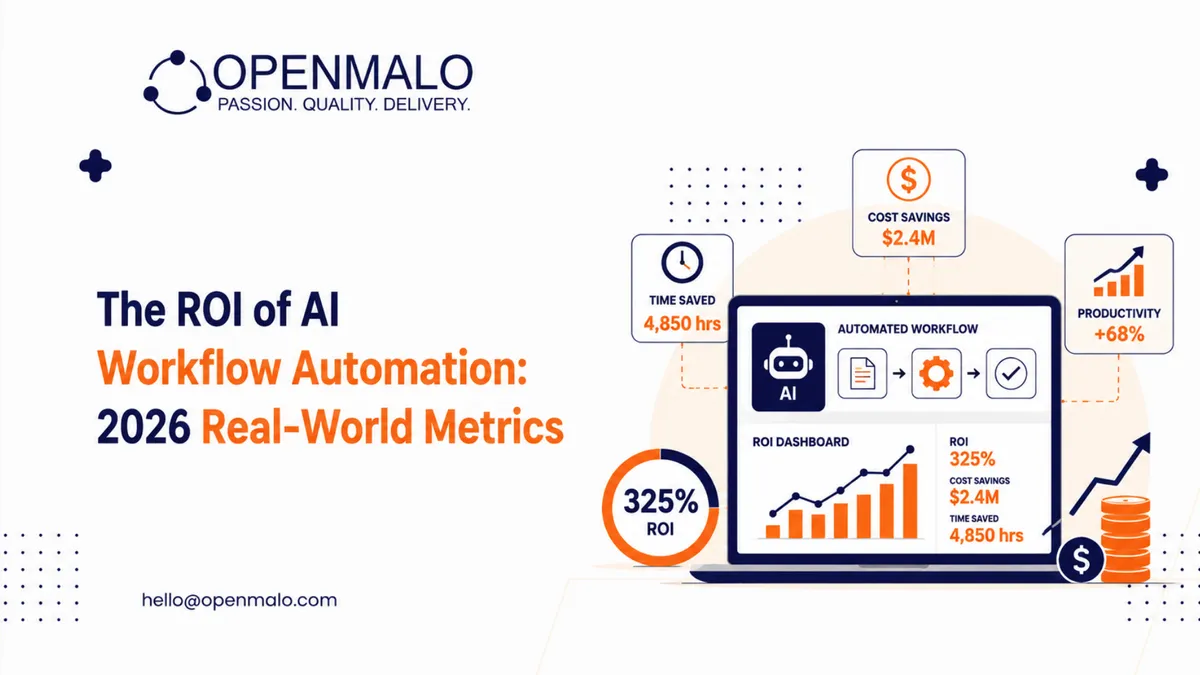
In 2026, the question is no longer "Does AI work?" but "How fast does it pay for itself?" As we move past the era of experimental pilots, enterprises are demanding hard financial proof. For organizations in India, the UAE, and the US, the "AI Tax" is only justifiable when it results in structural cost reduction or exponential growth.
At OpenMalo Technologies, we specialize in hardening these workflows. Our internal data and 2026 global benchmarks show a stark reality: 20% of companies are capturing 74% of the total economic value of AI. The difference lies in moving from "surface-level tools" to integrated agentic workflows.
This report breaks down the actual ROI metrics, payback periods, and sector-specific wins we are seeing on the ground in 2026.
1. The 2026 Benchmark: Average Returns and Payback Periods
According to 2026 implementation data, properly scoped AI automation projects are delivering a 3-year average ROI of 240%. While "Generative AI" wrappers offer incremental wins, Agentic AI—systems that can execute multi-step tasks autonomously—is pushing average returns as high as 171% in Year 1.
- Average Payback Period: 6 to 12 months for high-volume use cases (e.g., Accounts Payable, Customer Service).
- Success Rate: 92% of projects that explicitly "pay down workflow debt" before deploying AI meet or exceed their ROI targets.
- The Scaling Gap: Companies that move from pilot to full production report 41% higher satisfaction with financial outcomes compared to those stuck in the "testing" phase.
2. Sector Breakdown: Where the Money is Made
In 2026, the BFSI (Banking, Financial Services, and Insurance) sector leads the market, but the gains are spreading rapidly.
| Sector | High-Value Use Case | Proven Impact (2026 Data) |
|---|---|---|
| Finance | Accounts Payable / AP | 80% faster processing; 0.1% error rate |
| Healthcare | Compliance Reporting | 75% automation; $1.2M annual savings |
| Logistics | Route Optimization | 10-20% fuel cost reduction |
| Software | SDLC & Testing | 44% productivity boost at scale |
3. Efficiency Metrics: Throughput vs. Headcount
The most significant ROI in 2026 isn't coming from replacing people; it's coming from Throughput Gains.
- Task Throughput: Business users report a 66% average increase in the volume of work processed.
- Time Reclaimed: The average AI-augmented employee saves 5.4% of their work hours weekly—reclaiming over one full workday every month.
- Cost-per-Transaction: AI automation provides a structural reduction in the "cost-per-unit" of output, which compounds every quarter as the models learn from your specific data.
4. The "Agentic Dividend": Why 2026 is Different
The "Agentic Dividend" refers to the massive jump in ROI when AI moves from drafting to doing.
- Autonomous Decisioning: Leading companies are now making decisions without human intervention at 3x the rate of their peers.
- Trust at Scale: By implementing Responsible AI Frameworks, firms have doubled employee trust in AI outputs, directly accelerating adoption and ROI.
- Compound Growth: Productivity in AI-embracing industries is growing 4.8x faster than the global average.
5. The OpenMalo ROI Framework: How to Measure Success
To avoid the "Productivity Paradox," OpenMalo Technologies uses a 4-pillar scorecard for our clients:
- Direct Cost Savings: (Hours saved/week x loaded labor cost) - (AI API/Inference costs).
- Accuracy Gains: Reduction in rework costs multiplied by the historical error rate.
- Time-to-Insight: Measuring the reduction in days-to-close or time-to-market for new features.
- Net Revenue Retention (NRR): Tracking how AI-driven personalization impacts customer LTV and churn.
Key Takeaways
- Speed is a Strategy: 48% of CFOs cite "Cycle-Time Reduction" as their biggest AI win, outranking simple headcount savings.
- Foundations Matter: Paying down legacy technical debt can improve your AI ROI by up to 29%.
- Growth > Efficiency: The top-performing 20% of companies use AI for business model reinvention and revenue growth, not just cost-cutting.
- Payback is Fast: For well-selected use cases, expect a positive return within 12 months.
Conclusion
The numbers for 2026 are clear: AI workflow automation is no longer a luxury—it is a structural competitive advantage. However, achieving these numbers requires more than just buying a license; it requires deep workflow redesign and a focus on "Hardened" production systems.
At OpenMalo Technologies, we don't just build the tools; we architect the ROI. Let's turn your AI vision into a measurable financial engine.
Stop guessing your AI returns. OpenMalo Technologies provides full-scale ROI audits and hardened AI automation deployments for enterprise leaders.